
What Is AI Asset Inspection ROI for Utilities?
A complete guide for asset managers and maintenance leaders: how to measure, model, and justify the return on AI asset inspection — across faster defect detection, lower inspection cost, fewer outages, and smarter maintenance prioritization.
For most utility asset managers, the question is no longer "does AI inspection work?" It's "how do I prove the return to a CFO who has seen plenty of technology promises?" This guide answers that end to end — how the return is built, the formula to calculate it, the benchmark numbers to anchor a business case, the KPIs that survive a board review, and the honest limits you should plan around.
One argument runs through all of it, and it's the part most ROI pitches skip: the return on AI asset inspection is largely decided before a single model runs — at the data-quality layer. AI can only assess what the imagery actually shows. By Detect's field estimates, roughly 40% of utility inspection imagery is rejected or unusable somewhere in the pipeline, and about 48% of infrastructure rework traces back to bad inspection data. So the highest-leverage ROI move is rarely a better defect model — it's utility-grade data on the first pass. Hold that ceiling in mind as we walk the levers below.
- Data quality is the real ROI ceiling. Roughly 40% of utility inspection imagery is unusable and about 48% of rework traces to bad data — so the return is decided before any model runs. Fix capture first.
- Four levers carry the business case (the FAST framework): Find more defects (~4.5× vs. ground crews), Avoid outages (a $67B–$121B/yr backdrop), Slash inspection cost (~60% lower), and Target the riskiest assets (predictive maintenance ~50% cheaper than reactive).
- Price every finding. Weighing, say, a $15K planned repair against a $150K statistical failure risk turns a defect list into a dollar-ranked work plan — the input the ROI formula needs.
- ROI compounds. Each cycle deepens a condition baseline that sharpens prediction, frees capital through deferral, and produces audit-ready documentation for rate cases and wildfire filings.
- Speed and integration convert it to cash. Same-day analysis lets crews fix defects before they fail; the value is realized only when findings flow into GIS, work-order, and EAM systems.
- How AI asset inspection works
- The data-quality ceiling
- The FAST ROI framework
- The ROI formula + worked example
- Why ROI compounds: the condition baseline
- Manual vs. AI: benchmark table
- Improving grid reliability
- Reducing unexpected outages
- Predictive maintenance from visual data
- Same-day analysis
- The KPIs that matter
- Why utilities struggle (and the fixes)
- How to evaluate a platform
- FAQ
How AI asset inspection works
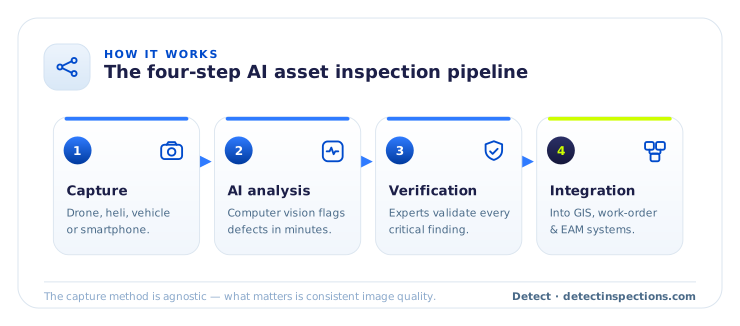
Before the ROI, the mechanism — because understanding it is what lets you separate marketing claims from measurable value. Modern AI asset inspection follows a four-step pipeline:
- Capture. Visual data is collected from the field — increasingly by drone, but also by helicopter, vehicle-mounted cameras, or smartphones. The capture hardware is effectively commoditized; what's scarce is consistent image quality. The strongest programs push standards upstream — shot-sheet specs that define every required photo before the prop spins, and image-quality gates that flag bad capture while crews are still on site, when a re-shoot costs minutes instead of another truck-roll.
- AI / computer-vision analysis. Trained models scan the imagery and classify anomalies — corroded hardware, cracked insulators, vegetation encroachment, loose or missing components — against a structured defect catalog (Detect's spans 258 component-level defect types, trained on millions of real inspection images), at a speed no human team can match. Production models now reach 95–99% precision on benchmark defect datasets (peer-reviewed results, 2024), though field accuracy is bounded by an assessability ceiling that image quality sets.
- Human verification. A qualified reviewer validates the AI's findings. The best programs keep a human in the loop on every critical finding — this is what controls false positives and builds engineering trust.
- Integration. Verified findings flow into the systems crews already use — GIS (e.g., ArcGIS), work-order, and enterprise asset management (EAM) platforms — so a defect becomes a scheduled repair, not a PDF in an inbox.
The ROI ceiling no one prices: data quality
Before the four levers, the precondition. Every ROI model in this market assumes the AI gets a fair look at the asset — and often it doesn't. AI can only assess what the imagery shows, so the return is set upstream of the model, at the quality of the data going in. This is the lever most vendors leave unpriced, and it's the one that moves all the others.
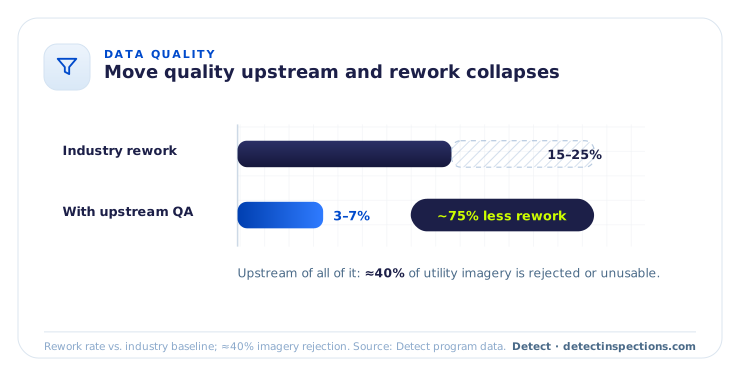
The numbers are blunt. By Detect's field estimates, roughly 40% of utility inspection imagery is rejected or unusable somewhere in the pipeline — wrong angle, missing component, resolution too low to call a defect. About 48% of infrastructure rework traces to bad inspection data, not bad fieldwork. And a typical program loses three to six months between capture and action. None of that is a model problem; no amount of detection accuracy recovers a photo that never showed the crack.
That reframes where ROI is actually won. The cheapest defect to act on is the one caught on the first pass, with imagery good enough to classify and verify without a return trip. Programs that move quality upstream — standardized capture, shot-sheet specs, and on-site image-quality gates — report rework falling from the industry's 15–25% range to 3–7% within two inspection campaigns (Detect program data). That swing is close to pure margin: every avoided re-shoot is a truck-roll, a delay, and a re-analysis you never pay for.
The four ways AI asset inspection delivers ROI: the FAST framework
With assessable data as the floor, every credible ROI case reduces to four levers. Detect calls it the FAST framework — Find, Avoid, Slash, Target — because each lever maps to a line item a finance team can verify.
F — Find more defects
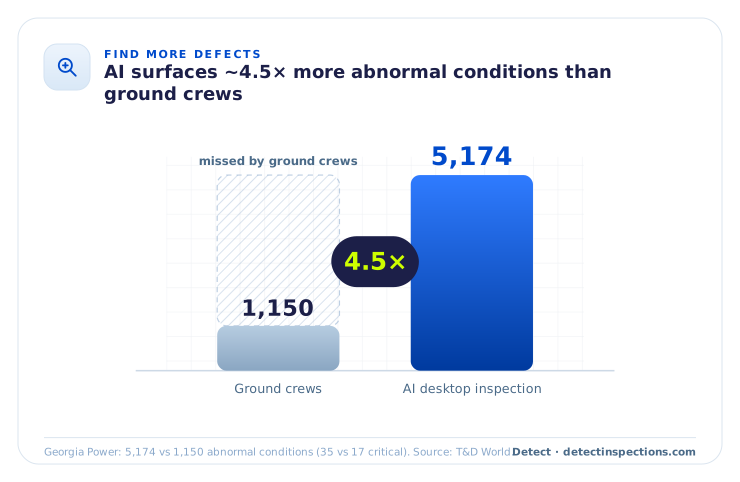
AI surfaces conditions manual inspection misses. In Georgia Power's program, drone-plus-analysis inspections identified 5,174 abnormal conditions against 1,150 found by ground crews — roughly 4.5× more — and 35 critical conditions versus 17 (T&D World). Independent case work has found drone inspection identifying 48% more conditions plus high-priority issues missed entirely on the ground. More defects found early is the raw material for every downstream dollar saved.
A — Avoid outages
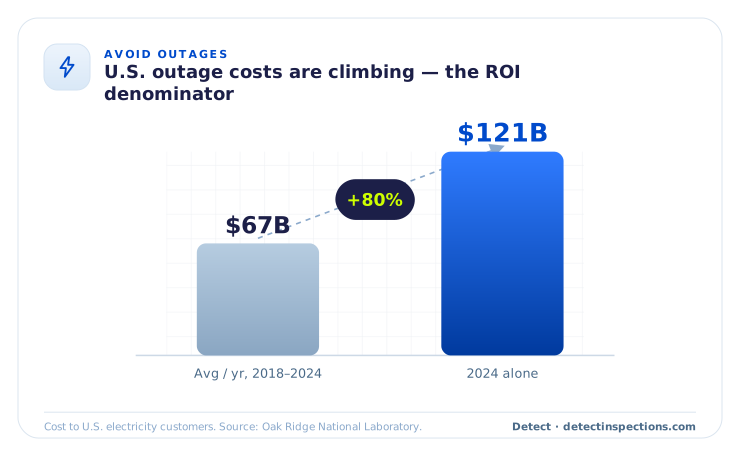
Earlier detection plus condition-based repair means fewer cascading failures. The stakes are large: major U.S. power outages cost electricity customers an average of $67 billion per year from 2018–2024, spiking to $121 billion in 2024 (Oak Ridge National Laboratory). Utilities that shift to proactive maintenance report measurable reliability gains — see the dedicated reliability and outage sections below.
S — Slash inspection cost
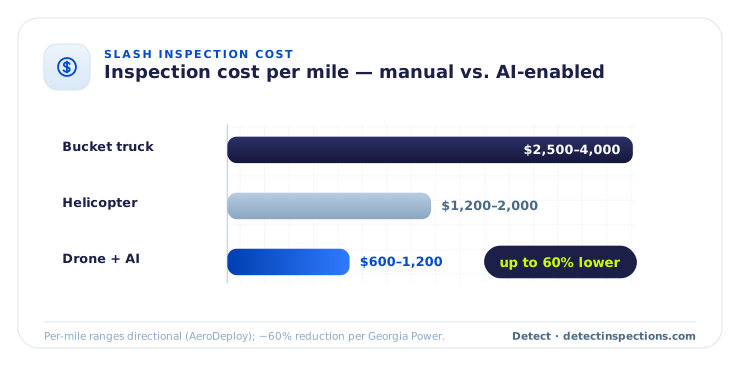
This is the most immediate, hardest-to-dispute lever. Georgia Power reported roughly 60% annual cost savings and a 40% reduction in inspection time after moving to drone inspections (Georgia Power). On a per-mile basis, drone inspection runs about $600–$1,200/mile versus $2,500–$4,000/mile for bucket-truck ground crews (AeroDeploy, vendor estimate — directional). The savings come from removing field labor, truck-rolls, and travel time — the same shift that lets teams inspect 10× more assets on flat headcount while cutting costly rework. Rework is its own cost line, so holding it to 3–7% instead of the industry's 15–25% compounds the per-mile savings rather than competing with them.
T — Target the riskiest assets
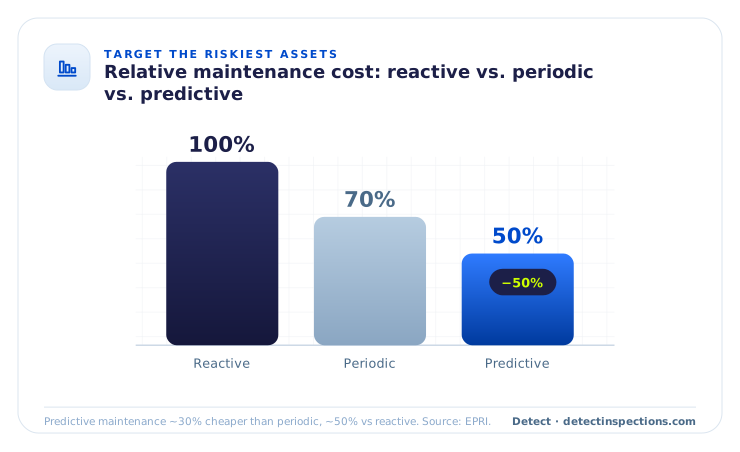
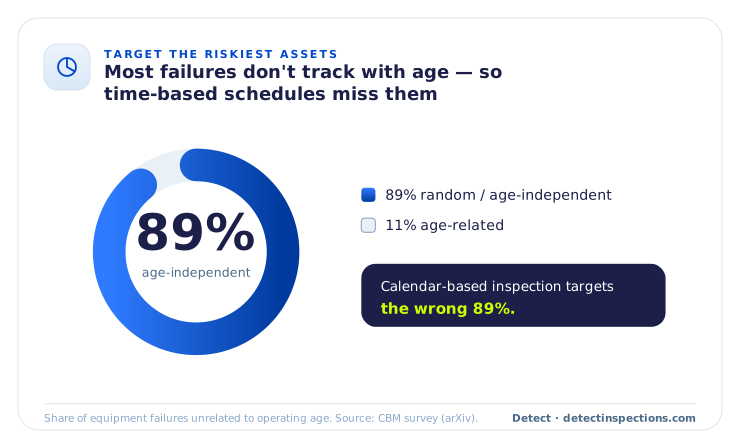
The deepest ROI is in spending differently, not just inspecting cheaper. Research consistently finds that roughly 89% of equipment failures are random with no strong relationship to operating age (condition-based-maintenance survey) — which means time-based schedules waste effort on healthy assets while missing failing ones. EPRI finds predictive (condition-based) maintenance runs ~30% cheaper than periodic maintenance and ~50% cheaper than reactive repair (EPRI). AI-driven prioritization moves the budget to the assets most likely to fail next, escaping the punishing economics of reactive maintenance.
The Detect value stack: the five lines a budget owner reads
The four FAST levers are how the value is created. When the case goes to a budget owner, a board, or a rate-case filing, translate them into five business lines - and use the same five, in the same words, every time:
| Lever | What moves | Where it shows up |
|---|---|---|
| Inspection cost reduction | Cost per structure assessed falls as one crew covers more assets per field day | O&M budget |
| Avoided field trips | Findings verified from imagery replace confirmation truck rolls and climbs | O&M budget, crew safety exposure |
| Risk reduction | Critical defects caught in the detectable phase instead of after failure | SAIDI and SAIFI, wildfire and liability exposure |
| Cycle-time improvement | The lag from capture to scheduled work order shrinks | Backlog age, storm readiness |
| Capex deferral | Condition data lets sound assets earn extensions past age-based replacement dates | Capital plan, rate case |
Each lever maps back to the framework: Find and Avoid carry the risk lines, Slash carries the cost lines, and Target carries cycle time. Capex deferral is the fifth lever - it comes from the condition baseline covered below, where multi-cycle condition data replaces age assumptions with evidence.
The AI inspection ROI formula
Most ROI claims in this market are loose percentages. Here is the actual equation you can populate with your own numbers:
[ (defects caught × avg. avoided failure cost) + (field hours & truck-rolls saved × loaded rate) + avoided regulatory / wildfire penalties ] − program cost ───────────────────────────────────────── program cost Worked example (illustrative). Suppose a utility inspects 1,400 line miles a year. Moving to AI desktop inspection at the cost-reduction rate Georgia Power reported (~60%) takes a roughly $3.5M manual program to about $1.4M — a ~$2.1M annual labor-and-truck-roll saving on its own. Layer in the avoided-failure value: if earlier, more complete detection prevents even a single major outage, the avoided cost is measured against a backdrop where major U.S. outages cost customers $67B–$121B a year and a single prevented transmission failure can run into seven figures. The labor savings alone often cover the program cost; the avoided-outage and avoided-penalty terms are where the ROI multiplies.
Turning a finding into a number. The avoided-failure term only works if each finding carries a dollar value. The practical method: tie every finding to a structure, component, and severity score, then price it against a statistical outage-cost model. Weighing a $15,000 planned repair against a $150,000 statistical failure risk, for example, turns a raw defect list into a ranked, dollar-denominated work plan — and lets you sort spend by avoided risk rather than by calendar. That scoring is also what makes the "Target" lever auditable for a rate case or a wildfire-mitigation filing.
Why the ROI compounds: the condition baseline
A one-time inspection produces a defect list. A program produces something more valuable: a condition baseline — a longitudinal record of every asset's measured condition, inspection over inspection. That baseline is where AI inspection stops being a recurring cost and starts behaving like an appreciating asset.
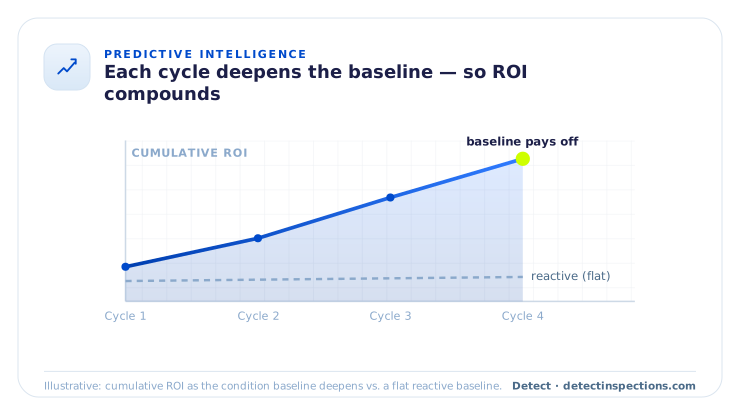
Three things compound as the baseline deepens. Change detection sharpens — the system isn't just finding defects, it's measuring how fast each one is progressing, which is the input prioritization actually needs. Capital decisions get evidence — an asset proven healthy across several cycles can have its replacement deferred, freeing budget, while one trending toward failure can be funded before it fails. And the work gets easier to defend — a baseline is exactly the documentation a commission or a wildfire-mitigation filing asks for.
There's a strategic corollary worth naming: the baseline is the reference every future inspection is measured against, so it's also the asset that's hardest to walk away from. A platform that holds your condition history holds a real switching cost — which is an argument for choosing one whose data you can export and that integrates with the systems you already run, rather than one that locks the baseline behind its own walls.
Manual vs. AI asset inspection: the benchmarks
| Dimension | Manual field inspection | AI desktop / drone inspection | Source |
|---|---|---|---|
| Cost per mile | ~$2,500–$4,000 (bucket truck) | ~$600–$1,200 | AeroDeploy (directional) |
| Throughput | 2–3 miles/day | 5–14 miles/day | AeroDeploy / Georgia Power |
| Inspection cost | baseline | ~60% lower | Georgia Power |
| Inspection time | baseline | ~40% less | Georgia Power |
| Abnormal conditions found | baseline | ~4.5× more | Georgia Power / T&D World |
| Defect-detection precision | inspector-dependent | 95–99% on benchmarks | peer-reviewed (curated data) |
| Rework rate (bad-data re-shoots) | ~15–25% | ~3–7% with upstream QA | Detect program data |
| Time from capture to action | weeks to 3–6 months | same-day to days | Detect / industry |
| Maintenance cost (condition-based) | reactive baseline | ~50% lower | EPRI |
Field results vary with image quality and program maturity; lab precision figures use curated datasets and overstate real-world rates. Treat vendor cost figures as directional and validate against your own program.
How AI visual inspection improves grid reliability
Reliability improvement comes from two mechanisms working together. First, speed-to-repair: a defect found and verified today can be fixed before it fails, rather than discovered after an outage. Second, prioritization: condition-based targeting points crews at the highest-risk lines, turning routine inspection into measurable reliability gains.
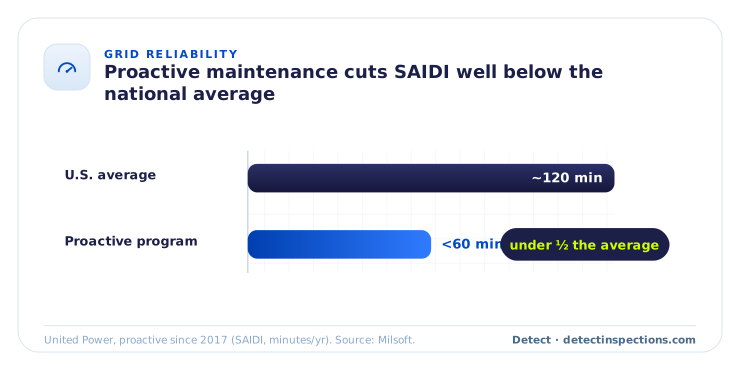
Both show up in the metrics regulators and boards already track. Utilities running proactive maintenance report materially better reliability — United Power, proactive since 2017, posted SAIDI under 60 minutes against a U.S. average near 120 (Milsoft). The point for a business case: reliability gains aren't abstract — they translate directly into SAIDI, SAIFI, and CAIDI movement you can put in front of a commission.
How AI asset inspection reduces unexpected outages
Unexpected outages are, overwhelmingly, equipment failures that weren't caught in time. AI inspection attacks them at the source: by finding ~4.5× more abnormal conditions than ground crews and surfacing the critical ones early enough to repair. Because predictive maintenance runs about 50% cheaper than reactive repair (EPRI) and a single emergency response can cost as much as 70% more than the same repair in a scheduled window, every failure converted from "reactive" to "planned" compounds the savings.
Set against the macro cost — $67B–$121B a year in U.S. outage cost (ORNL) — even modest reductions in unplanned outages dominate the ROI calculation. This is why the avoided-outage term, not the inspection-cost line, is usually the largest number in a mature business case — especially as aging transmission structures drive more of the underlying failure modes.
Predictive maintenance and predictive intelligence from visual data
The endgame of AI asset inspection isn't a defect list — it's predictive intelligence: turning visual data into a forward-looking view of which assets will fail and when. Predictive maintenance is the application of that intelligence — scheduling repairs based on an asset's measured condition rather than a calendar.
The case for it is statistical: since roughly 89% of failures are age-independent, time-based schedules are a poor proxy for actual risk. A platform that analyzes visual data, scores condition and risk, and feeds prioritized work into the EAM system converts inspection from a compliance chore into a predictive maintenance engine. When evaluating platforms for this, the key capability is whether the system produces condition-based maintenance triggers from imagery — not just annotated photos — the step that elevates inspection into modern utility asset management.
Same-day analysis: why turnaround speed is itself ROI
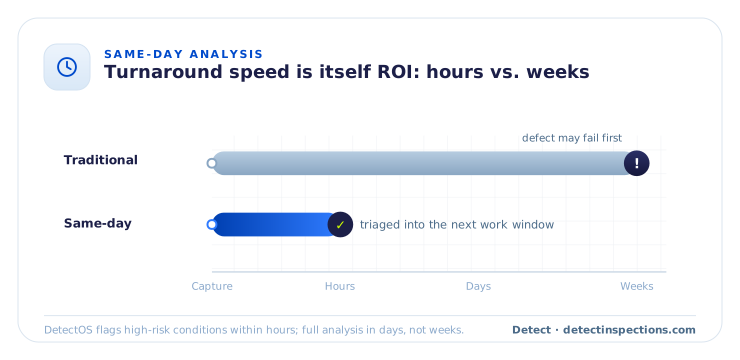
Time-to-finding is an under-rated lever. When analysis takes weeks, a defect can fail before the report lands; when it takes hours, it can be triaged into the next work window. Same-day analysis means imagery captured in the field is run through AI and returned as verified condition findings within hours, not weeks.
Software-layer platforms that decouple analysis from capture — and pair fast computer-vision models with human verification — can deliver this turnaround. DetectOS, for example, flags high-risk conditions within hours and delivers full analysis in days, not weeks — in transmission programs, turnarounds as fast as three days against five-day contract requirements — working on any visual data the utility already collects. Speed converts directly into reliability: the faster a critical defect is verified, the sooner same-day AI triage routes it into the next work window — before it causes an outage.
The KPIs that matter
A business case survives scrutiny when it speaks the metrics leadership already reviews. Split them into two layers:
Macro KPIs — for the board
- SAIDI / SAIFI / CAIDI — the reliability outcomes the program is judged on
- Reactive → proactive ratio — share of work that's planned vs. emergency
- Inspection cost per mile / per asset — the headline efficiency number
- Capital deferral — assets proven healthy enough to defer replacement, freeing budget
Micro KPIs — for the program owner
- Cost per defect found — true unit economics of detection
- Defect-catch rate vs. human baseline — accuracy against ground truth
- Assets inspected per hour / crew — throughput and capacity multiplier
- False-positive rate — the cost of "ghost defects"
- Time-to-finding — same-day vs. weeks
Why utilities struggle — and what closes the gap
A credible ROI case is honest about the ceiling. AI asset inspection is not a magic solution, and three constraints determine whether the return materializes:
- Data quality is the ceiling. AI can only assess what the imagery shows. Inconsistent capture — wrong angles, poor resolution, missing components — caps detection accuracy regardless of model quality. Programs that under-invest in capture standards watch the ROI evaporate into costly data-quality failures.
- False positives have a cost. Models flag conditions that turn out benign. Without human verification, "ghost defects" erode engineering trust and waste field time. A human-in-the-loop step on critical findings is non-negotiable.
- Integration and change management decide adoption. Value is realized only when findings reach the work-order and EAM systems and crews act on them. Platforms that return analysis but don't integrate leave most of the ROI on the table.
The utilities that capture the full FAST return treat AI inspection as an operating system for their visual data — standardizing capture, keeping experts in the loop, and wiring findings into the work crews already do — getting there is exactly where many utilities struggle.
How to evaluate an AI asset inspection platform
Whether you're a large utility, a maintenance team, or an asset manager building a shortlist, the same vendor-neutral criteria separate platforms that deliver ROI from those that don't:
- Data-source flexibility — does it work on the imagery you already collect (drone, helicopter, vehicle, smartphone), or does it lock you into one capture method?
- Upstream data-quality controls — does it only grade imagery after the fact, or push shot-sheet standards and on-site quality gates upstream to stop bad capture before it costs a re-shoot? This is the lever that sets the ceiling on every other one.
- Detection accuracy with a human in the loop — high precision and verification, not one without the other.
- Turnaround speed — same-day triage vs. multi-week reports.
- Integration — native handoff to GIS, work-order, and EAM systems.
- A portable condition baseline — does it build a longitudinal condition history you can export, so the ROI compounds and you keep your data if you switch?
- Security & compliance — SOC 2 Type II and data-handling rigor for enterprise deployment.
- Scalability — proven across thousands of assets, not a pilot-only tool.
Detect's Grid Inspection AI Scorecard turns criteria like these into a weighted, side-by-side comparison - run the seven-criterion platform scorecard on identical sample imagery from your own line, and the right platform separates itself on evidence rather than demos.
The market splits into rough categories — continuous vehicle-mounted monitoring, drone-service-led offerings, vegetation/satellite analytics, and software-layer platforms that analyze any visual data. For transmission and distribution component inspection with same-day turnaround, a software-layer platform that works on your existing imagery and feeds your EAM system tends to score highest on the criteria above. The same lens applies when evaluating an inspection vendor or designing a rework-free inspection workflow.
See the ROI on your own assets
DetectOS turns any visual data — drone, helicopter, truck, or smartphone — into utility-grade, same-day condition intelligence: defects classified against a 258-type catalog, verified by experts, scored against outage risk, and built into a condition baseline that compounds. Measurable return across all four FAST levers — on the data-quality floor that decides them.
Explore the platform →Frequently asked questions
How is AI asset inspection ROI calculated?
How do utilities justify investment in AI asset inspection software?
What is a typical payback period for AI asset inspection?
Why does data quality determine AI asset inspection ROI?
Does AI asset inspection ROI improve over time?
How do you turn an inspection finding into an ROI number?
How do AI visual inspection platforms improve grid reliability?
How does AI asset inspection reduce unexpected outages on power grids?
Is AI more accurate than manual inspection?
What is predictive intelligence for power grid assets, and how is it different from predictive maintenance?
Which platforms offer same-day AI analysis of utility asset images?
Which predictive maintenance platforms analyze visual data for grid assets?
Why do utilities struggle to use AI visual inspection platforms effectively?
Do utilities need drones to use AI asset inspection?
What should large utilities and maintenance teams look for in an AI asset inspection platform?
What KPIs should utilities report to measure AI asset inspection ROI?
What regulatory drivers make AI asset inspection urgent for utilities?
Related reading: see how AI inspection software helps prevent grid outages.
