
Transmission Line Inspection for Failure Prevention and Grid Reliability
From Postmortem Analysis to Proactive Strategy
With over 70% of U.S. transmission infrastructure being more than 25 years old, failure isn’t a matter of if, but when.
Yet many utilities still rely on inspection methods that can't keep up.
When a single high-voltage transmission line goes down, it can cascade through the grid, sparking wildfires, halting industrial operations, and leaving entire communities in the dark. The stakes are highest not during the failure itself, but in the lead-up. There could be weeks, months, even years when early signs go unnoticed or unaddressed.
In this article, we’ll unpack real-world failure scenarios, examine why traditional inspection methods fall short, and outline a prevention strategy for utility operators facing increasing scrutiny and risk.
The hidden costs of transmission line failure
Transmission infrastructure might have been built for resilience 50 years ago, but it's aging fast.
As climate volatility intensifies and grid loads increase, these structures are being tested beyond their original limits. The failure of a single transmission line can cause cascading effects: localized blackouts, damaged equipment down the line, regulatory penalties, and loss of public trust. The costs quickly escalate beyond the immediate repair budget.

Consider the 2020 wildfire in Oregon’s Santiam Canyon.
An overloaded transmission line sagged into nearby vegetation during high winds, igniting a fire that destroyed thousands of structures and forced mass evacuations.
Utility investigations later found that the line in question had not been inspected in over a year and that vegetation clearance records were outdated. It’s a textbook example of how data blind spots, not just physical degradation, contribute to failure.
These aren’t isolated incidents. New grid demands continue to multiply. This includes AI data centers to electric vehicle expansion, each of which is layering additional stress on an already brittle system.
Every failure event triggers post-mortem analysis, but many utilities still lack the proactive tools to prevent the next one.
What the post-mortem tells us (but usually too late)
Post-failure investigations often reveal a frustrating truth: the signs were there.
Microcracks in cross-arms. Corrosion at the base of transmission towers. A loose bolt that was visible in drone footage but never reviewed. The data existed, but it wasn’t accessible, actionable, or timely enough to prevent the failure.
These stories surface a consistent pattern that there is a significant lag time between inspection and action. Traditional inspection workflows, whether ground-based, helicopter-driven, or third-party, often involve long processing windows. Image libraries sit untagged. Field teams hand off data with no clear routing path.
On top of that, the sheer volume of assets, including hundreds of miles of transmission lines, multiple types of transmission towers, makes prioritization a guessing game.
The postmortem gives us a timeline of what went wrong. But without a system that transforms raw inspection data into structured, real-time insights, it’s just a history lesson.

Why traditional transmission line inspections fail to scale
Conventional inspection programs were not designed for the velocity or volume of today’s grid environment. Ground teams are stretched thin, and helicopter flyovers are expensive, weather-dependent, and sometimes miss critical angles. Even with drones, image processing, and manual defect tagging often take weeks.
And scaling is all about consistency (not just coverage).
Different inspection crews interpret visual data differently. A hairline crack might be flagged by one team and dismissed by another.
The lack of standardized defect classification across asset types (lattice vs. monopole towers, AC vs. DC lines, etc.) introduces even more variability. This is a major liability, particularly when transmission tower inspection becomes a compliance requirement tied to NERC or FERC audits.
Then there’s the cost.
Transmission inspection costs vary widely by method, with ground patrols and helicopter inspections quickly ballooning in cost without guaranteeing defect detection. With utilities often managing thousands of line miles, even a 10% inefficiency balloons into millions in wasted spend annually.
The role of AI in transmission inspection analysis
The magic of Artificial intelligence lies in making patterns visible.
Platforms like DetectOS can review thousands of images from transmission line inspections in minutes, surfacing anomalies that would take human teams weeks to detect.
More importantly, they take those defects and contextualize them.
For instance, DetectOS can correlate a particular asset’s defect history with vegetation growth data, line loading trends, and prior inspection results. This allows utilities to not only flag a cracked insulator but to understand how environmental or structural stressors may accelerate its failure.
Inspection data analysis & action
Because the system is cloud-based and integrates with platforms like ArcGIS, SAP, and Maximo, inspection data doesn’t get trapped in a silo. Instead, it becomes an active signal within existing utility workflows, which means that:
- Engineers can schedule crews in response to real-time alerts
- Compliance teams can export inspection records aligned to regulatory schemas
- Asset managers can view year-over-year defect trends at the portfolio level
In wildfire-prone regions, AI inspection also serves a public safety function.
Early detection of vegetation encroachment or downed equipment near energized lines can trigger mitigation actions long before red flag conditions escalate. As AI models continue to improve, they’ll even be able to predict defect likelihood—shifting utilities from a “fix it” mindset to a “prevent it” one.

Reframing overhead inspections: From line item to risk mitigation strategy
Historically, transmission inspection has been treated as a regulatory checkbox or fixed cost. You’ve got to account for this necessary but budget-constrained line item. That said, the economic equation changes when you factor in risk avoidance.
The cost of a major outage can reach millions per hour for industrial customers, and the reputational damage from wildfire liability can sink decades of goodwill.
Forward-thinking CFOs are beginning to ask a new question: What’s the ROI of not modernizing inspections?
AI-powered visual inspection platforms
AI-powered inspection platforms like DetectOS reframe inspections as a risk mitigation and operational efficiency strategy. By reducing the reliance on high-cost methods like helicopter flyovers, optimizing field team deployment, and helping prioritize critical maintenance actions, modern inspection platforms can lower total costs while increasing defect detection accuracy.
Additionally, as uptime becomes a commercial differentiator, especially in regions serving data centers, hospitals, and EV charging corridors, investments in faster, smarter inspections can directly support SLAs and regulatory compliance.
The shift is clear: by integrating AI inspection into a broader reliability strategy, transmission inspection becomes a profit protector and not just another O&M line item. And as regulatory expectations evolve, early adopters will be better positioned to demonstrate proactive compliance and infrastructure resilience.
Smart grid system: Inspection, integration, intelligence
Transmission line failure prevention comes from unifying the way utilities inspect, interpret, and act on asset data.
Inspections supported by AI technology are a starting point, but real changes happen when those insights flow seamlessly into the systems and teams that can operationalize them.
That’s why integration matters.
DetectOS’s native connections to GIS and ERP platforms ensure that inspection findings don’t stay buried in PDFs or proprietary databases. Every crack, hotspot, or vegetation risk becomes a live data point within a utility’s asset hierarchy that's visible to everyone from field ops to finance.
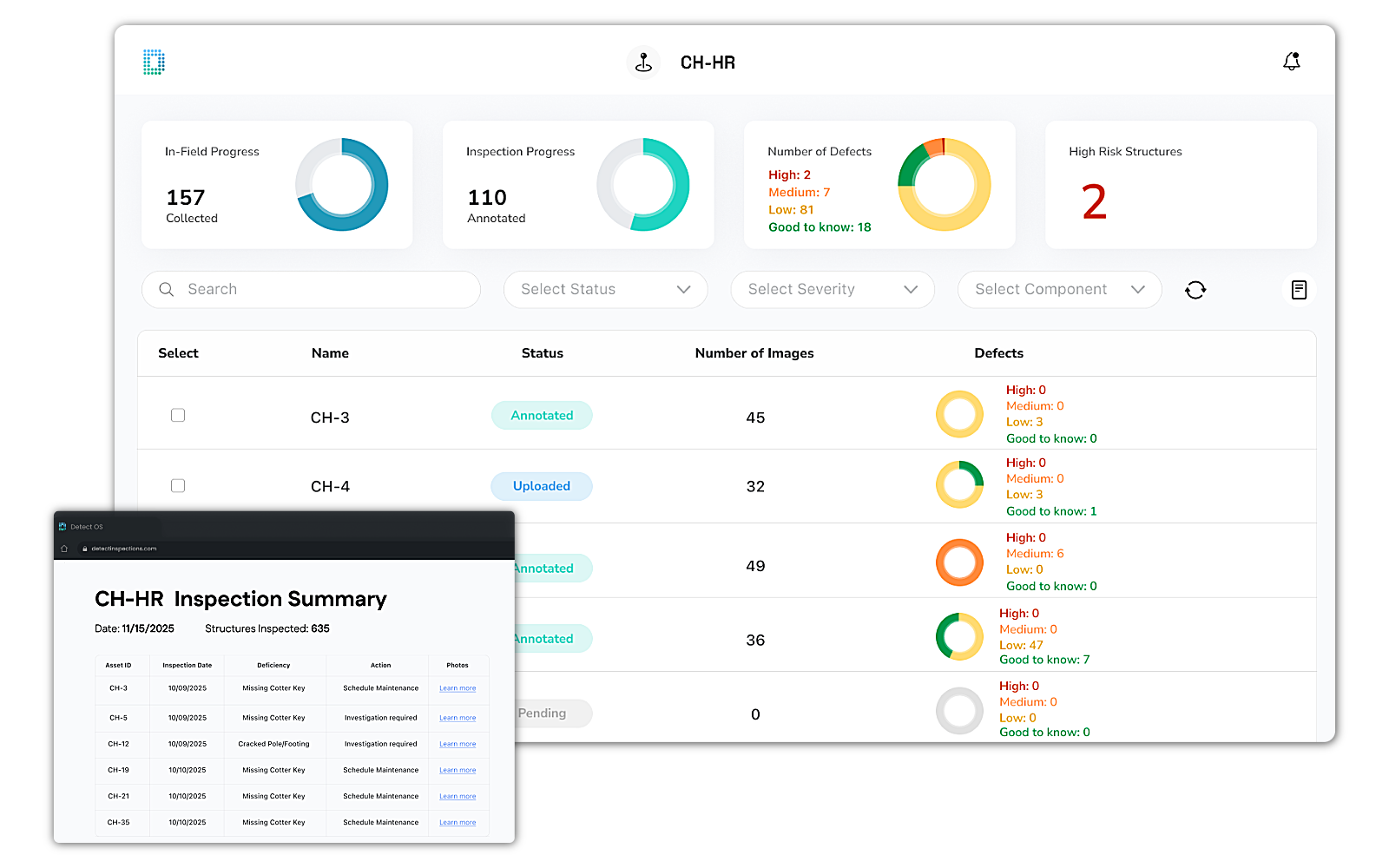
Continuous power utility asset intelligence
Intelligence, too, must be continuous.
Detect’s edge-to-cloud architecture allows for in-field data uploads, reducing lag time from inspection to insight. And with built-in feedback loops, the system learns from operator input over time, refining defect classification, prioritization rules, and risk scoring based on real-world outcomes.
The final piece is cultural. Preventing transmission line failure requires utilities to shift from reactive to anticipatory thinking and go from “What broke?” to “What’s next?”
That shift doesn’t happen overnight. But with the right tools and processes in place, it becomes not just possible, but inevitable.
Stronger grids start with smarter utility asset inspections
Detect exists to help utilities detect potential failures and stop them before they start.
Federal permitting reform raises the stakes on this. The Senate bill introduced in September 2026 would put more interstate lines on faster timelines and exempt in-corridor reconductoring from new environmental review; what it does not do is build the condition record, which is the Permit-to-Baseline Gap every transmission owner now has to close on purpose.
With a software-first approach, field-tested AI, and native integrations across your asset stack, DetectOS empowers your team to scale inspections, reduce risk, and protect the grid at the speed modern life demands.
If you're ready to turn post-mortems into prevention, request a free audit or explore how DetectOS fits into your existing inspection and asset management workflows.
Related reading: see how AI inspection software helps prevent grid outages.
