
What is a Wildfire Mitigation Plan? 2026 Reference for Electric Utilities
It’s mid-May 2026. CAL FIRE has already responded to multiple incidents in the foothills. PG&E and Southern California Edison have begun their seasonal Public Safety Power Shutoff readiness rotations. The 2026-2028 base Wildfire Mitigation Plans are filed and approved. The annual updates for the 2027 cycle begin in late summer.
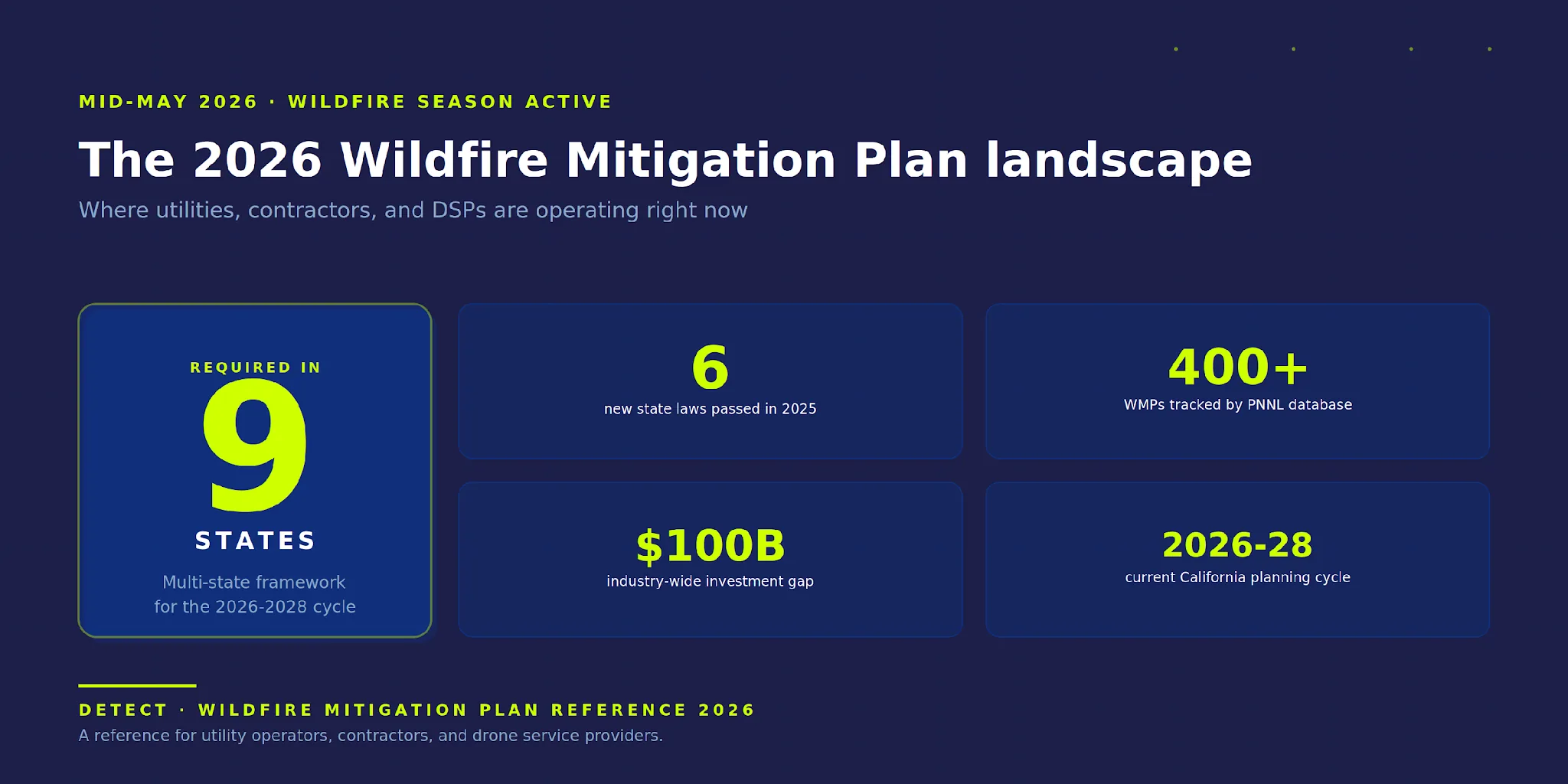
The framework has converged. Nine states now require electric utilities to file Wildfire Mitigation Plans, and most file against a structure that has standardized across jurisdictions. What is changing is how regulators evaluate the plans - the shift from input metrics like miles patrolled to outcome metrics like risk reduced. That shift puts inspections at the center, because inspections are the only WMP section that produces outcome data directly.
If you manage a utility's wildfire program, run an inspection contractor, or own a drone service provider, you are already mid-execution. 70% of transmission structures in the United States have exceeded their designed lifespan, and nearly half the utility workforce is expected to retire within the next decade. Wildfire risk does not sit alone. It compounds with aging assets, workforce constraints, and an increasingly outcome-based regulatory framework.
This reference covers what is in a Wildfire Mitigation Plan, where WMPs are required in 2026, and how plans are reviewed and enforced. It also covers the sections that now decide whether the rest of the document holds up under audit.
KEY TAKEAWAYS FOR THE 2026 WMP CYCLE
- Nine states require WMPs as of 2026 (CA, OR, WA, CO, ID, NV, UT, MT, HI), and PNNL tracks more than 400 plans from 170 utilities across 19 states for the 2019-2028 period.
- Every WMP filed across the multi-state framework converges on the same eight sections: overview and risk methodology, mitigation strategies, mitigation initiatives, inspections, vegetation management, grid design and operations, data governance, and community engagement.
- Energy Safety's 2026-2028 framework weighs outcomes over inputs, which makes inspections the load-bearing section. Every other section depends on inspection data: Risk Spend Efficiency, vegetation management, hardening prioritization, and enforcement defensibility under PU Code 8386.1.
- The four mitigation strategies have very different economics: vegetation management ($6-8B annually nationally), traditional hardening (~$1.05M per mile), covered conductor (~$1.21M per mile), and strategic undergrounding (~$2.66M per mile). PG&E plans 5,000 additional miles of undergrounding between 2028 and 2037.
- The same inspection data serves four audiences: the state regulator (Energy Safety), the underwriter (AEGIS and commercial markets), the credit rating agency (Moody's, S&P), and the utility's board.
What is a Wildfire Mitigation Plan?
A Wildfire Mitigation Plan, or WMP, is a written program an electric utility files with its state regulator. It describes how the utility constructs, maintains, and operates its lines and equipment to reduce catastrophic wildfire risk. Nine states require WMPs by law as of 2026. California's program, created by SB 901 (2018) and AB 1054 (2019), is the most developed.
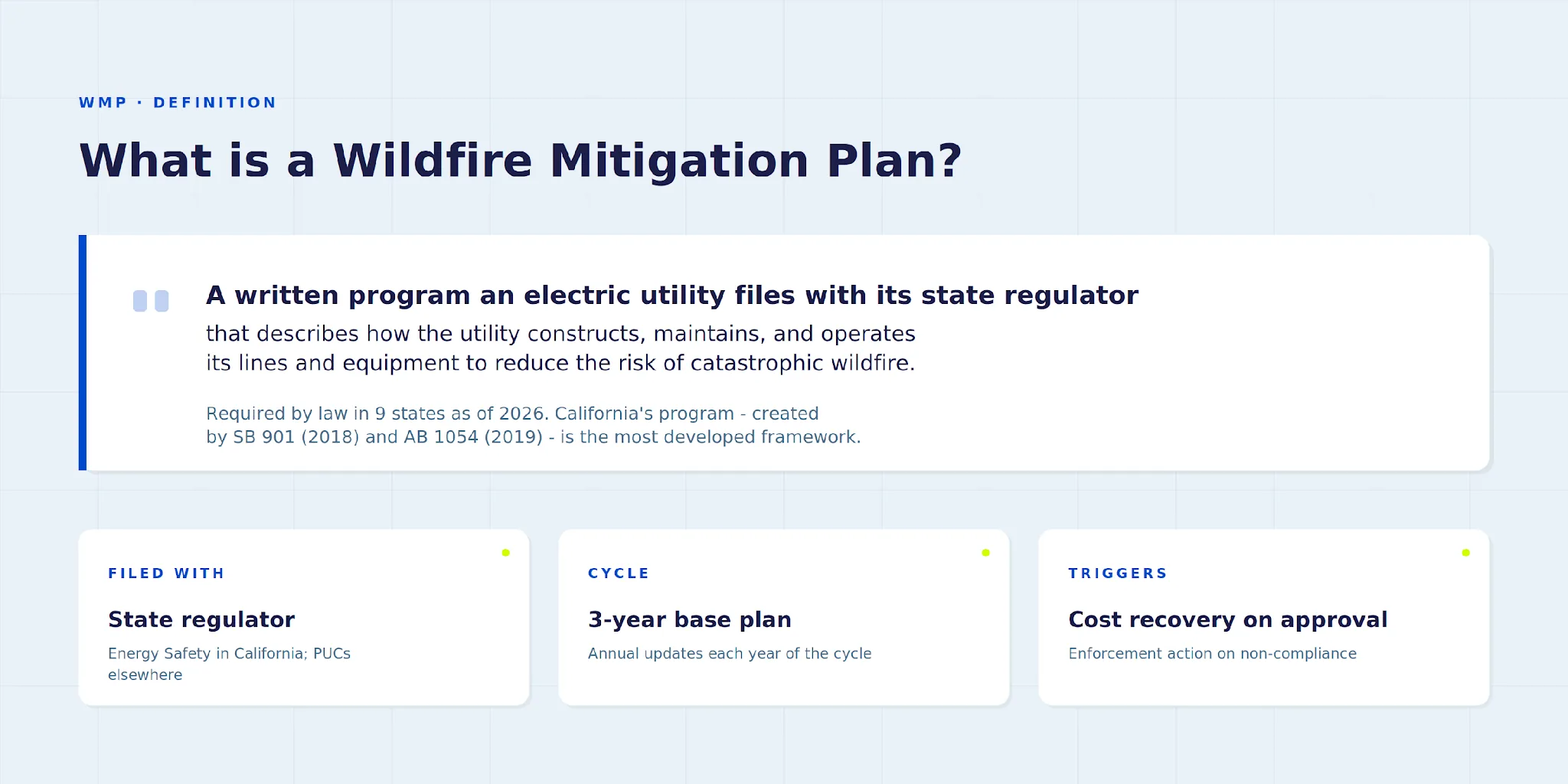
The plan is both an operating document and a regulatory artifact. Filed with the state regulator, it commits the utility to specific work over a defined period - usually three years in California, annually elsewhere. Approval triggers cost recovery eligibility. Non-compliance triggers enforcement.
In California, the framework is governed by four key statutes:
- Public Utilities Code 8386 - the foundational requirement for investor-owned utilities to file WMPs
- Public Utilities Code 8387 - the parallel requirement for publicly-owned utilities, including the independent evaluator obligation
- Public Utilities Code 8386.1 - penalty assessment factors for non-compliance
- Public Utilities Code 8386.3 - plan review and approval procedures
The Office of Energy Infrastructure Safety reviews and approves plans. The California Public Utilities Commission ratifies decisions and holds enforcement authority. Outside California, the structure is similar but the cadences differ. Oregon utilities file annually under SB 762 (2021). Washington utilities follow RCW 76.04.185 (2023). Colorado's PUC reviews filings on a flexible cycle. Idaho's Wildfire Standard of Care Act takes a different approach entirely: an approved WMP creates a rebuttable presumption of non-negligence in wildfire litigation.
Pacific Northwest National Laboratory's WMP database tracks more than 400 plans from 170 utilities across 19 states, covering the period 2019 through 2028. Six states passed new wildfire-utility legislation in 2025 alone. Federal involvement remains advisory rather than regulatory: a June 2025 federal Executive Order produced PNNL's national best-practices framework.
If you have never read a WMP, start with the Energy Safety guidelines for the 2026-2028 cycle and PNNL's database. The structure of every filing tracks the framework the guidelines describe.
Where are Wildfire Mitigation Plans required in 2026?
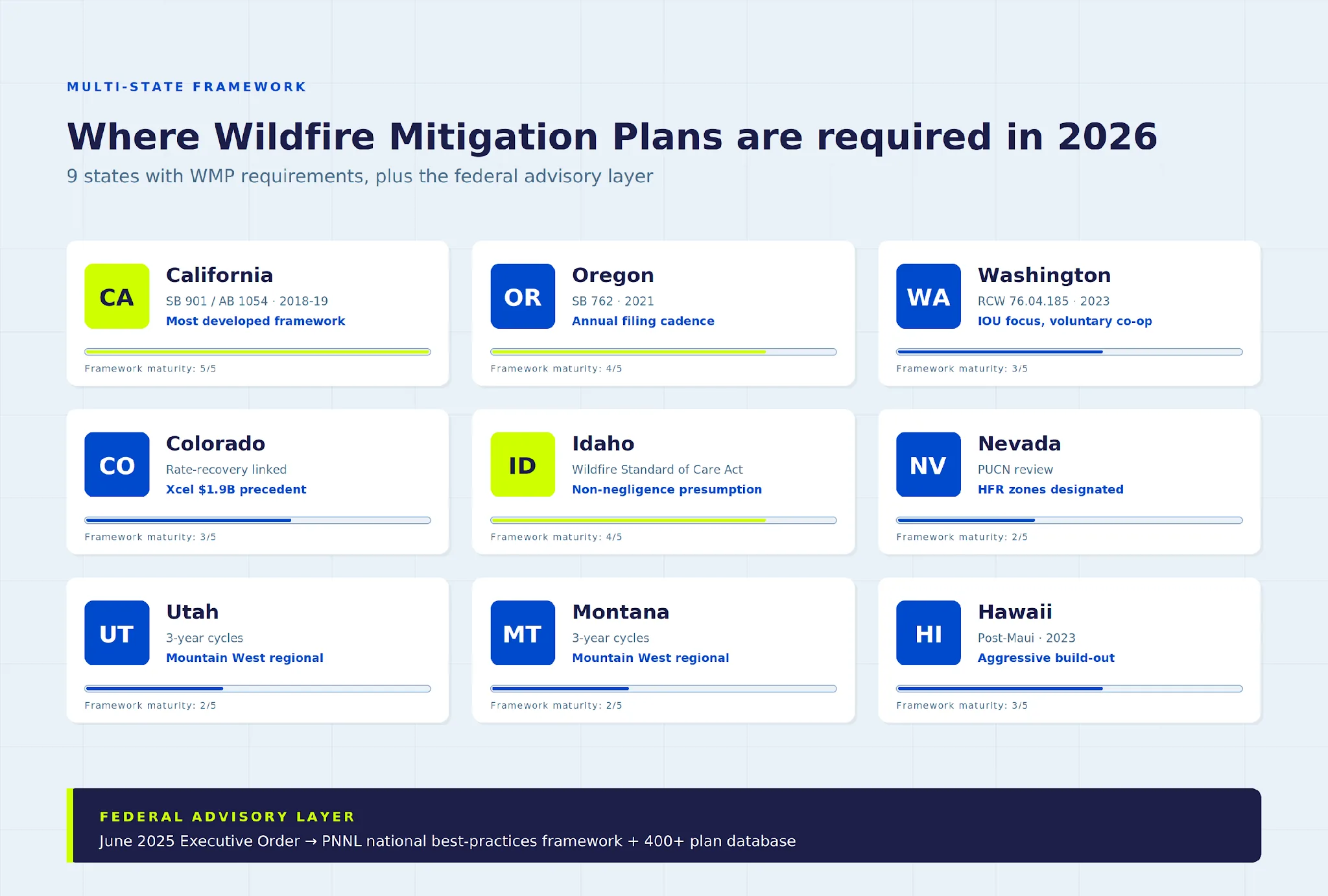
Nine states now require utilities to file Wildfire Mitigation Plans. Six states passed new legislation in 2025 alone. The framework varies by jurisdiction; the inspection backbone is largely the same.
California wildfire mitigation program: the most developed framework
SB 901 (2018) and AB 1054 (2019) established the modern California wildfire mitigation program. Three-year base plans with annual updates. Oversight moved from the CPUC's Wildfire Safety Division to the Office of Energy Infrastructure Safety in 2021. The current cycle covers 2026-2028. All major investor-owned utilities have filed plans for review. The list includes PG&E's 2026-2028 wildfire mitigation plan, Southern California Edison, San Diego Gas & Electric, Bear Valley Electric Service, Liberty Utilities, Horizon West, and Trans Bay Cable.
Oregon: SB 762 annual filing requirement
Senate Bill 762 (2021) created the framework, codified at ORS 757.963. The Oregon Public Utility Commission administers under Oregon Administrative Rules Division 300. Annual filing requirement with a December 31 deadline. Oregon was an early mover on integrating inspection cycles directly with WMP frameworks. Portland General Electric and PacifiCorp file in Oregon under this framework.
Washington: RCW 76.04.185
Investor-owned utility focus, with the Washington State Department of Commerce publishing recommended formats and elements under RCW 76.04.185 (2023). Cooperatives and municipals file voluntarily. Pacific Power and Avista are the principal IOU filers.
Colorado: Xcel Energy's wildfire mitigation plan sets the precedent
Xcel Energy filed a $1.9 billion wildfire mitigation plan with the Colorado PUC in June 2024 (docket 24A-0296E), approved in June 2025 (Utility Dive coverage). Colorado's framework links plan approval directly to ratepayer recovery, which has pulled other Colorado utilities into the process.
Idaho: the Wildfire Standard of Care Act
Idaho's Wildfire Standard of Care Act creates the country's strongest legal incentive to file. An approved WMP creates a rebuttable presumption of non-negligence in wildfire litigation. The presumption is rebuttable, so a plaintiff in post-fire litigation can argue that the utility did not reasonably implement the plan. Inspection records are the evidence that decides which way the presumption falls.
Other states
Nevada, Utah, and Montana have varying frameworks within the 9-state list. Hawaii built out its framework rapidly after the 2023 Maui wildfires. Multi-state utilities filing across the Mountain West and Pacific Northwest face the most complex compliance environment, operating against three or four different documentation standards at once.
Federal layer
A June 2025 Executive Order produced Pacific Northwest National Laboratory's "Current Best Practices on Wildfire Risk Reduction for Electric Transmission and Distribution Systems." PNNL also maintains the national WMP database referenced earlier. The federal layer remains advisory rather than regulatory, but it is now part of the conversation.
The substantive requirements are similar across states, but the filing cadences, penalty regimes, and documentation expectations differ. A vendor or contractor that serves utilities across three states is operating against three different documentation standards applied to nearly identical fieldwork.
What is actually in a Wildfire Mitigation Plan?
The WMP table of contents has converged across states. Read the 2026-2028 plans filed by major utilities side by side. You will find the same skeleton: risk modeling, mitigation strategy, named initiatives, inspections, vegetation management, grid design and operations, data governance, and community engagement. Eight sections. Each one feeds the next.
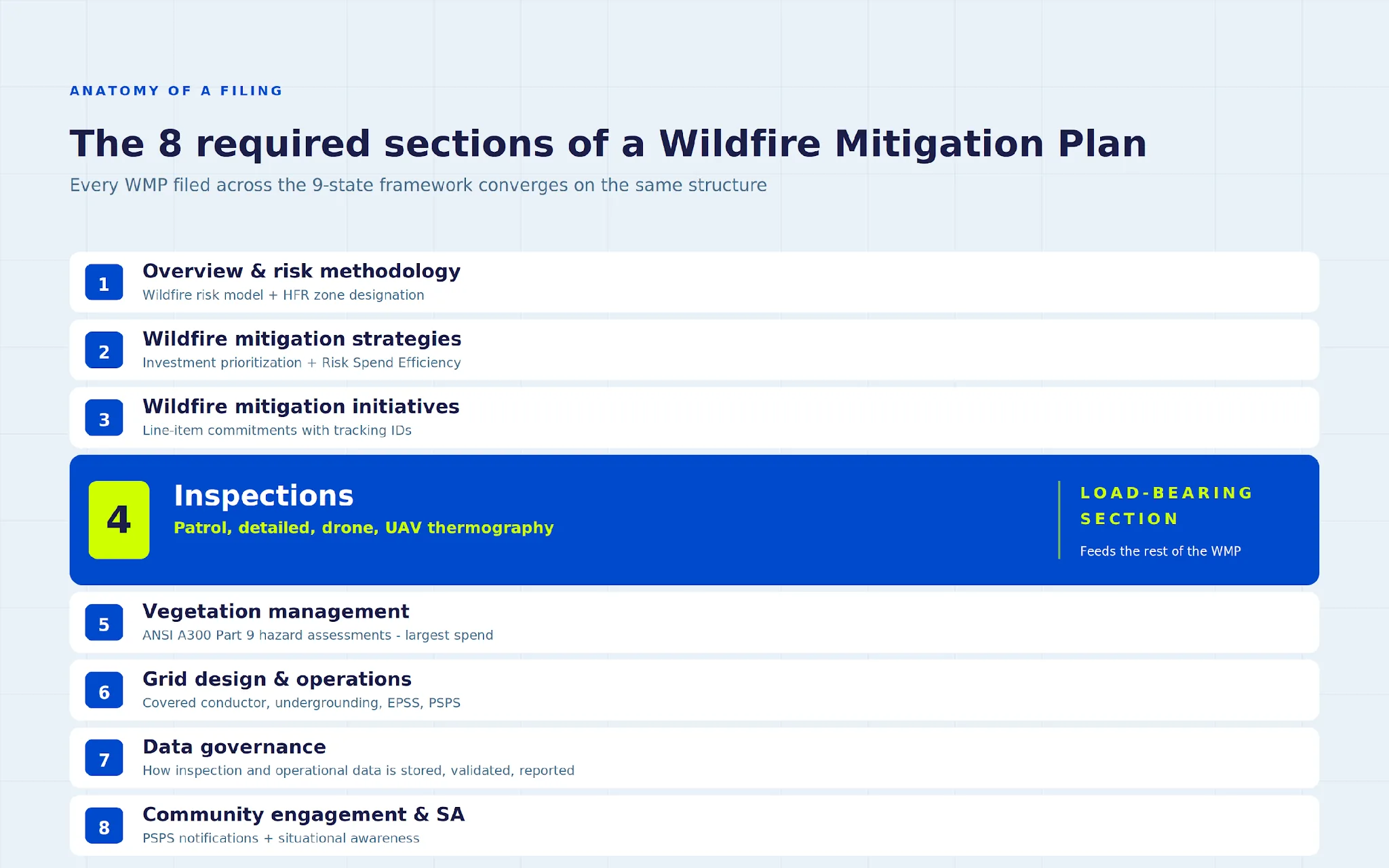
Here is what each section covers, and why it matters.
1. Overview and risk methodology
The utility's wildfire risk model, the data inputs, the high-fire-risk zone designation. PG&E's risk modeling identifies 90 circuit segments that produce roughly 20 percent of the utility's total wildfire risk. The concentration matters: it determines where inspection and hardening investment goes first. Without a defensible risk methodology, the prioritization in the rest of the plan does not hold.
2. Wildfire mitigation strategies and Risk Spend Efficiency
How the utility prioritizes investment across the four big-money wildfire mitigation strategies: vegetation management, system hardening, undergrounding, and covered conductor. Risk Spend Efficiency (RSE) is the metric most utilities now use - the ratio of risk reduction to spend. RSE calculations live or die on the underlying inspection data. Section 7 returns to this.
3. Wildfire mitigation initiatives
The actual line items the utility commits to in the plan period. Each initiative gets a tracking ID and quarterly reporting metrics. Bear Valley Electric Service tracks UAV thermography and UAV photography as separate WMP initiatives, each with its own database identifier. The granularity matters because Energy Safety's review evaluates progress initiative by initiative, not at the plan level.
4. Inspections
Most filings now list seven inspection types: patrol, detailed, intrusive pole, substation, infrared, drone, and UAV thermography or photography. PG&E inspected 220,000 poles by drone in 2024 alone. Quality Assurance and Quality Control is typically a separate, shorter section. It is also the section that most often becomes the audit weakness.
The connection between drone inspection capture and WMP-grade evidence runs through field workflow, and the field workflow is decided upstream of the inspection itself. The procurement-side criteria for what utilities evaluate when choosing a drone inspection vendor - certifications, QA protocols, data delivery standards, prior-utility benchmarks - determine whether the data will hold up in a filing. That question is settled before any analyst opens the file.
5. Vegetation management
Tree trimming, hazard tree assessment under ANSI A300 Part 9, defensible space, fuel reduction. Vegetation management is the single largest spending category for most utilities, and it is the most common subject of enforcement action when documentation falls short of the standard.
6. Grid design and operations
Covered conductor installation, strategic undergrounding, Enhanced Powerline Safety Settings (EPSS), Public Safety Power Shutoff (PSPS) protocols, fast-trip protection settings. PG&E has installed 698 high-definition cameras and 1,620 weather stations as of December 31, 2025. Of the 1,620 weather stations, 1,400 are AI and machine-learning enabled.
7. Data governance
How the utility stores, validates, and reports inspection and operational data. Energy Safety's outcome-based metrics framework lives or dies on this section. A utility that cannot connect specific inspection findings to specific mitigation actions has a harder time defending its plan. The most common gaps mirror the five data quality failures driving inspection rework.
8. Community engagement and situational awareness
Customer notification protocols for PSPS, vulnerable customer registries, public outreach, situational awareness tools. PG&E's continuous monitoring program avoided 23 ignitions in High Fire Risk Areas and 16 million outage minutes between January 2025 and March 2026. That number is the format Energy Safety wants to see: a clear connection between an operational system and a wildfire-relevant outcome.
Wildfire mitigation examples from the 2026-2028 cycle
Specific examples of utility commitments in the current 2026-2028 cycle, taken from public filings, give a sense of the scale and texture of typical WMP work.
- PG&E's plan to underground roughly 1,100 miles of distribution lines over the three-year period.
- SCE's continuing buildout of covered conductor across Tier 2 and Tier 3 fire zones.
- Bear Valley Electric Service's UAV-led inspection initiatives with named tracking IDs.
- SDG&E's drone-led inspection program for high-fire-risk districts.
- Xcel Energy's $1.9 billion plan in Colorado as the first major non-California filing at that scale.
Wildfire mitigation strategies compared: vegetation, hardening, covered conductor, undergrounding
Four wildfire mitigation strategies dominate utility wildfire spending: vegetation management, traditional system hardening, covered conductor installation, and strategic undergrounding. They sit at very different points on the cost and risk-reduction curve. A WMP filing has to defend the mix - why this much of one and not more of another. That means the four options have to be understood in comparison, not in isolation. The same logic now governs grid resilience investment beyond wildfire: condition evidence decides which structures get which treatment.
Industry estimates put total utility wildfire investment needs at roughly $100 billion. Vegetation clearing alone runs between $6 billion and $8 billion annually across the U.S. utility sector. The cost-per-mile economics of the other three are summarized below using publicly reported utility filings; specific numbers vary by terrain, voltage class, and contractor market.
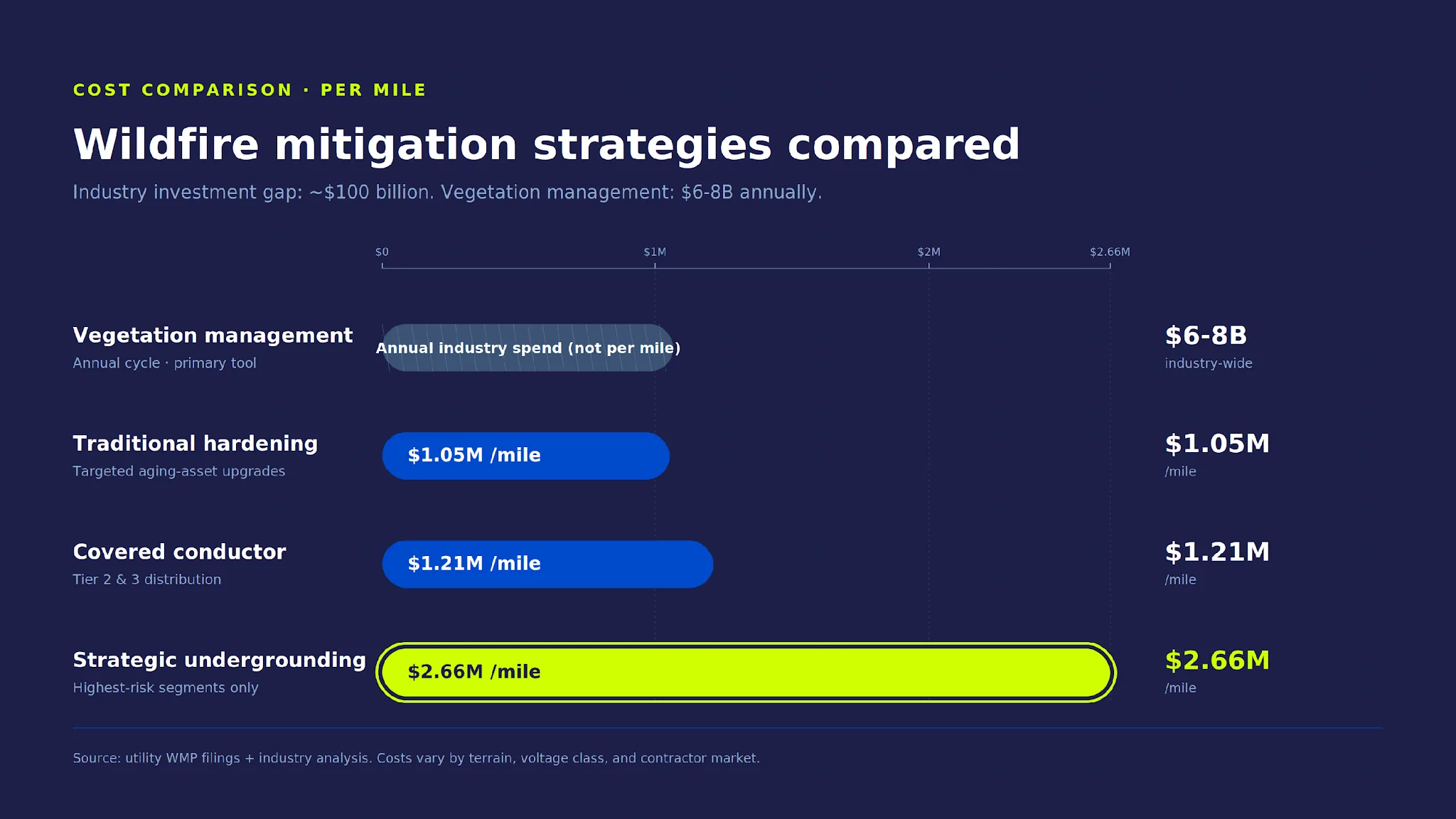
Undergrounding is the most expensive and the most durable. PG&E has completed 1,210 miles of undergrounding through Q1 2026 and plans 5,000 additional miles from 2028 through 2037. At roughly $2.66 million per mile, that program represents the largest single capital commitment to wildfire risk reduction in the U.S. utility sector. Most utilities cannot afford undergrounding at that scale and rely on a mix of the other three options instead.
The prioritization across the four options is governed by Risk Spend Efficiency, but the math underneath the RSE numbers is about something simpler: the true cost of reactive maintenance in utilities. Every defect identified in an early-stage inspection compounds across the rest of the mitigation budget. Every defect missed compounds in the other direction.
Vegetation management deserves a closer look because of its scale. The ignition mechanisms vegetation contact drives are well-documented in CPUC fire-cause data. Vegetation contact and contact with foreign objects together account for the majority of utility-related fires larger than 10 acres in California.
Why inspections are the wildfire mitigation plan section that decides everything else
Of the eight WMP sections, inspections is the only one that produces outcome data directly. Every other section depends on it. Vegetation management decisions depend on hazard-tree inspection data. Covered conductor and hardening prioritization depend on detailed inspection findings on existing assets. Risk Spend Efficiency calculations depend on a defensible defect register. Enforcement defensibility under PU Code 8386.1 depends on documentation that shows what was found and what was done.
That section is also where the legal test lands. Most 2025-2026 state laws protect a utility that substantially complied with its plan, which in practice means proving the inspections it promised happened on every structure, on schedule; the 2026 utility inspection requirements guide maps that test alongside the Texas pole statutes, NERC's 100 kV recommendation, and FEMA's pre-incident evidence rule.
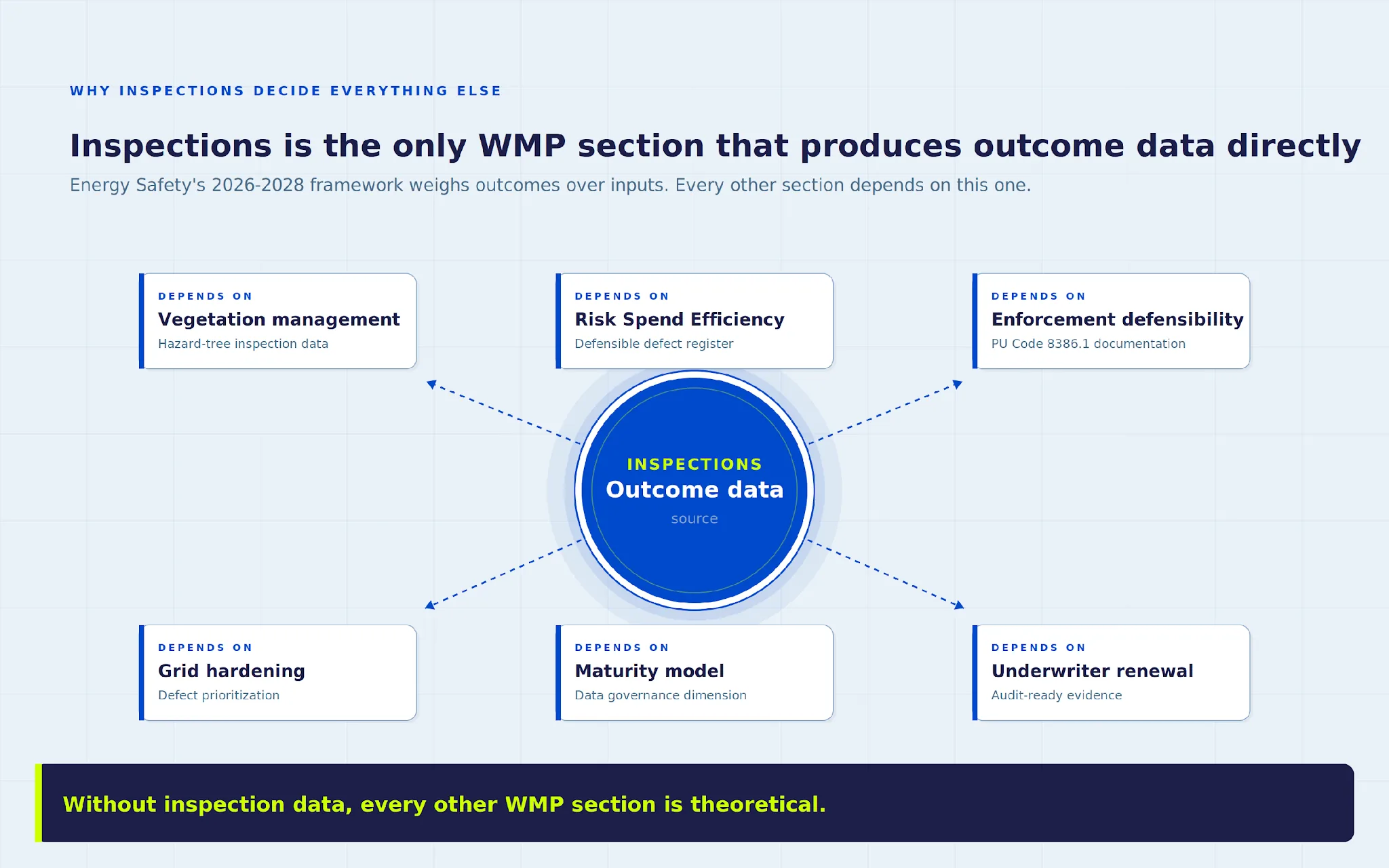
Energy Safety's 2026-2028 framework explicitly weighs outcomes over inputs. Miles patrolled is an input. Risk reduced is an outcome. Utilities that cannot connect their inspections to specific defects identified, specific structures hardened, and specific risk reduction achieved will have a harder time defending substantial compliance than utilities that can.
A WMP that does not name a data quality standard for the underlying inspection program is filing one of the most important sections of its plan with a footnote where the load-bearing section ought to be.
This is where the WMP filings most often fall short. Most plans address how often inspections happen and how they are sampled, but few define what makes the inspection data itself trustworthy enough to act on. That is the question that will increasingly decide which inspection programs withstand audit and which do not.
What most WMP filings miss is the five data quality failures costing utility inspection programs the most money and the most audit credibility. They are photo-to-structure association, orientation tracking, image quality assurance, documentation alignment to utility standards, and defect taxonomy alignment. Roughly 48 percent of infrastructure rework traces to bad data, and the same failure modes that drive rework also undermine WMP audit defensibility.
The fix lives at the crew level. Drone pilot training built specifically for utility inspection work - automated flight planning, 3D shot sheets, integrated QA - is the operating answer to most of the five failures. So is basic structural literacy: recognizing lattice, monopole, H-frame, and dead-end transmission structures in the field is what separates utility-grade data from rejected imagery in the first place.
Two operational filings make the workflow concrete. The standard capture-to-compliance pipeline is documented in a general-purpose transmission line inspection workflow. The sharper edge of the same workflow shows up in a 9-day HVDC transmission inspection. A single loose clevis bolt in a suspension assembly - missed by traditional QA - was identified before winter conditions hit, preventing a $1M+ outage.
The workforce dimension sharpens the case further. Most inspection programs hit their bottleneck not in the field but in the manual review weeks that follow. That is the entire argument for inspecting 10X more utility assets without hiring 10X more crew. Same crew. Same equipment. The bottleneck moves from people to platform.
How is a Wildfire Mitigation Plan reviewed, approved, and enforced?
The review process is two-stage in California and similar in most other states. The Office of Energy Infrastructure Safety reviews the plan and issues a decision. The California Public Utilities Commission ratifies and holds enforcement authority. Other states use single-agency review (Oregon PUC, Washington UTC, Colorado PUC, Idaho PUC). The underlying logic is the same: a state regulator certifies that the plan meets the framework requirements before the utility can recover costs.
Annual Reports on Compliance
Utilities file Annual Reports on Compliance (ARCs) each year, documenting progress against each WMP initiative by its tracking ID. Energy Safety's Performance Assessment Division reviews the reports and can refer non-compliance to the Safety Enforcement Division for penalty action.
The penalty framework
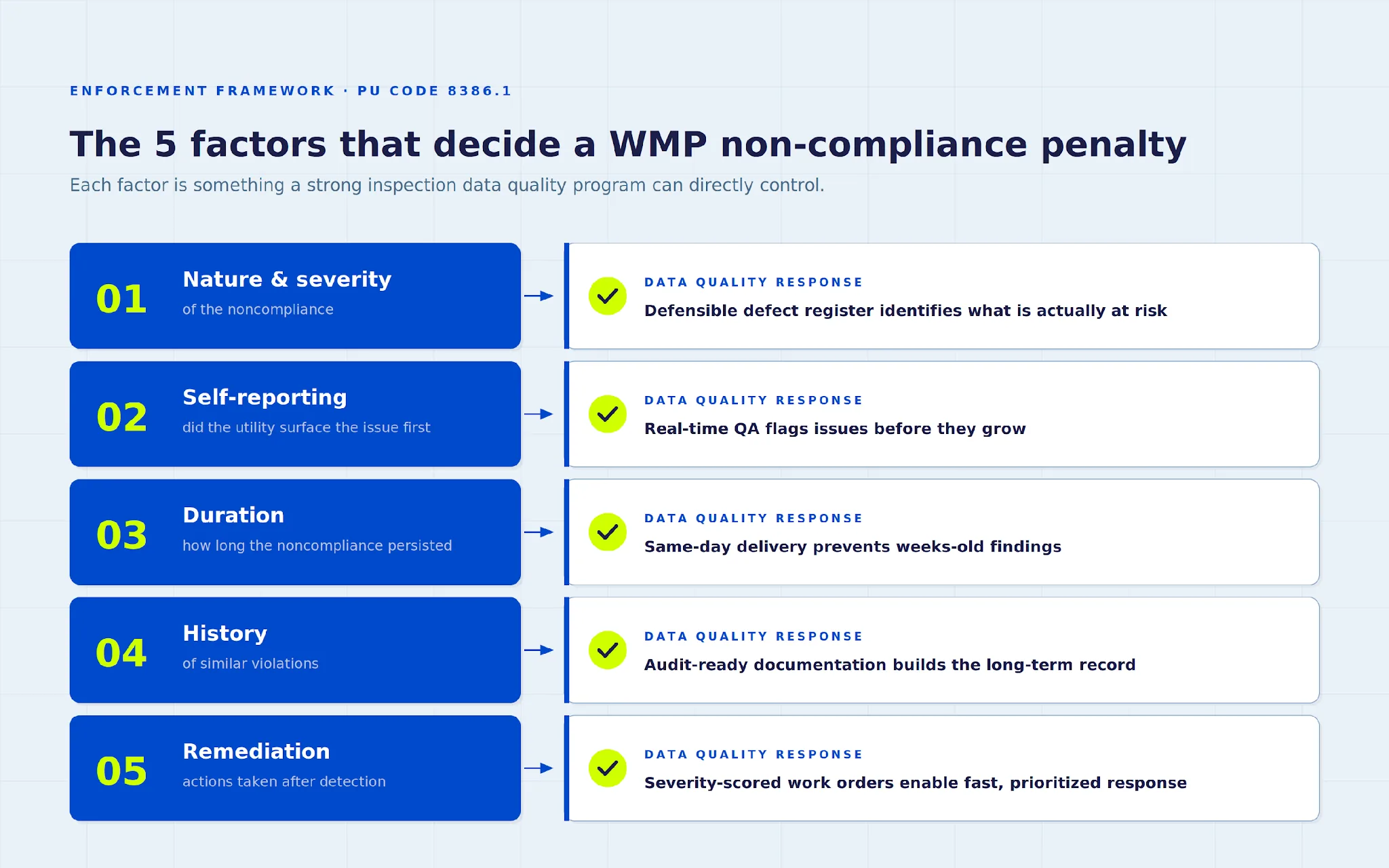
Public Utilities Code 8386.1 governs penalty assessment. The factors are explicit: nature and severity of noncompliance, whether the utility self-reported, duration of noncompliance, the utility's history of similar violations, and the utility's actions to remediate.
A 2020 enforcement action under PU Code 8386.3 illustrated how the framework actually operates. A multi-state IOU's California plan committed to 38 line-miles of covered conductor installation; by the end of the compliance year, 1.4 line-miles were installed. The Safety Enforcement Division's investigation also found that the utility did not demonstrate it required ANSI A300 Part 9 hazard tree assessments for distribution and transmission circuits. The fieldwork may have happened. The documentation that proved it met the standard did not.
The pattern that emerged from that case is the pattern that continues to define WMP enforcement today. The factors that increase a penalty are the factors a strong inspection data quality program can control. Self-reporting requires knowing a problem exists. Remediation requires identifying which structures need fixing. Documentation is what allows a utility to demonstrate substantial compliance to the regulator in the first place.
The Idaho exception
Idaho's Wildfire Standard of Care Act is the most distinctive compliance feature in the multi-state framework. An approved WMP creates a rebuttable presumption of non-negligence in wildfire litigation. The presumption is rebuttable: a plaintiff in post-fire litigation can still argue the utility did not reasonably implement the plan. Inspection records are the evidence that decides which way the presumption falls.
Publicly-owned utilities and independent evaluators
Under PU Code 8387, publicly-owned utilities in California must contract a qualified independent evaluator. The evaluator reviews the utility's plan and its implementation. This is the audit function that increasingly defines what "defensible" looks like. The evaluator's review focuses on whether the inspection cadence, documentation, and defect tracking substantiate the utility's WMP commitments.
How does a wildfire mitigation plan translate to ratepayer recovery and Risk Spend Efficiency?
The economics of a WMP run through Risk Spend Efficiency, or RSE. The chain: utility files WMP, regulator approves, utility implements, utility seeks rate recovery, the CPUC reviews prudence, costs flow to ratepayers. The variable in the chain is RSE - the metric utilities use to defend prioritization.
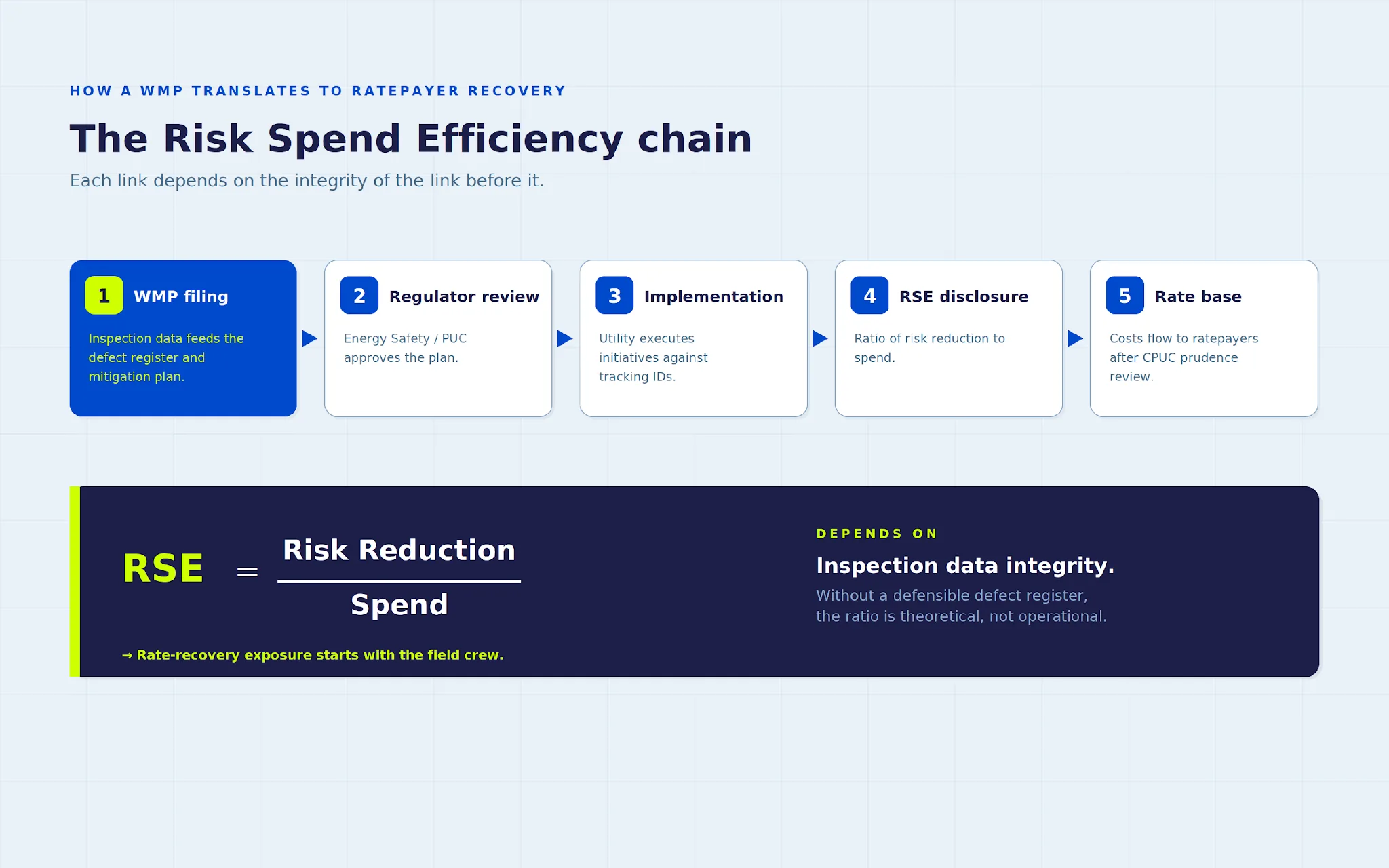
RSE is the ratio of wildfire risk reduction to investment cost. A utility uses RSE to argue which mitigations should be funded first. A high RSE means a lot of risk reduction for the dollar. A low RSE means the opposite. Regulators increasingly require RSE disclosures alongside cost recovery requests.
The integrity of RSE numbers depends on the underlying inspection data. Without a defensible defect register, RSE calculations are estimates. Without consistent severity scoring across the asset base, comparisons between mitigation options become apples-to-oranges. Without alignment between the utility's defect taxonomy and the WMP's risk model, the ratio is theoretical rather than operational.
This is why inspection data quality has become a rate-recovery exposure, not just an operations metric.
Who else uses the same Wildfire Mitigation Plan data?
The audience for a WMP filing is the regulator. The audience for the same inspection data is also the underwriter, the credit rating agency, and the utility's own board. One inspection program produces evidence for all four.
SMUD's risk team has publicly described presenting wildfire mitigation evidence to its insurance underwriters at every annual renewal. The presentation includes system inspections, vegetation management, and asset hardening. Moody's revised SMUD's credit outlook to stable, citing the utility's "comprehensive actions to shield itself from wildfire risk" specifically.
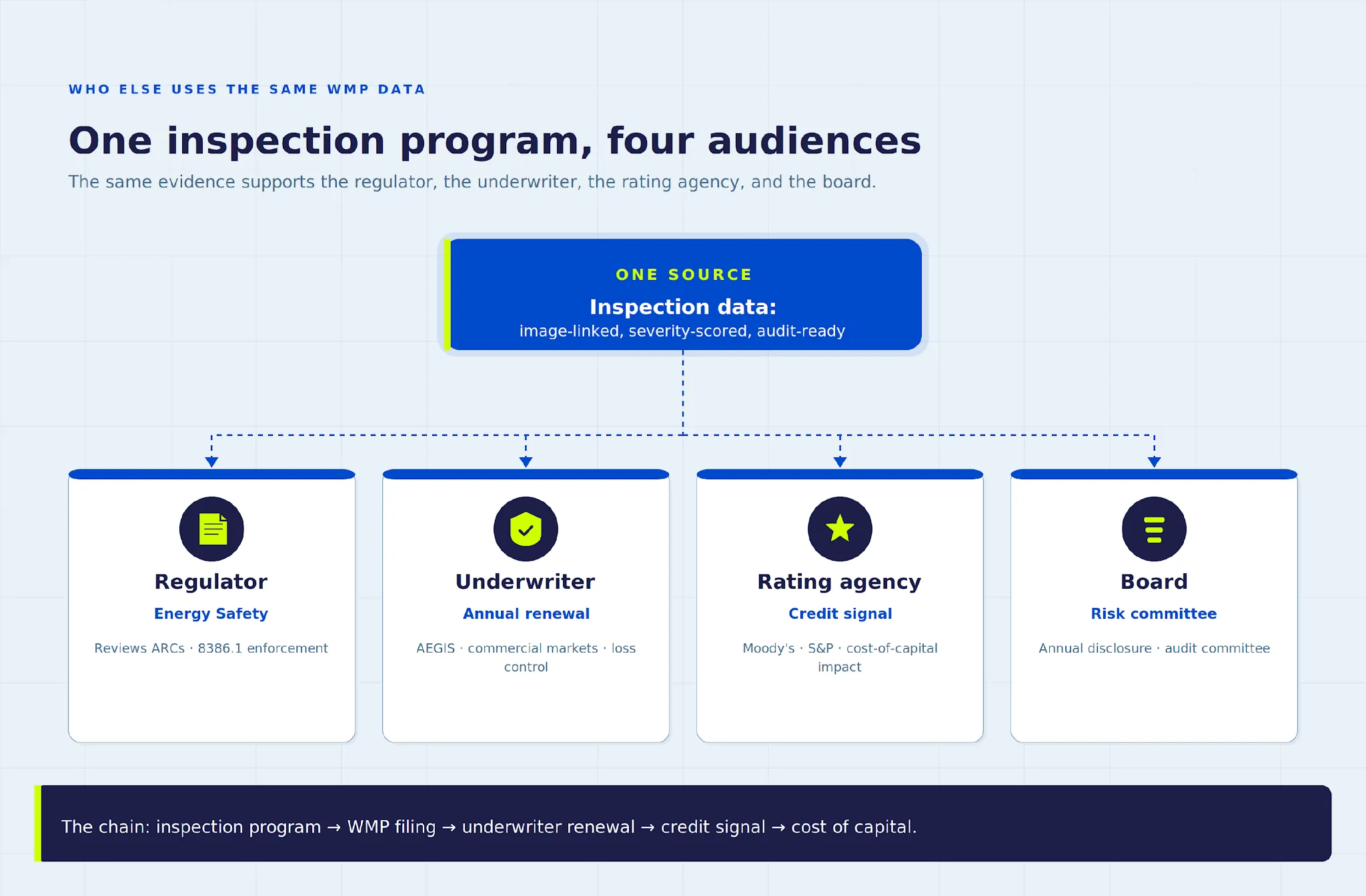
The chain runs in one direction. The inspection program produces evidence. The evidence supports the WMP filing. The same evidence supports the underwriter renewal. The underwriter's terms shape the credit signal. The credit signal affects the utility's cost of capital. The cost of capital determines what the utility can invest in the next round of grid hardening.
California IOUs carry approximately $1 billion each in commercial wildfire insurance coverage. The premium dynamics are passed to ratepayers after CPUC review of prudence. The inspection program is one of the documented mitigations underwriters score when setting terms.
AEGIS is the mutual insurer that covers virtually every major North American electric utility. Its Loss Control function exists to "help member companies mitigate costly exposures and improve the quality of information that supports the underwriting process." Their electric risk assessments specifically include system inspections. The phrase "quality of information" is the same phrase that should appear in the QA and QC section of every WMP filing. In most cases, it does not yet.
What is the Wildfire Mitigation Plan Maturity Model?
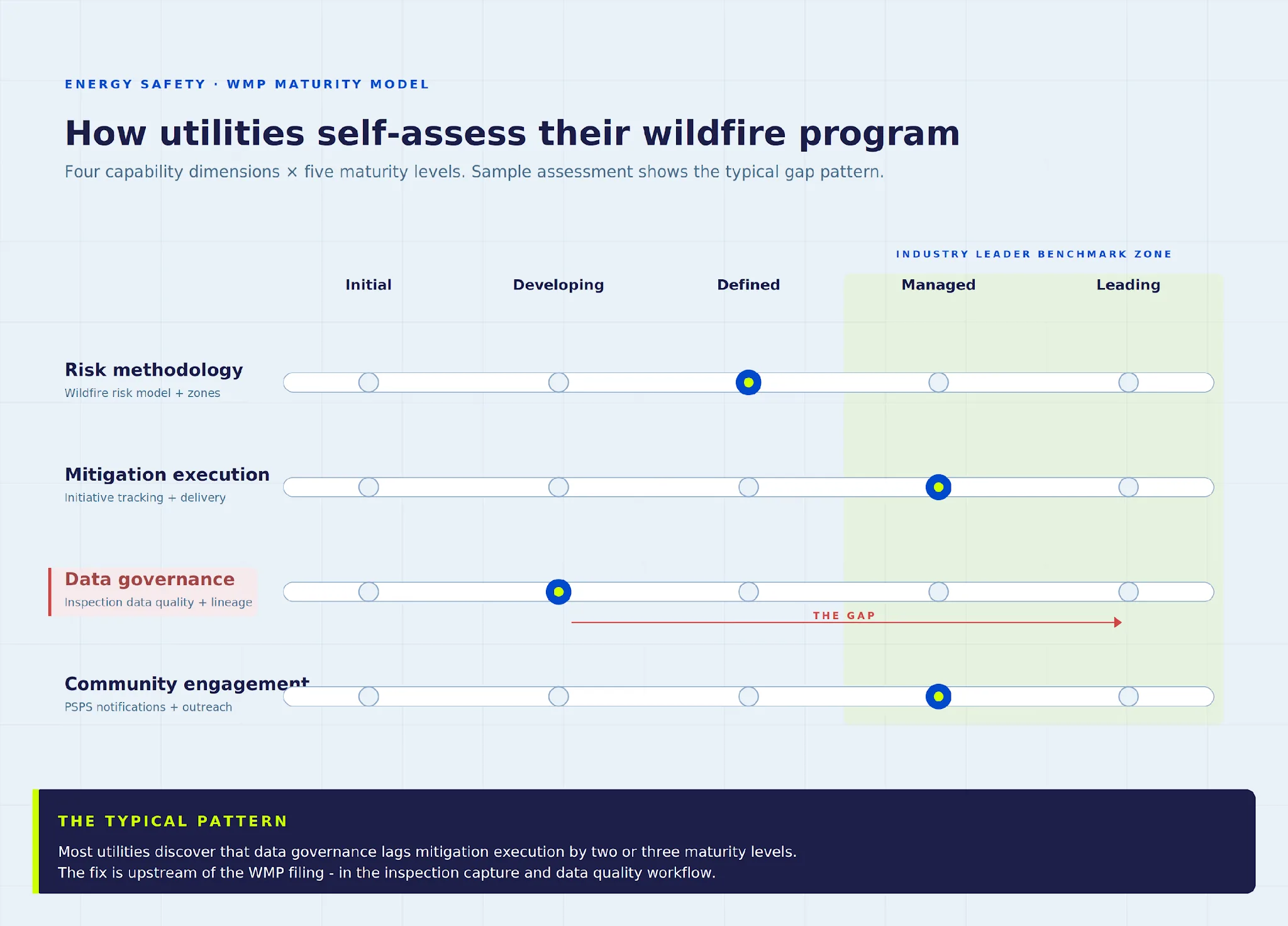
Energy Safety publishes a Maturity Model and Survey Guidelines as part of the 2026-2028 framework. Utilities self-assess across four capability dimensions - risk methodology, mitigation execution, data governance, and community engagement - on a five-level scale running Initial, Developing, Defined, Managed, Leading.
The model matters because it is increasingly the language Energy Safety uses to compare utilities and identify weak areas in plans. A utility that places itself at "developing" on data governance signals one thing to the regulator. A utility that places itself at "leading" signals something different - and has to defend the rating. Independent evaluators read the same scores in publicly-owned utility filings.
Self-assessment is straightforward in principle and harder in practice. The maturity dimensions overlap with the eight WMP sections covered above. The model adds questions about process maturity, data lineage, organizational ownership, and continuous improvement that the WMP itself does not always require. The pattern across most filings: data governance lags mitigation execution by two or three maturity levels. A utility may execute well in the field but document poorly in the file. The maturity model surfaces that gap explicitly.
The fix is upstream of the WMP itself - in the inspection capture and data quality workflow that produces the underlying evidence. Closing the gap is rarely a matter of more inspections. It is a matter of a more defensible record of the inspections already being done.
Where to start with your 2027 WMP update
It is May 2026. The 2026-2028 base plans are filed. Annual WMP updates for 2027 begin in late summer. Fire season is active. If you manage a utility's wildfire program, run an inspection contractor, or operate a drone service provider, the work between now and the filing window shapes the next plan.
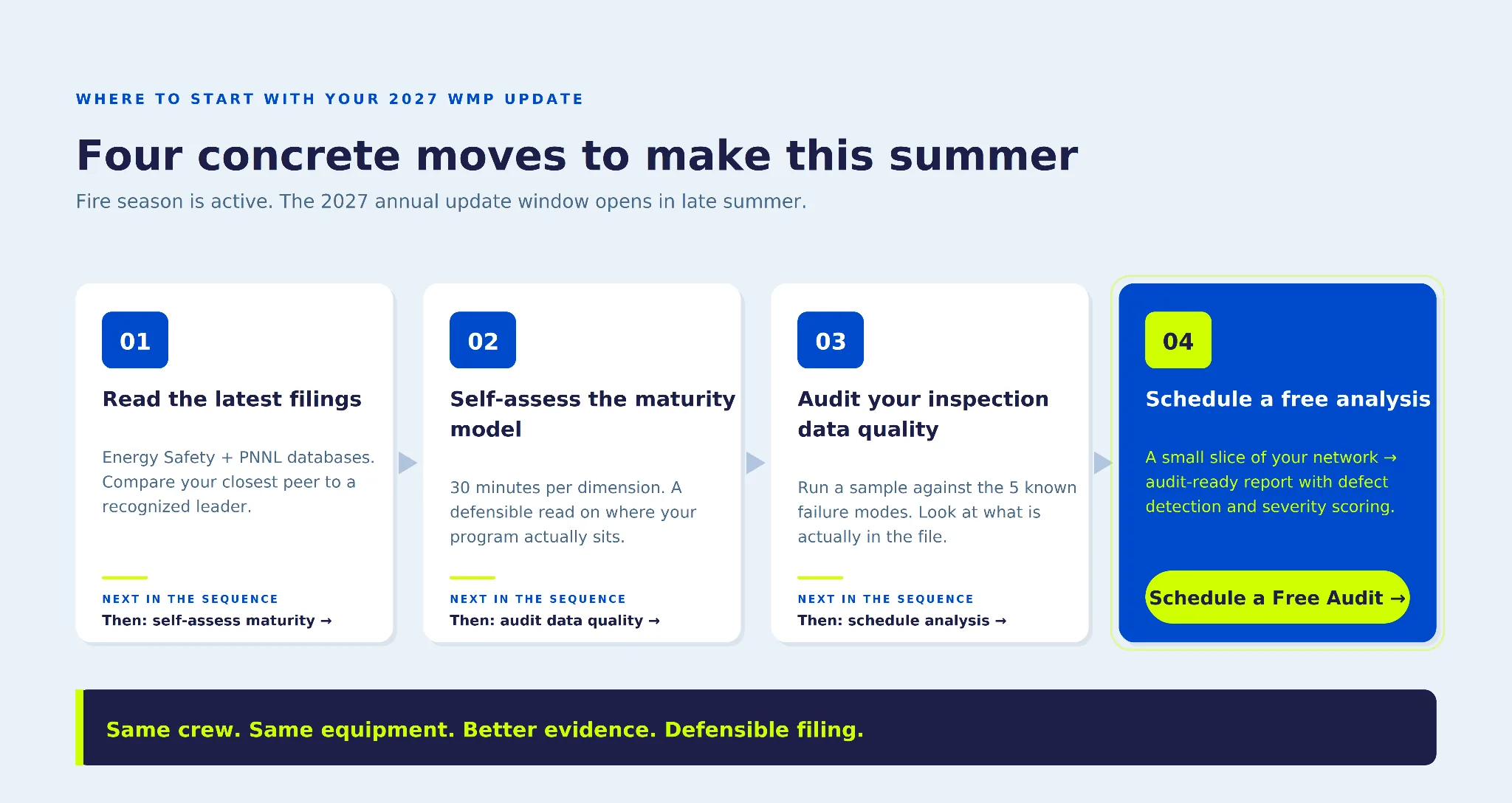
Four concrete moves are worth making this summer.
- Read the latest filings in your jurisdiction. Energy Safety's portal lists every active California filing. PNNL's database covers the full multi-state landscape. Read the plan most similar to your utility's profile and the plan from the utility most often cited as a leader. Compare the two.
- Self-assess against the maturity model. The model is public. The questions take 30 minutes per dimension. The output is a defensible read on where the inspection program, the data governance section, and the documentation pipeline currently sit.
- Audit your inspection data quality before audit season. The five data quality failure modes - photo-to-structure association, orientation tracking, image quality assurance, documentation alignment, defect taxonomy alignment - are the most common audit weaknesses. Run a sample. Look at what is actually in the file.
- Schedule an analysis of a representative section of your system. Pick a small slice of your network and run an audit on it. The output is an audit-ready report covering defect detection, severity scoring, and risk prioritization on the sample. It is the fastest way to see what a WMP-grade inspection workflow actually produces in practice, against your own assets.
LEARN MORE ABOUT DETECT'S WILDFIRE MITIGATION SERVICES
The Detect Data Quality Program is the inspection workflow built for the WMP era. It produces image-linked, severity-scored, audit-ready data the regulator, the underwriter, and the engineering team can all use. The workflow is the operating answer to Energy Safety's outcome-based metrics framework, and the same data that supports your WMP filing supports your annual underwriter renewal.
See how DetectOS turns visual data into predictive intelligence at the asset level, or read how DetectOS works for the three-step capture-to-decision pipeline.
Frequently Asked Questions
What is a Wildfire Mitigation Plan?
A Wildfire Mitigation Plan, or WMP, is a written program an electric utility files with its state regulator. It describes how the utility constructs, maintains, and operates lines and equipment to reduce wildfire risk. WMPs are required by law in nine states as of 2026, with California serving as the most developed framework under SB 901 and AB 1054.
What is in a Wildfire Mitigation Plan?
A WMP typically includes eight sections: overview and risk methodology, mitigation strategy development, specific mitigation initiatives, inspections, vegetation management, grid design and operations, data governance, and community engagement. Most filings now list seven recognized inspection types, including drone inspections as a distinct workflow.
Who is required to file a Wildfire Mitigation Plan?
In California, investor-owned utilities file under Public Utilities Code 8386 and publicly-owned utilities file under PU Code 8387. Idaho, Oregon, Washington, Colorado, Nevada, Utah, and other states have similar requirements. Some cooperatives also file voluntarily. The federal government does not mandate WMPs but coordinates national best practices through PNNL.
How often must a Wildfire Mitigation Plan be updated?
California requires three-year base plans with annual WMP updates. The current cycle covers 2026 through 2028, with annual updates due each year. Oregon and Washington require annual filings. Idaho, Utah, and Montana use three-year cycles aligned with their PUCs. Federal involvement is advisory rather than regulatory.
What is the penalty for non-compliance with a Wildfire Mitigation Plan?
California Public Utilities Code 8386.1 governs penalty assessment, weighing the nature and severity of noncompliance, whether the utility self-reported, the duration of noncompliance, the utility's history, and remediation actions. A 2020 enforcement case involving a multi-state IOU established the public precedent for how the framework operates in practice.
Can drone inspection data satisfy WMP requirements?
A: Yes. Drone inspections are explicitly listed as a recognized inspection category in major utility WMPs for the 2026-2028 cycle. The data must meet documentation standards including reliable photo-to-structure association, orientation tracking, image quality assurance, and alignment to the utility's defect taxonomy. The inspection vendor's QA workflow should be documented in the filing.
How do utilities prove WMP compliance?
Utilities file Annual Reports on Compliance (ARCs) with their state regulator. The reports document progress against each WMP initiative by its tracking ID. In California, Energy Safety's Performance Assessment Division reviews the reports and can refer noncompliance to the CPUC's Safety Enforcement Division for penalty action under PU Code 8386.1.
What is Risk Spend Efficiency (RSE)?
Risk Spend Efficiency is the ratio of wildfire risk reduction to investment cost. Utilities use RSE to prioritize among wildfire mitigation strategies like vegetation management, covered conductor, system hardening, and undergrounding. RSE calculations depend on defensible defect identification and risk scoring, which is why inspection data quality has become a regulatory and rate-recovery exposure.
Who oversees Wildfire Mitigation Plans in California?
The Office of Energy Infrastructure Safety reviews and approves WMPs under Public Utilities Code 8386.3. The California Public Utilities Commission ratifies Energy Safety's decisions and holds enforcement authority. Cal Fire and the State Fire Marshal are involved in adjacent regulatory frameworks including defensible space and building standards.
How much do utilities spend on wildfire mitigation?
U.S. utilities collectively spend $6 to $8 billion annually on vegetation management alone. Strategic undergrounding costs approximately $2.66 million per mile, compared to $1.21 million per mile for covered conductor and $1.05 million per mile for traditional system hardening. The total industry investment gap is estimated at $100 billion.
What are common wildfire mitigation strategies for electric utilities?
Four wildfire mitigation strategies dominate utility filings: vegetation management (the largest annual category at $6-8B), traditional system hardening (~$1.05M/mile), covered conductor installation (~$1.21M/mile), and strategic undergrounding (~$2.66M/mile). Most WMPs use a mix prioritized by Risk Spend Efficiency, and almost all rely on drone and detailed inspections to direct the prioritization.
