
What is Utility Asset Management? 2026 Best Practices and Trends
Updated October 2026
Roughly 70% of the transmission structures carrying power across North America have outlived the design life they were built to. Demand is climbing, the workforce is shrinking, and the room for reactive repair is closing. Managing that gap - deciding what to maintain, upgrade, or replace, and when - is the job of modern utility asset management.
When a single component failure can cascade into outages affecting thousands of customers, the difference between proactive control and a costly emergency comes down to how well a utility knows the real condition of its assets. This guide covers the complete approach: how to build accurate asset information, manage each asset across its life, choose the right tools, and apply the trends reshaping the field in 2026.
On this page
- What is utility asset management?
- Why is accurate, complete asset information essential for utilities?
- What makes up a complete and reliable asset register?
- How can utilities maintain asset register accuracy over time?
- What does effective asset lifecycle management look like?
- How should utilities prioritize maintenance and measure performance?
- What organizational conditions enable successful asset management?
- Which tools and technologies power modern utility asset management?
- How does utility asset management software integrate with GIS and EAM systems?
- How should utilities evaluate utility asset management software?
- What is the best utility asset management software?
- How do electric utilities manage assets in challenging environments?
- What new trends and innovations are shaping asset management?
- How is utility asset management evolving to meet the industry’s biggest challenges?
- Frequently asked questions
- Ready to discover what your current inspections are missing?
What is utility asset management?
Utility asset management is how a utility tracks its physical infrastructure and decides what to do with it - which assets to maintain, upgrade, or replace, and when. It runs across electric, gas, water, and telecom, and it ties every one of those calls back to three things: cost, risk, and reliability.
The scope is wide. Each kind of utility manages a different set of assets:
- Electric utilities manage generation, transmission lines, distribution networks, substations, and grid control systems.
- Water utilities oversee treatment plants, distribution pipelines, pumping stations, and storage.
- Gas utilities maintain pipeline networks, compressor stations, and distribution systems.
- Telecommunications providers manage fiber networks, cell towers, and switching equipment.
At Detect, we work only on the electric grid. But the goal is the same everywhere: make sure what you spend today buys the system you’ll need in ten years - not just a fix for the next maintenance ticket.
You’ll also see this called energy asset management or asset management in the energy sector. Same discipline - managing the physical assets that generate, move, and deliver energy. Everything below applies across all of it; the examples focus on electric transmission, distribution, and substations.
The core principles behind utility asset management
Five principles hold no matter what you manage:
- A complete asset inventory is the cornerstone. Document every component’s specifications, location, condition, and operational history so decisions are based on what you actually have, not what you assume.
- Lifecycle planning takes the long view, weighing total cost of ownership from acquisition through disposal. Done well, it extends useful life and avoids premature replacements that waste capital.
- Risk-based maintenance prioritizes by asset criticality and failure probability instead of uniform scheduling. Not every structure carries the same consequence of failure - resources should follow the risk.
- Data-driven decision-making replaces subjective judgment with evidence: historical performance, predictive analytics, and condition data from the field.
- Performance monitoring tracks KPIs for asset health, maintenance effectiveness, and efficiency, so you can see whether the strategy is working and adjust.
Why is accurate, complete asset information essential for utilities?
Because in a utility, a decision made on bad data doesn’t just waste money - it can drop power to a hospital. Accurate asset information is what lets you put the right crew on the right structure before it fails, instead of after. Three things make it non-negotiable.
The stakes are high, and the grid is old. Roughly 70% of North American transmission structures have passed their design life, and more than 40 million U.S. distribution transformers are past theirs. The American Society of Civil Engineers graded U.S. energy infrastructure a D+ in 2025. Utilities are spending to catch up - about $1.1 trillion over five years (Edison Electric Institute) - but that capital is wasted if it follows age on a spreadsheet instead of real condition.
Reliability is non-negotiable, and failure is expensive. Hospitals, data centers, and homes assume the power stays on. When it doesn’t, the bill is staggering: major U.S. outages cost customers an estimated $121 billion in 2024. Good asset management is what keeps the lights on before the failure, not after.
Regulators want proof. You have to defend rate cases and capital plans with evidence. A real asset program produces both - the documentation regulators expect and the savings customers feel.
The operational challenges reshaping utility asset management
Four pressures are forcing the change at once:
- Contactless monitoring. Remote infrastructure, hazardous environments, and safety protocols limit hands-on inspection. Drone inspection, satellite imagery, and IoT sensors capture asset condition without putting crews in harm’s way - often with more complete coverage than foot patrols can achieve safely.
- Rising customer expectations. Customers now expect real-time information and fast response, so asset systems and customer-facing platforms have to share the same accurate data.
- Sustainability and ESG pressure. Carbon targets, renewable integration, and distributed energy resources add complexity that asset programs must absorb without sacrificing reliability.
- The utility workforce shortage. Nearly half of today’s experienced line workers are expected to retire within the decade, and for every five who leave, only two enter the trade - a gap projected to reach hundreds of thousands of workers by 2040. Capturing asset intelligence in systems rather than in people’s heads is the response, letting a smaller crew inspect far more assets without lowering quality.
What makes up a complete and reliable asset register?
An asset register is your single source of truth - a live record of every structure and component, covering what it is, where it is, how old it is, and what condition it’s in. Get it right and every later decision has something solid to stand on. Building one comes down to five practices:
- Develop a complete, accurate register. Catalog every component - technical specs, installation dates, manufacturer, and operational parameters. This baseline anchors all later activity.
- Keep it current. A register decays the moment the system changes. Automated data capture keeps it accurate by recording additions and retirements as they happen, instead of relying on periodic manual updates that miss interim changes.
- Run regular condition assessments. Routine field inspections catch developing issues before they turn critical and feed the performance data that predictive programs depend on.
- Control data quality. Validation processes should flag inconsistencies, missing fields, and outdated records before they corrupt a decision.
- Automate the obvious checks, keep humans on the hard ones. Rules can catch impossible dates or contradictory specs. Engineering judgment is still required for the gray areas.
Best practices for utility asset data collection
A register is only as good as the data flowing into it. These practices keep that data trustworthy:
- Standardize collection across departments. Common naming conventions, formats, and procedures eliminate the gaps and inconsistencies that quietly undermine decisions.
- Prioritize by asset criticality, not the calendar. Direct attention to the components where failure carries the greatest consequence.
- Run risk-based scenario analysis. Model the failure modes behind grid outages and their operational impact so you can plan contingencies on real risk, not guesswork.
- Use condition-based maintenance. Trigger work on actual condition rather than fixed schedules that fire too early or too late.
- Track the right KPIs. Measure both leading indicators (maintenance compliance) and lagging ones (outage frequency) for a full picture of performance.
Here’s the catch most programs miss: the data is usually the problem, not the drone. Across utility inspection programs, 15 to 25% of delivered imagery needs rework before it can be used. Most of that traces to workflow gaps - inconsistent capture, missing component coverage, metadata mismatches - not pilot skill.
Standardize the capture and move quality checks into the field - the focus of Detect’s Data Quality Program - and that figure drops to 3 to 7%. Clean data in, a register you can trust out.
How can utilities maintain asset register accuracy over time?
The hardest part of an asset register isn’t building it - it’s keeping it true. Systems change constantly: storms damage structures, crews swap components, new construction comes online. A register that is 90% accurate is one bad assumption away from a wrong decision, and most registers drift further from reality every quarter they aren’t refreshed.
The fix is to close the loop between the field and the record. When inspection findings flow straight into the register and the work-order system, the gap between what’s true in the field and what’s written down disappears.
The enemy is lag. On many programs, three to six months pass between capturing a problem and acting on it - long enough for the condition to change before anyone moves. Compressing that lag is half the value of modern inspection.
A drone campaign can document thousands of structures in days, but it only pays off if the data lands in your system of record automatically - and if it’s captured right the first time. Knowing which structure type you’re flying is the difference between usable data and rejected data.
The grid is the world’s largest machine, and its health comes down to millions of small components. Keeping the register honest means looking at them far more often than foot patrols ever allowed.
What does effective asset lifecycle management look like?
Lifecycle management means treating every asset as something you manage from the day it’s planned to the day it’s retired - not just something you fix when it breaks. Done well, it stretches useful life and times the spend, so you replace on condition and risk instead of guesswork. Five stages:
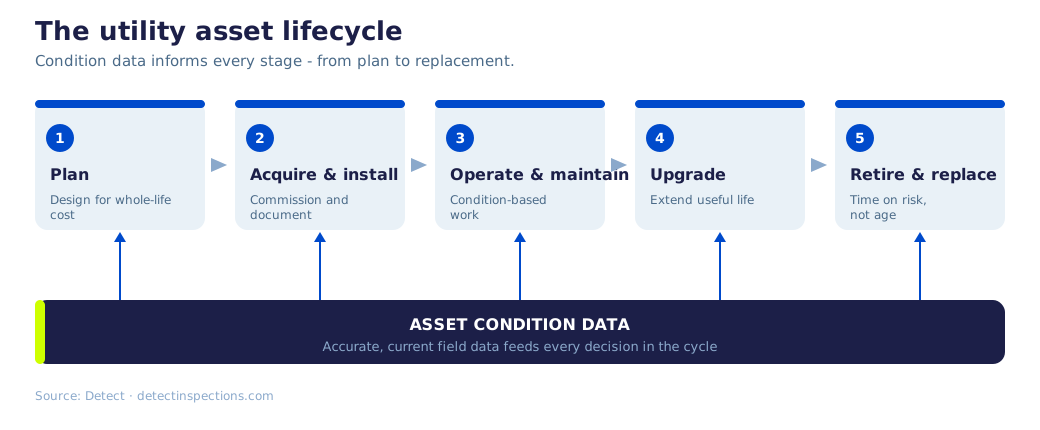
- Acquisition and installation. Plan for long-term operating requirements, compatibility, and lifecycle cost from the start. Sound planning prevents the expensive modifications and early replacements that flow from a rushed analysis.
- Installation quality. Proper procedures, quality control, and commissioning tests set the foundation for decades of reliable operation - and the documentation becomes essential for future troubleshooting.
- Proactive maintenance and upgrades. Condition data and performance trends let you time maintenance precisely, stopping small issues from becoming major failures without wasting effort on work that isn’t needed yet.
- Upgrade planning. Weigh technological advances, changing requirements, and lifecycle economics so each upgrade earns its return.
- Decommissioning and replacement. Time replacements on condition and risk, not age alone. Early replacement wastes capital value; late replacement risks reliability and drives up maintenance costs.
Two things make condition data central to all of this in 2026.
You can’t wait for a transformer. Power transformer lead times now average around 128 weeks - more than two years. Age-based replacement assumptions break down when the replacement takes that long to arrive. You have to order on real condition, early.
New isn’t the same as safe. On a newly commissioned HVDC line - 250 miles, roughly 2,600 lattice towers - a 30-day drone campaign by a three-person team flagged 1,270 conditions and caught one critical anomaly. That single find averted a forced outage and protected more than $1 million in revenue, on infrastructure everyone assumed was risk-free. Lifecycle management starts the day an asset is energized, not years later.
How should utilities prioritize maintenance and measure performance?
No utility can give every asset equal attention, so the real discipline is matching effort to risk: rank assets by how likely they are to fail and how much damage a failure would cause, assign each the maintenance strategy that fits, then track a handful of metrics that show whether the program is actually reducing outages and cost.
Prioritizing maintenance by risk
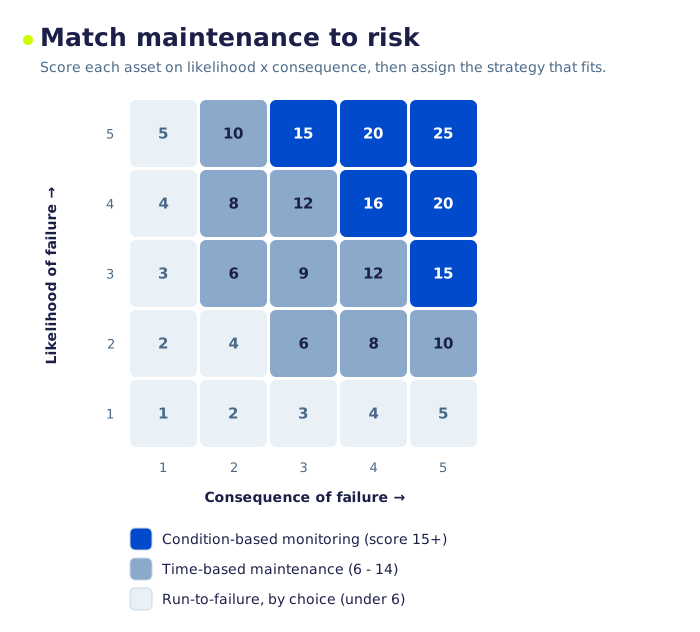
The shift underway is from inspecting everything on the same calendar toward risk-based maintenance - the core idea behind reliability-centered maintenance (RCM). Score each asset on two axes, the likelihood of failure and the consequence if it fails, and let that score decide the strategy:
| Asset profile | Maintenance strategy | What it means |
|---|---|---|
| High consequence, with a detectable warning sign | Condition-based monitoring | Trigger work on measured condition - for example, a rising dissolved-gas trend in a transformer |
| Predictable, age- or cycle-related wear | Time-based maintenance | Service on a fixed schedule |
| Low consequence, cheap and fast to replace | Run-to-failure, by choice | Let it fail, document the decision, and move the budget to assets that can actually take you down |
A fourth option - redesigning the failure out entirely - applies when no inspection interval is short enough to catch the problem in time.
That last point is the whole game. Every failure has a window between the first detectable sign and the actual break, and you have to inspect more than once inside it to catch it. When the window is shorter than your inspection cycle, the asset needs a sensor or a redesign - not another calendar entry. Our guide to power grid failure causes walks through the full method, including a criticality-scoring rubric you can adapt.
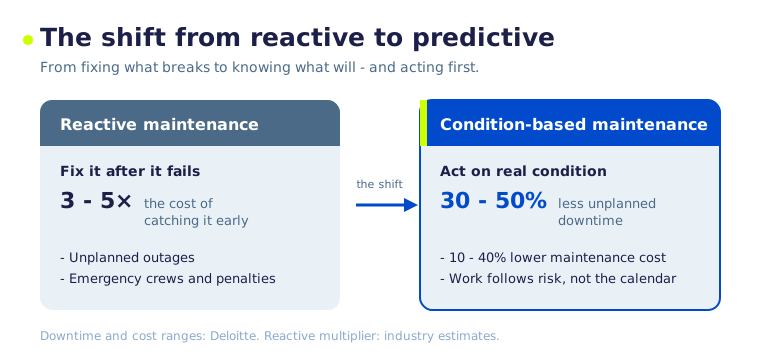
The business case is well documented: condition-based programs typically cut unplanned downtime by 30 to 50% and maintenance costs by 10 to 40%, while reactive repairs run three to five times the cost of catching the same problem early.
The metrics that show it’s working
A program is only as strong as what it can prove. The measures that matter most:
- SAIDI and SAIFI - the duration and frequency of customer outages, the headline reliability indices regulators watch.
- Planned-to-emergency work ratio - the share of maintenance that is scheduled rather than reactive, and the share of assets on condition-based versus calendar schedules.
- Asset register accuracy - how closely the system of record matches what is actually in the field.
- Inspection rework rate - the percentage of inspection data that must be recaptured before it is usable, a leading indicator of data quality.
- Mean time between failures - tracked by asset class, to confirm that condition gains are real and not just deferred.
What is asset performance management (APM)?
Asset performance management (APM) is the practice of using condition and performance data to predict how assets will behave - and to decide which interventions are worth making. Where EAM tracks what you own and what work is scheduled, APM asks whether each asset is healthy and what it will cost to keep it that way. The two work together: APM analytics set the priorities, and the EAM turns them into work orders. The metrics above - failure rates, condition scores, risk rankings - are the raw material APM runs on.
What organizational conditions enable successful asset management?
Technology isn’t enough on its own. Three organizational conditions decide whether a program sticks:
- Leadership buy-in provides the support and resources a real program requires. Without it, asset management fragments into disconnected efforts that never deliver.
- Staff training equips people with both the technical skills and the process knowledge to execute - increasingly important as experienced workers retire.
- Centralized data systems eliminate the silos that hide critical information, giving everyone access to current, accurate asset data.
Which tools and technologies power modern utility asset management?
Modern utility asset management runs on an interlocking stack: GIS to map assets, digital twins and IoT sensors to model and monitor them, EAM and CMMS platforms to plan and track the work, and AI-powered visual inspection to keep the underlying condition data accurate. Each layer is covered below, along with where it connects to the others.
Geographic Information Systems (GIS)
GIS turns the asset register into a map. For utilities it drives the daily work tabular data can’t: routing crews to the right structure, modeling vegetation encroachment near conductors, and speeding outage restoration by showing which assets sit downstream of a fault. The spatial view also surfaces risk patterns - clusters of aging structures, corridors in high fire-threat districts - that a spreadsheet hides.
Digital twins and 3D modeling
A digital twin pairs a detailed 3D model of a structure with its live operational data, so engineers can assess a tower’s condition or test a design change without a truck roll. For new construction, the twin becomes the baseline that every future inspection is measured against.
Asset inventory and mapping
GPS tagging and RFID tie each physical asset to its record, so a crew in the field can scan a tag and pull up specs, install date, and maintenance history on the spot. The payoff is fewer mis-identified structures and far less time reconciling what’s in the field against what’s in the system.
Work order management and scheduling
Work management software routes crews by location, skill, and travel time, and puts the right asset data and instructions on a phone in the field. Replacing paper work orders cuts the administrative drag that quietly eats field hours.
Predictive maintenance and network modeling
IoT sensors track temperature, vibration, and electrical load continuously, flagging developing faults before they trip. Network models then simulate failure scenarios to pinpoint which assets would do the most damage if they failed - so limited maintenance dollars follow real operational risk instead of a fixed calendar. This is the shift from time-based to condition-based work that defines a modern program. That operating model - condition data feeding risk-ranked work - is the foundation of predictive grid intelligence programs.
AI-powered visual inspection
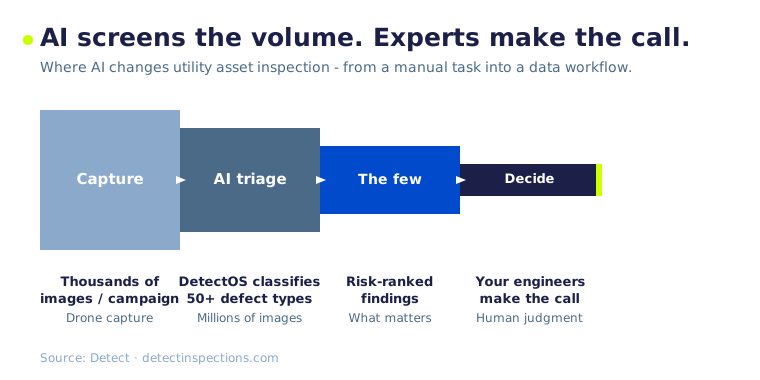
A drone can photograph more of the grid in a day than a crew can review in a month. That’s the real shift: utility inspection has become a data problem, not a flying problem - and that’s where AI earns its place.
DetectOS assesses structures against a 258-type, 19-class defect catalog, trained on millions of real inspection images, and surfaces the findings that matter. In one Detect program, a three-person crew covered 96 structures with 100% capture in a single field day - no climbs, no bucket trucks. The principle holds: AI screens the volume, your experts make the call. Here’s how the workflow runs, capture to classified report.
When AI inspection stalls, the model is rarely the problem. It’s data quality, workflow, and usability - the real reasons utilities struggle with these platforms.
What is utility asset management software (EAM)?
Utility asset management software - often called enterprise asset management (EAM) - is the system of record for a utility’s physical assets. It unifies the asset register, condition monitoring, maintenance planning, work orders, and performance reporting so information stops living in silos. The other tool you’ll hear about is a CMMS (computerized maintenance management system); the two overlap but aren’t the same:
| Dimension | CMMS | EAM |
|---|---|---|
| Focus | Maintenance execution | Full asset lifecycle |
| Core jobs | Work orders, schedules, parts, labor | Acquisition to disposal, capital planning, risk |
| Question it answers | “What needs fixing, and when?” | “What should we maintain, upgrade, or replace - and when?” |
Most utilities run an EAM platform with CMMS functionality built in rather than choosing between them. Whatever the platform, it is only as accurate as the condition data feeding it - the layer Detect’s utility asset management software works in, turning inspection imagery into structured asset condition data that flows into your existing EAM, GIS, and CMMS.
How does utility asset management software integrate with GIS and EAM systems?
Utility asset management software pays off when it feeds the systems your teams already run - the GIS that holds the asset register and the EAM or CMMS that schedules the work. Without those connections, inspection findings sit in a separate silo and someone re-keys them by hand. That manual step is where condition data goes stale and where errors creep back into the register.
Two integration paths matter more than the rest.
How does inspection data flow into Esri ArcGIS?
For most electric utilities, Esri ArcGIS is the system of record for where assets are and what they are. Inspection platforms keep that record honest by delivering condition data as georeferenced records - each finding tied to a structure ID and a location, so it joins directly to the GIS feature it describes. Done well, every inspection cycle refreshes the register as a by-product of the work. No separate re-survey, no spreadsheet handoffs.
The test is simple: ask whether findings arrive as structured records your GIS team can join to existing layers, or as PDFs someone has to transcribe.
How does it connect to IBM Maximo and SAP work management?
The work itself lives in an EAM - IBM Maximo and SAP are the two you will meet most often in electric utilities. The integration that matters is the capture-to-work-order loop: a verified defect, with its severity, structure ID, and photo evidence, arriving in the EAM as a work-order-ready record. When that loop is manual, the time from image capture to scheduled work stretches from days into months - and high-severity findings wait in an inbox. The data agreements that keep the loop automatic - shared asset identity, verified image association, mapped defect codes, attached evidence - are the subject of Detect's guide to integrating AI utility inspections.
DetectOS is built for that loop: findings leave the platform as structured, georeferenced records with severity and evidence attached, ready for the systems that hold your register and dispatch your crews. You can see how a finding moves from image to work queue in practice.
How should utilities evaluate utility asset management software?
Evaluate electric utility asset management software on whether it improves the decisions your team makes - not on feature count. Eight criteria separate platforms built for electric utilities from generic asset systems.
| Criterion | What to look for |
|---|---|
| Utility-native data model | Structures, spans, and circuits out of the box - not a generic asset tree you spend a quarter configuring. |
| Condition-data ingestion | Accepts drone, helicopter, and ground imagery in one system, so one capture program feeds one record. |
| Risk-based prioritization | Findings ranked by severity and consequence - not a flat defect list your engineers must triage themselves. |
| Expert review process | A documented human verification step. Ask to see the workflow that keeps false positives out of your queue. |
| GIS and EAM integration | Findings land in ArcGIS, Maximo, or SAP as structured records - no re-keying. |
| Deployment time | Weeks, not quarters. Ask for the timeline of a real first campaign. |
| Security posture | SOC 2 Type II at minimum, with role-based access control and audit logging. |
| Audit-ready reporting | Regulator-ready documentation generated from the same condition record - not rebuilt by hand for each filing. |
The review criterion is where platforms differ most. Detect’s answer is the Hybrid AI + Expert Review model: AI screens the volume, and utility-trained experts verify every finding before it reaches your queue. That model is the foundation of AI asset inspection for utilities across transmission and distribution.
For the inspection-analysis layer specifically, score shortlisted platforms on identical sample imagery from your own lines - the grid inspection AI scorecard weights verified accuracy, capture-quality control, and EAM integration so the comparison rests on evidence rather than demos.
What is the best utility asset management software?
There is no single best utility asset management software - electric utilities run a stack, not a system. The strongest programs pair an EAM system of record with GIS and a condition-intelligence layer that keeps the asset register current with verified inspection findings.
| Software category | What it owns | Representative systems |
|---|---|---|
| EAM / work management | The asset register, work orders, and maintenance history - the system of record. | IBM Maximo, SAP, Oracle WAM, IFS |
| GIS | Location, connectivity, and network context for every structure and span. | Esri ArcGIS Utility Network |
| CMMS | Lighter-weight maintenance scheduling for smaller fleets and facilities. | General-purpose CMMS tools |
| Inspection intelligence | Turns drone, helicopter, and ground imagery into ranked, verified condition findings that feed the other three. | DetectOS |
The categories are complements, not substitutes. How the inspection layer itself splits into types, and which stages of the condition record each one carries, is the subject of our guide to asset inspection software. An EAM without fresh condition data manages a record of what your grid used to be. An inspection platform without EAM integration produces findings nobody schedules. When you evaluate a vendor, the question is not "which category are you" - it is "which categories do you feed."
How do electric utilities manage assets in challenging environments?
Electric utilities operate in conditions that break standard playbooks: extreme weather, corrosive coastal air, and terrain too remote or hazardous for routine foot patrols. Managing assets here means monitoring environmental stress, capturing condition data remotely, equipping crews for the field, and integrating it all so nothing slips through the gaps. Here is how that breaks down.
Harsh environments
Heat, salt air, and storms age infrastructure faster, so assets in harsh environments need closer watch and condition-based timing - not the same calendar as everything else.
Two government-owned rural lines show what that looks like. They were built from wooden H-frame structures - 96 of them, more than 40 years old. A single-day drone inspection found 55 high-risk conditions: rotten poles, corroded hardware, splitting cross-arms. The imagery was clear enough to finally justify capital funding a decade of patrol reports couldn’t - and it protected power for 17 remote communities heading into winter.
Distribution fleets face the same physics at larger numbers: groundline decay is the leading failure path for the roughly 130 million wood utility poles on the US grid - and it rarely shows on the surface.
Real-time connectivity and rugged field tools
Grid operations demand an immediate response to changing conditions, so real-time connectivity lets utilities monitor continuously and react fast to faults, with smart-grid technology providing the communication backbone. In the field, rugged mobile devices keep crews connected to asset data and work systems regardless of weather or terrain, cutting administrative drag and improving safety compliance.
Cost savings through integration
When your tools talk to each other, you stop paying for duplicate data entry and the overhead of stitching disconnected systems together. The bigger win is the decisions: one condition record shared across transmission, distribution, and substation monitoring, instead of three half-pictures that never line up.
What new trends and innovations are shaping asset management?
Three forces are reshaping utility asset management in 2026: smart-grid and IoT integration that turns periodic inspection into continuous monitoring, AI and machine learning that compress analysis from weeks to days, and sustainability and resilience mandates - wildfire chief among them - that increasingly dictate how and how often utilities inspect. What those mandates ultimately ask for is condition evidence - the working input of grid resilience in asset management. Each is covered below.
Smart grid and IoT integration
Smart meters, line sensors, and connected switchgear give utilities a live feed of grid conditions instead of a snapshot from the last patrol. The value isn’t the sensors themselves - it’s catching the anomaly, a rising transformer temperature or a sagging conductor, early enough to act before it becomes an outage.
Advanced analytics, AI, and machine learning
AI reduces the analytical load on utility staff while improving consistency. Machine learning models keep improving as they learn from operational outcomes, so AI-assisted decisions grow more valuable over time. The practical question for any utility is not whether AI can help, but where the human judgment stays - the answer is on the findings that carry the most risk.
Sustainable and resilient practices
ESG targets and climate risk now shape capital plans as directly as cost and reliability do. The clearest example is wildfire: across much of the West, mitigation requirements dictate how often utilities inspect their lines and how fast they act on what they find. (For utilities in fire-prone territory, our guide to wildfire mitigation plans covers what 2026 programs require.)
How is utility asset management evolving to meet the industry’s biggest challenges?
The utility industry sits at a hard intersection: aging infrastructure meeting record demand. With so much of the grid past its original design life, reactive maintenance can no longer protect communities or budgets.
The shift underway is from reactive to predictive - from fixing what breaks to knowing what will. The technology to make that shift exists today. The return is documented. The frameworks are established. What’s changed is that the data is finally good enough, and frequent enough, to act on.
The evidence is in the field. A 30-day campaign that protects $1 million on a brand-new line. A single day of inspection that frees a decade-stalled capital request. The same crew covering ten times more assets. These aren’t projections - they’re outcomes from programs that treated asset condition as something to measure continuously, not assume.
For a deeper look at where the industry is heading, our two 2026 reports lay out the data: The State of the Utility Inspection Drone Industry and our guide to cutting rework and protecting margins.
The question is no longer whether to adopt intelligent inspection. It’s how quickly you can put it to work before the next preventable failure.
Frequently asked questions
What is the difference between asset management and maintenance management?
Maintenance management focuses on keeping individual assets running through repairs and servicing. Asset management is broader: it governs the entire lifecycle - planning, acquisition, operation, maintenance, and replacement - and ties each decision to cost, risk, and reliability across the whole system, not just one component.
What is utility asset management software?
Utility asset management software, often called enterprise asset management (EAM), is the system of record for a utility’s physical assets. It unifies the asset register, condition monitoring, maintenance planning, work orders, and performance reporting in one place so data stops living in silos. The strongest programs pair that software with accurate field condition data, since the system is only as reliable as the information feeding it.
What is the difference between EAM and CMMS?
A CMMS (computerized maintenance management system) handles maintenance execution - work orders, schedules, parts, and labor. EAM (enterprise asset management) is broader, covering the full asset lifecycle from acquisition through disposal, including capital planning and risk. Most utilities run an EAM platform with CMMS capabilities built in rather than choosing between them.
What is energy asset management?
Energy asset management is the systematic oversight of the physical assets that generate, transmit, and distribute energy - power plants, transmission lines, substations, and distribution networks. It is largely interchangeable with utility asset management, applying the same lifecycle, risk, and condition-based principles to energy infrastructure specifically.
How does drone inspection improve utility asset management?
Drone inspection feeds the asset register with frequent, geo-referenced condition data that foot patrols cannot match at scale. Paired with AI that classifies defects across structures and components, it lets a small crew assess far more assets, replaces age-based assumptions with real condition data, and catches developing problems before they cause outages.
What is condition-based maintenance?
Condition-based maintenance triggers work on an asset’s actual measured condition rather than a fixed time schedule. By acting only when monitoring data shows it’s needed, utilities avoid both premature maintenance that wastes resources and delayed maintenance that risks failure.
How do utilities decide which assets to maintain first?
By risk. Most modern programs score each asset on two axes - how likely it is to fail and how severe the consequences would be - then concentrate condition-based monitoring on the highest-scoring assets, put predictable age-related wear on time-based schedules, and let low-consequence, easily replaced assets run to failure by choice. This focuses limited budget where a failure would do the most damage.
How often should utilities update their asset register?
Continuously, in practice. A register loses accuracy the moment the system changes, so leading programs capture additions, retirements, and condition changes as they happen - through automated data collection and regular inspection campaigns - rather than relying on periodic manual updates that miss interim changes.
Why do so many utility inspections require rework?
Across utility inspection programs, 15 to 25% of delivered imagery needs remediation before it can be used. Most of that traces to workflow gaps - inconsistent capture, missing component coverage, metadata mismatches - rather than pilot skill. Standardized capture and field-side quality checks typically cut the rework rate to 3 to 7%. Our full guide to cutting rework on infrastructure inspections breaks down each root cause and the fix.
What is the difference between EAM and APM software?
EAM software manages the record of your assets and the work done on them - inventory, work orders, maintenance history. APM software analyzes condition and performance data to predict failures and prioritize interventions. Most utilities run both: APM decides what deserves attention, and the EAM manages the work that follows.
What distinguishes modern utility asset management from traditional methods?
Traditional asset management runs on calendar-based inspection cycles and static records - each asset is visited on a schedule, and the register is updated by hand. Modern practice is condition-based: verified inspection findings update the register continuously, and maintenance is ranked by risk and consequence rather than by date. The difference shows up in the outcomes - fewer unplanned failures, and capital directed by measured condition instead of assumed age.
Do utilities need separate EAM and inspection software?
Usually, yes - they solve different problems. The EAM system is the record: assets, work orders, history. Inspection software is the update stream: it turns imagery into verified condition findings. What matters is the integration - findings should land in the EAM as structured records that open work orders, not as PDF reports someone re-keys.
Ready to discover what your current inspections are missing?
Find the critical defects hiding in your network with a free audit of your assets. We’ll run an analysis on a representative section of your system and show you what autonomous intelligence catches before it becomes a failure. No strings, no obligations.
Related reading: understand the ROI of AI asset inspection for utilities, then see how ranked findings become next year's maintenance plan in how AI inspection platforms guide utility planning. The full span from captured image to scheduled work order is mapped in from image to work order.
