
The true cost of reactive maintenance in utilities
Emergency repairs, week-long outages, and penalties that dwarf what prevention would have cost - and the predictive alternative that catches failures first.
- 70% of transmission structures have passed their designed lifespan, and climate-driven outages are up 80% in a decade
- Nearly 50% of the utility workforce is expected to retire within ten years - taking the failure-spotting experience with them
- An emergency repair can cost up to 70% more than the same work in a scheduled window
- One caught clevis bolt on a new HVDC line saved $1M+ in lost revenue alone
- The move to predictive starts with a baseline assessment of the highest-consequence assets
- What is predictive maintenance in electric utilities?
- Reactive vs predictive: what’s the difference?
- Reactive vs predictive in transmission infrastructure
- What does reactive maintenance really cost?
- Why do most inspection methods create blind spots?
- What is predictive asset intelligence?
- How do utilities move from reactive to predictive?
- How do you make the business case?
- Frequently asked questions
- The industry’s inflection point
Sometimes, utility outages are due to massive hurricanes sweeping through a region. Other times, it can come down to a single loose clevis bolt.
You can prepare for a hurricane - but only so much. A loose clevis bolt can and should be caught with proper maintenance.
This happened to a Detect client. And it didn’t involve old equipment failing after decades of service. This was new construction, with a defect that traditional inspection methods had missed entirely. The utility’s risk team caught it just in time - but only because they had dropped reactive maintenance in favor of intelligent, data-driven asset management.
70% of transmission structures have already passed their designed lifespan. Climate-driven outages have grown 80% over the last decade. And nearly 50% of the workforce that knows how these assets fail is expected to retire within ten years. The industry can no longer afford a “fix when broken” mindset.
The costs of reactive maintenance keep mounting. Utilities that stay on this path are gambling with community safety, budgets, and compliance.
What is predictive maintenance in electric utilities?
Predictive maintenance means finding potential failures before they happen. It works by reading the evidence assets already produce:
- High-resolution inspection imagery
- AI analysis that flags early warning signs
- Historical data on how each asset has performed
Instead of waiting for equipment to fail or show visible wear, teams act on subtle signals - early.
For operators responsible for thousands of structures across large territories, this changes the job. Teams rank repairs by actual risk, not by what happens to be visible.
The result: fewer surprise outages, better use of maintenance budgets, and safer conditions for field crews.
Reactive vs predictive maintenance: what’s the difference?
The difference comes down to when you act.
Reactive maintenance is exactly what it sounds like. Equipment gets repaired or replaced after it fails - or after it shows obvious signs of failing. This approach has been common in the industry for a simple reason: transmission infrastructure is enormous, and inspecting every asset regularly is hard.
Predictive maintenance flips the timing. It looks for early signs of wear before failure happens. By reading inspection data, imagery, and performance history, utilities rank maintenance by real risk - not by visible damage alone.
For operators managing thousands of structures across vast territories, that shift puts resources where they matter most. It also cuts the odds of an unexpected outage.
Reactive vs predictive maintenance in transmission infrastructure
Here is how the two approaches compare in day-to-day operations.
| Maintenance approach | Reactive maintenance | Predictive maintenance |
|---|---|---|
| Maintenance trigger | Failure or visible damage | Early indicators of deterioration |
| Inspection frequency | Infrequent or incident-driven | Continuous or scheduled monitoring |
| Operational risk | Higher outage probability | Reduced unexpected failures |
| Maintenance cost structure | Emergency repairs and overtime | Planned maintenance and prioritization |
| Asset visibility | Limited to accessible areas | Comprehensive digital inspection coverage |
What does reactive maintenance really cost?
The electrical grid is a sprawling machine - with an emphasis on sprawling.
It’s no wonder utilities defer inspection and maintenance until assets show obvious signs of failure. But our team has seen first-hand how that plays out: the costs compound, and they end up far higher than prevention would have cost.
Workforce knowledge loss
Start with the workforce. Nearly 50% of today’s utility workers are expected to retire within the next decade. That opens serious gaps in knowledge and technical skill.
When experienced people leave, they take decades of understanding with them - how assets behave, how they fail, what the warning signs look like. That can’t be replaced quickly.
In a reactive maintenance environment, this gap gets dangerous. New technicians haven’t yet learned to spot the subtle signs before they become emergencies.
Emergency response costs
Emergency work shows the cost gap most clearly. When an asset fails without warning, the bill stacks up fast:
- Overtime labor rates
- Emergency contractor premiums
- Rush delivery on equipment and parts
- The operational disruption that follows an unplanned outage
A single emergency response can cost as much as 70% more than the same repair done in a scheduled maintenance window.
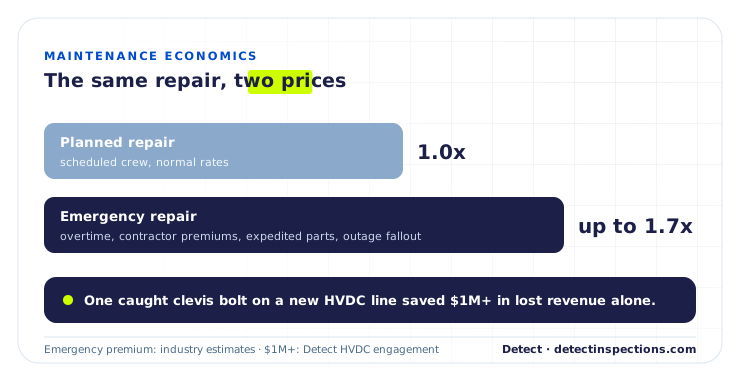
Our HVDC case study makes the point. Had that loose clevis bolt failed under peak load, the outage could have lasted more than a week. Site access, crane mobilization, and re-energization testing all add recovery time.
The utility estimated the prevented outage saved over $1 million in lost revenue alone - before counting the emergency mobilization and restoration costs it also avoided.
And the direct bill is only part of the burden. Community impact multiplies it: regulatory penalties, customer compensation, and long-term damage to reputation. When infrastructure fails during extreme weather - exactly when people need it most - the scrutiny from regulators, media, and the public can last for years.
And when the weather event does land, recovery runs on the same data discipline: how a utility turns its post-storm sweep into a severity-ranked damage register - and into evidence for the claims that follow - is mapped in the storm damage response guide.
Why do most inspection methods create dangerous blind spots?
The biggest challenge in maintaining transmission infrastructure is visibility. Traditional inspection creates blind spots where critical defects grow undetected - until failure is close or certain.
Manual inspection, even when done well, runs into hard limits:
- Inspectors can only assess what they can safely reach and clearly see
- Difficult terrain - dense urban settings or remote geography - puts whole sections out of view
- Reports take weeks or months, and conditions keep changing while you wait
Consider a recent situation involving 618 lattice structures across two transmission lines in Canada’s boreal forest.
The utility needed to document construction defects before the warranty expired and winter set in. Ground patrols would have meant weeks of dangerous travel through muskeg and permafrost. Helicopter surveys lacked the detail needed for warranty claims. ATV access put crews at risk in unstable terrain.
Any other method forced an impossible choice: accept potentially flawed construction with no recourse, or risk crew safety on the ground. Either option carried unacceptable costs - financial or human.
Speed is the other hard limit. By the time a manual inspection report reaches decision-makers, the information may already be stale - especially for fast-moving defects like corrosion or loosening hardware.
That timing gap bites hardest when an inspection finds something urgent. Most programs can’t pivot from routine assessment to emergency response, so manageable problems get time to become critical failures. The full anatomy of those gaps - coverage, latency, and record - is in why manual grid inspections still miss failure risks.
What is predictive asset intelligence?
Intelligent asset management changes both the speed and the accuracy of assessment. It combines advanced imaging, artificial intelligence, and expert validation.
Comprehensive infrastructure visibility
High-resolution imagery captured via drone, vehicle-mounted cameras, or even smartphones covers structures completely - in ways human inspectors couldn’t safely or affordably match.
Because the system reads imagery from any source, the visibility gaps close. And utilities get intelligence they can act on, at the pace grid operations now demand.
They also simply see more. Every component - from foundation bolts to conductor attachments - becomes visible and documented, with precise geo-referencing and orientation tracking.
AI-assisted defect detection
AI speeds up the analysis by flagging potential defects across structural, electrical, and environmental categories. The system learns each network’s quirks and gets more accurate with every inspection cycle.
Human inspectors miss subtle signs when they’re tired or distracted. AI holds the same attention to detail across thousands of components and images.
Real-time processing enables same-day decisions. Instead of waiting weeks for reports, the system can flag high-risk conditions while field crews are still on-site - turning a routine inspection into an immediate intervention when a critical defect shows up.
How do utilities move from reactive to predictive maintenance?
The transition takes planning across three fronts: the technology, the workflow, and the organization. In practice it comes down to four steps.
- Baseline asset assessment. Establish current conditions and identify the highest-priority assets first - the infrastructure where failure would hurt most. Early wins here build support.
- Technology integration. Connect the inspection platform to the asset management systems you already run. Your team shouldn’t need five tools to finish one task.
- Workforce training. Field crews learn new capture techniques; asset managers learn to read AI-assisted results. The investment pays back in quality and speed.
- Continuous monitoring. Build the feedback loops that drive improvement - regular reviews surface what to tune, and the growing history sharpens predictions.
How do you make the business case for change?
Winning support for predictive maintenance means putting costs and benefits in terms each group cares about.
Executive leadership
Lead with risk and position. Intelligent asset management cuts operational risk and marks the utility as a technology leader in an industry under growing scrutiny. Preventing major outages protects both financial results and reputation.
Financial teams
Bring concrete ROI numbers. Compare today’s reactive costs - emergency response, overtime premiums, outage impacts - against the predictable cost of a proactive inspection and maintenance program.
Operations teams
Show that the new tools make daily work easier, not harder. Better information, faster, means smarter resource calls and less emergency-response stress.
Regulatory affairs
Point to compliance and audit readiness. Complete documentation and systematic monitoring show proactive risk management that goes beyond the regulatory minimum.
Frequently asked questions
What is the difference between reactive and predictive maintenance?
Why is reactive maintenance so expensive for utilities?
What does predictive maintenance need to work?
Where should a utility start with predictive maintenance?
The utility industry’s inflection point
Aging infrastructure, workforce shortages, and rising customer expectations are converging. Reactive maintenance can’t hold.
Utilities that keep deferring systematic asset management are risking community safety and financial stability.
The technology to go from reactive to predictive exists today. Our clients’ results prove the ROI. The framework above gives a clear path.
When a single loose bolt can trigger million-dollar consequences, the true cost of reactive maintenance is too high to ignore.
See and stop failures before they happen
Schedule a free asset audit to discover what your current inspections might be missing - and what predictive maintenance would catch on your network.
Book a free audit →