
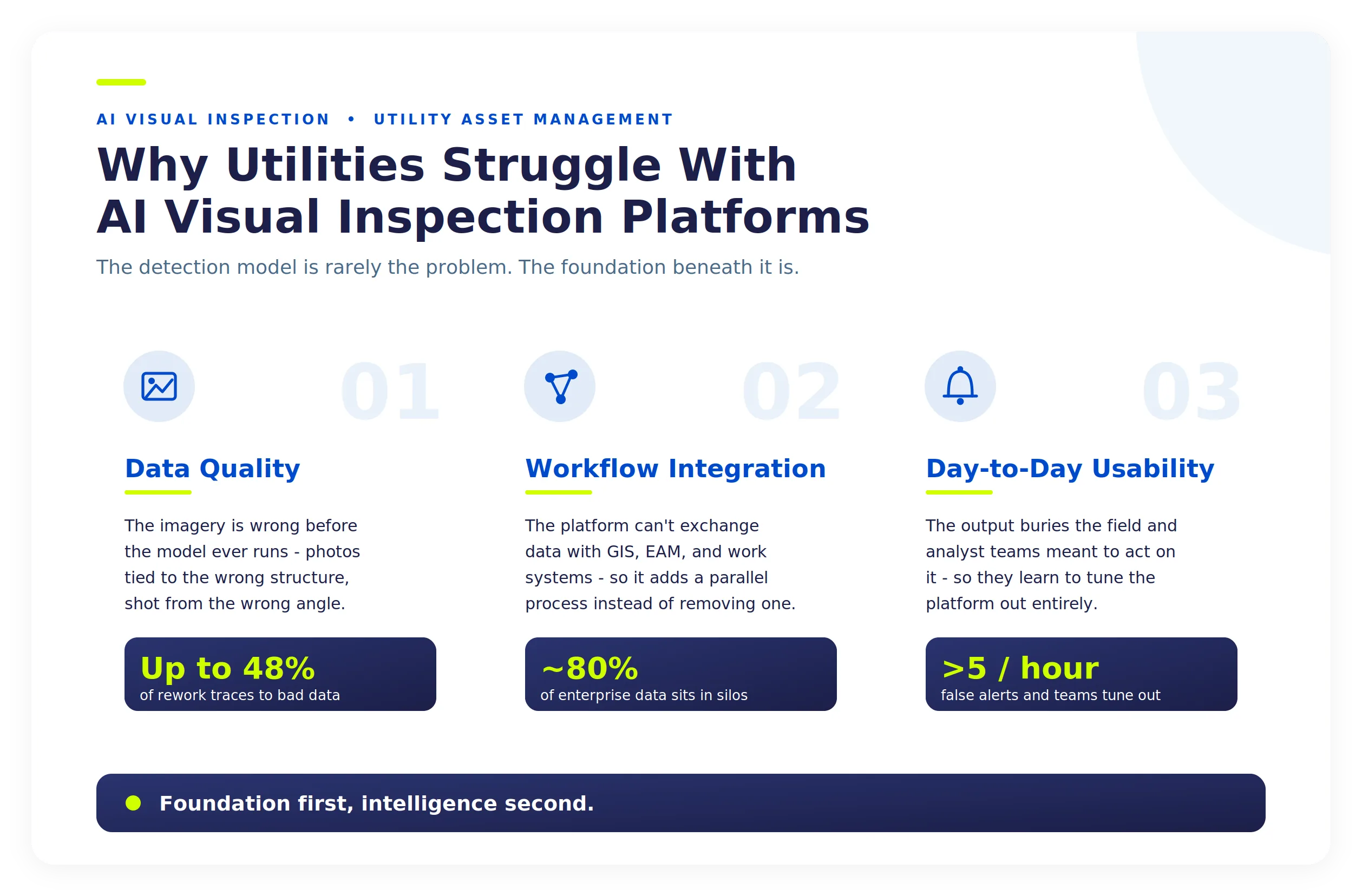
Why Utilities Struggle With AI Visual Inspection Platforms
On a 250-mile HVDC line, an analyst stopped scrolling. One image out of 122,714 showed a clevis bolt high in a suspension assembly, backed off its threads, with the cotter key that was supposed to hold it gone. Wind was already working the conductor. Left alone, the nut walks off, the clamp opens, a major renewable feed drops, and the line is down for more than a week. A crew cleared it in 120 minutes, and the catch averted a $1M+ outage.
The model did not flag that bolt on its own. A trained analyst did, working from imagery the platform had already screened and ranked. And the imagery was only worth screening because every frame was sharp, correctly exposed, and tied to the right structure.
The pitch is easy to say yes to. Point a model at your inspection imagery and it finds the corrosion, the cracked insulator, the backed-off bolt faster than a person scrolling through thousands of photos. Most large utilities have now run that pilot. Far fewer have scaled it. What breaks is rarely the model. It is the imagery that feeds the model, the systems meant to receive its output, and the teams expected to act on what it finds.
Key takeaways
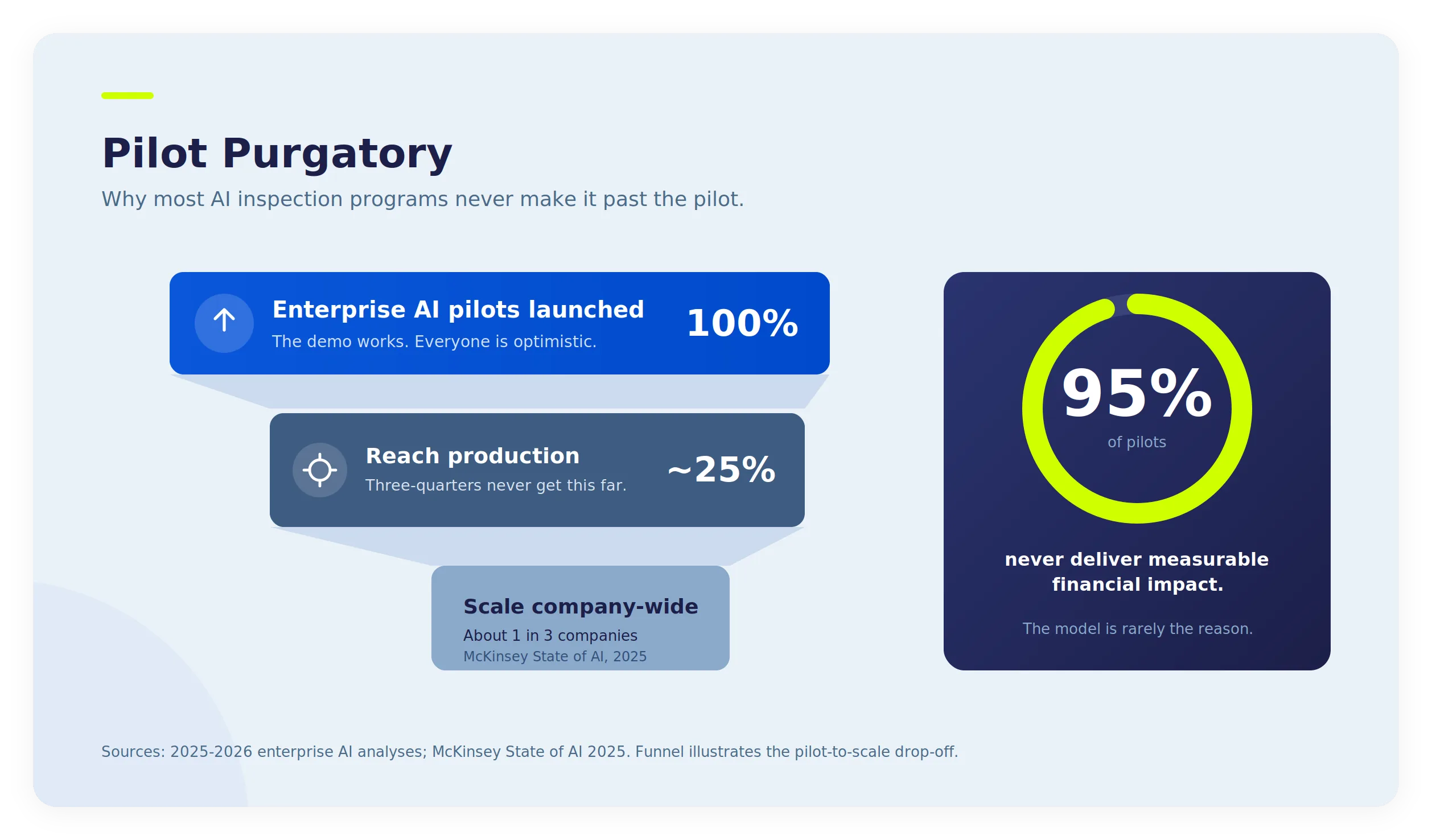
- The model is rarely the problem. Across 2025-2026 industry analyses, up to 95% of enterprise AI pilots never deliver measurable financial impact, and roughly three-quarters never reach production.
- Three issues drive most of the struggle: poor data quality at capture, weak workflow integration with existing utility systems, and day-to-day usability that overwhelms field and analyst teams.
- The fix is sequencing: foundation first, intelligence second. Validate capture in the field, tie every image to the right structure, route findings into the systems crews already use, and deliver same-day intelligence.
- The findings outearn maintenance. One image-linked, severity-scored record also defends your wildfire filing, your rate case, and your insurance renewal.
- The right buying question is not "how accurate is the model?" It is "what will this find, how fast will we know, and does it hold up in our operation?"
What is an AI visual inspection platform?
An AI visual inspection platform is computer vision inspection software that analyzes imagery of utility assets - poles, towers, conductors, insulators, substations - to find and classify defects automatically.
In power grid inspection, an AI visual inspection platform typically ingests drone, helicopter, or ground-captured images, identifies each asset and component, and flags conditions like corrosion, missing hardware, and vegetation encroachment for review.
The technology is mature. Grid and tower inspection is now the single largest category of applied visual AI, according to Roboflow's 2026 trends data, and the broader market is on track to grow from roughly $30 billion in 2025 to nearly $37 billion in 2026.
Capability is no longer the constraint. Getting trustworthy findings out of that capability - fast enough and clean enough that a crew chief will dispatch on them - is. That bar is testable: a capture-quality gate, accuracy by defect class, and expert review of every flag are seven checks you can run on any platform's first deliverable.
Why AI visual inspection platforms stall in large utility operations
The technology is ready and the spending is real. The pressure to use it is just as real:
- Aging assets. Around 70% of U.S. transmission lines are past 25 years of a roughly 50-year design life, and more than half of distribution transformers are beyond 33 years against a 40-year average.
- A failing grade. The American Society of Civil Engineers graded the grid a D+ in 2025, down from C- in 2021.
- A shrinking workforce. The Center for Energy Workforce Development estimates nearly half of utility workers will retire within the decade. For every five experienced tradespeople leaving, only two are entering.
- A rising cost of failure. NOAA counted 27 billion-dollar weather disasters in 2024 totaling $182.7 billion, and a single equipment-sparked wildfire has been enough to push a major utility into bankruptcy.
That last point has a face. The 2018 Camp Fire was sparked by a worn C-hook on a transmission line that had not been climbing-inspected in years - one piece of hardware, the exact kind an inspection program exists to catch, on a structure nobody had looked at closely. It pushed a major utility into bankruptcy. The cost of not looking compounds with time, and eventually it changes who pays.
Ask any line manager who has filed the same capital request for a decade and watched it come back denied. The rot was real. A stack of patrol notes just could not make it land with the people holding the budget.
So demand is clear and the tools exist. The struggle is in the gap between buying a platform and getting findings out of it that a utility can act on. Three reasons account for most of the failures, and all three sit underneath the model.
Reason 1: Data quality breaks the AI before it runs
The single biggest reason an AI visual inspection platform underperforms has nothing to do with the model. The imagery feeding the model is wrong before the model ever runs. Across utility inspection programs, about 40% of captured imagery is rejected or unusable somewhere in the pipeline, and roughly 48% of infrastructure rework traces back to bad data, not bad fieldwork.
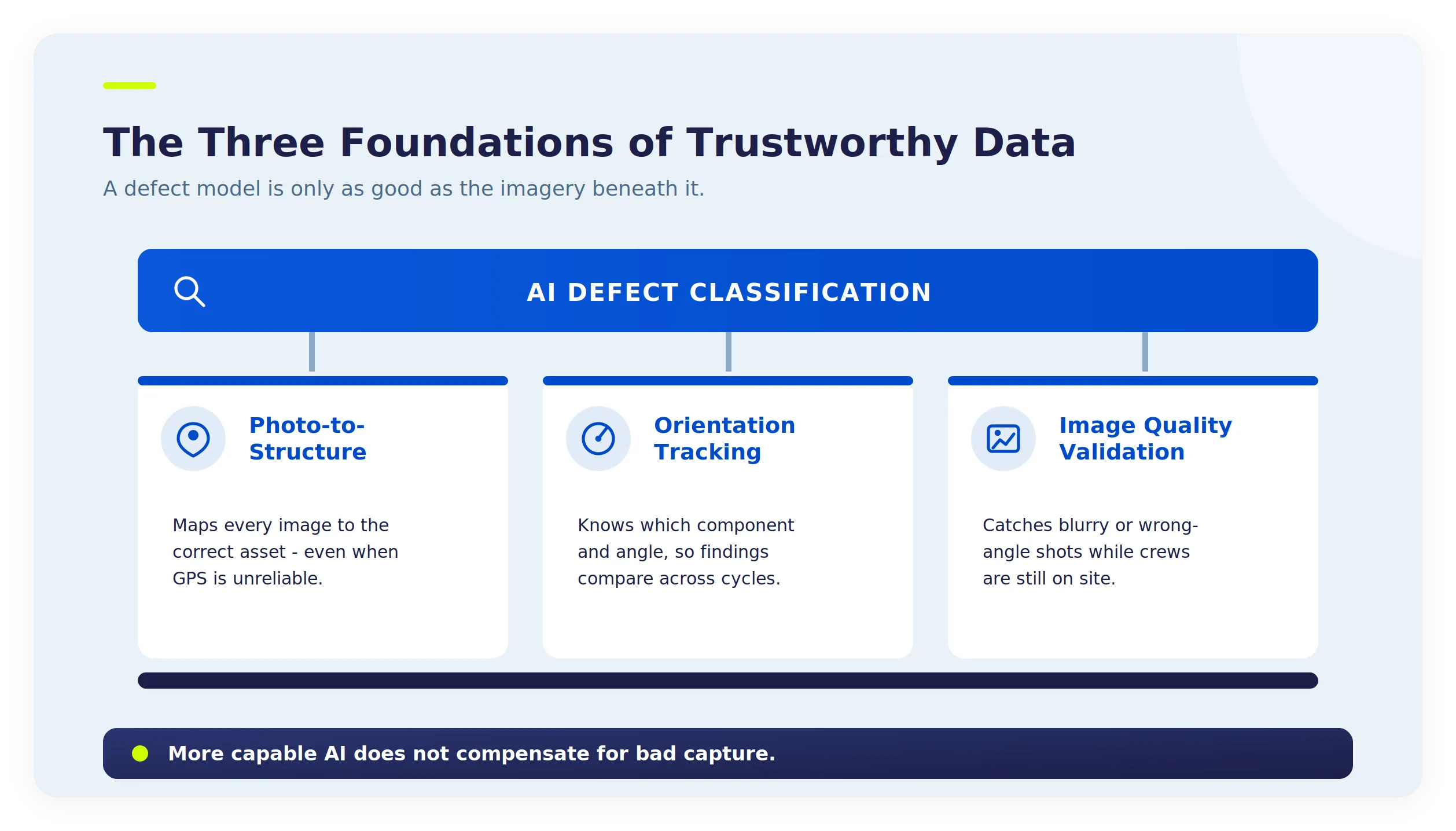
Three failures happen at the capture layer, and each one quietly corrupts everything downstream.
Photos aren't tied to the right structure
GPS coordinates from field captures are unreliable, and mis-association is the single largest source of inspection rework. Park two towers close together and auto-tagging lands the image on the wrong one.
If an image can't be mapped to the correct pole or tower with confidence, the finding attached to it is useless, or worse, misleading. You can have a flawless defect classification sitting on the wrong asset. This is the boring, foundational problem that breaks most inspection workflows, and it rarely shows up in a demo.
Orientation gets lost
A photo of a structure is only actionable if you know which component you are looking at, and from what angle.
Without automated tracking of component position and viewing angle across multi-phase towers and complex structures, inspection data isn't comparable over time or across crews. You lose the ability to say "this is the same connection we flagged last cycle, and it's worse."
Capture quality fails silently
A critical bolt photo that came back blurry, or a fitting shot from the wrong angle, isn't an edge case. It happens on every campaign.
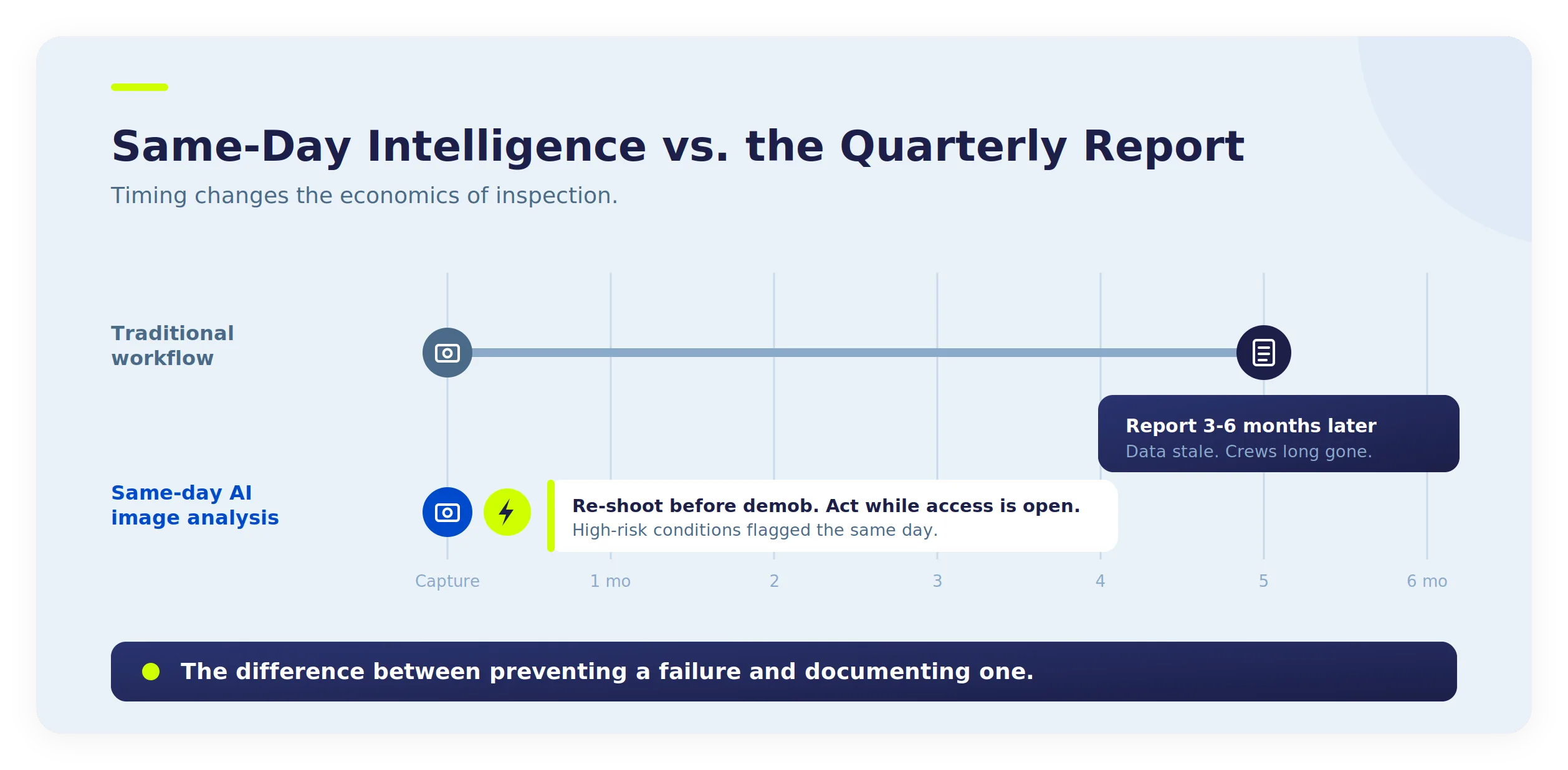
The damage is in the timing. If the quality problem isn't caught until a week after the drone team has demobilized and moved to the next site, the cost of re-shooting that imagery is tens of thousands of dollars and weeks of schedule - remobilizing a crew for what should have been validated on site.
More capable AI does not compensate for bad capture. The platforms that scale validate capture quality while crews are still in the field. The ones that don't have the most impressive detection demo and the highest re-inspection rate.
The math is unforgiving. Detect's transmission defect catalog runs to 258 types. On a sharp image, all of them are assessable. On a soft one, only the component-level defects survive - about 69%. On a blurry one, you are down to gross conditions only, about 7%. The fastener- and splice-level defects that decide reliability are the first to vanish when capture slips, and no model can recover a defect the pixels never held.
EPRI's own assessment of automated visual line inspections corroborates: useful image capture depends on precise positioning, and lighting, truncation, and obscuring of the target asset are recurring problems. When the foundation is wrong, the model produces confident answers to the wrong question.

Reason 2: Workflow integration with existing utility systems
The second reason large utilities struggle is integration. An AI visual inspection platform that can't exchange data with your GIS, EAM, and work management systems doesn't reduce work. It adds a parallel one.
Why pilots that looked great fall back in production
The pilot succeeded because it temporarily removed the complexity of your real operation. Production puts it back.
In a large utility, SCADA, GIS, EAM, and OMS were each built for stability, not for talking to one another. Each carries its own asset names, timestamps, and data formats. The breakdowns are predictable:
- Mismatched asset names between GIS and EAM mean the AI can't track the same transformer over time.
- Different timestamps between SCADA and OMS mean condition data loses its timing accuracy.
- Hand re-entry by field crews means the platform never learns what actually happened to the asset it flagged.
Around 80% of enterprise data sits trapped across disconnected systems (Forrester). For utility asset management, that fragmentation is the primary reason AI programs stall after the pilot.
The model isn't failing. The plumbing around it was never built.
Integration is a first requirement, not a final checkbox
For operations leaders, integration is the thing that decides whether the platform produces a prioritized work order inside your existing system, or a separate dashboard somebody has to log into, reconcile, and re-key.
- The first scales.
- The second gets quietly abandoned within two cycles.
The utilities getting this right treat it as the first requirement. EPRI's published work points to the goal directly: Duke Energy, working across six states, is focused on converting processed inspection imagery into work orders.
That is the bar. Findings that don't reach the work management system don't reduce risk.
One record, several audiences
Integration is also where the findings stop being a maintenance artifact and start earning their keep elsewhere. The same image-linked, severity-scored record that ranks your repair spend is the record that defends a wildfire mitigation plan, a rate case, and an underwriter renewal. It is the evidence behind a SAIDI or SAIFI number, and it is what a board wants to see before signing off on a capital plan.
Captured once, that record serves operations, the regulator, the insurer, and the board. A platform that traps it in a standalone dashboard throws most of that value away.
Reason 3: Day-to-day usability for field and analyst teams
The third reason is usability, and it's the one vendors discuss least. A platform that surfaces ten thousand findings a field or analyst team can't triage turns into a reporting burden.
Alert fatigue is a measured failure mode, too.
Operators who receive more than five false alerts per hour stop responding to real events within about two weeks.
Once a team learns to tune out the platform, the most accurate model in the world is worthless, because the one finding that mattered is buried with the noise. Detection without action is a data science project, not an infrastructure management tool.
Two usability needs decide whether a platform survives contact with day-to-day operations.
Speed that matches the work
Traditional inspection workflows deliver reports three to six months after capture. By then the data is stale, and the crew that could have re-shot a bad image is long gone.
Same-day AI image analysis changes the economics. High-risk conditions are flagged the day the imagery lands, while access is still open and the season hasn't turned. For an operation covering thousands of structures, that is the difference between preventing a failure and writing it up.
Expert judgment kept in the loop
A good platform makes the analyst's time count.
The strongest programs run every finding through human-in-the-loop validation: the AI screens the volume at scale, and trained analysts spend their attention only on the findings that warrant judgment. The HVDC campaign that opened this piece ran that way. Across 122,714 images captured by a three-person team in 30 days, the screen turned:
- 1,270 logged conditions, into
- 95 consolidated work actions to schedule, into
- 1 red-tag anomaly that needs a crew this week.
That is AI as a force multiplier for expert teams, not a substitute for them. The judgment runs both ways: the AI catches defects human QA has already passed, and analysts catch what the AI misreads. On one new line, the model flagged a corrosion pattern that an analyst recognized as a construction shortcut, not material decay - a call that changed how the finding was worked.

How to evaluate an AI visual inspection platform for utility asset inspection
Put the three reasons together and the buying decision reframes itself. For the executive who signs off, a missed defect that becomes an outage is a career-defining failure. The right question is not "how accurate is the model?" It is "what will this find, how fast will we know, and does it hold up in our operation?"
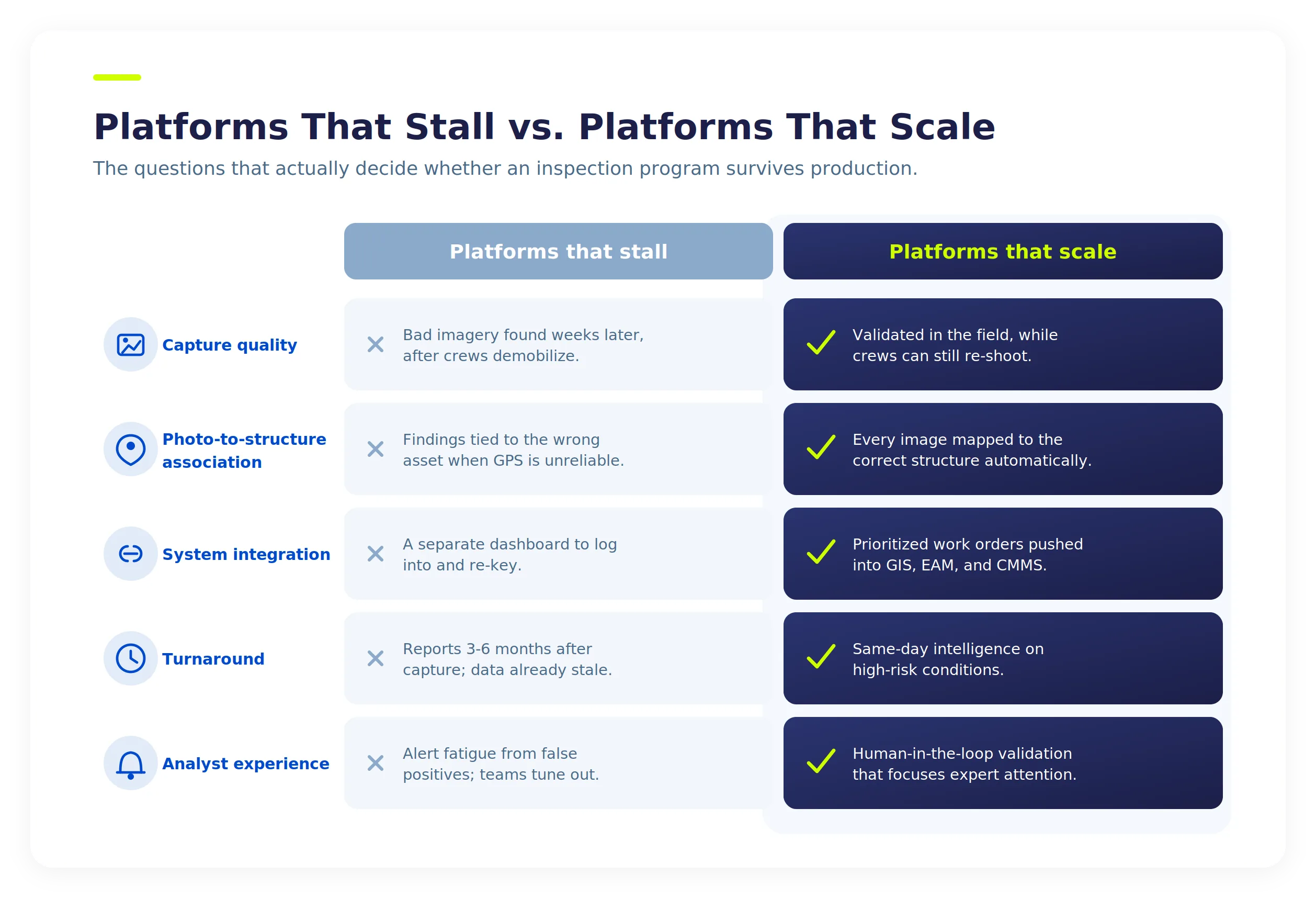
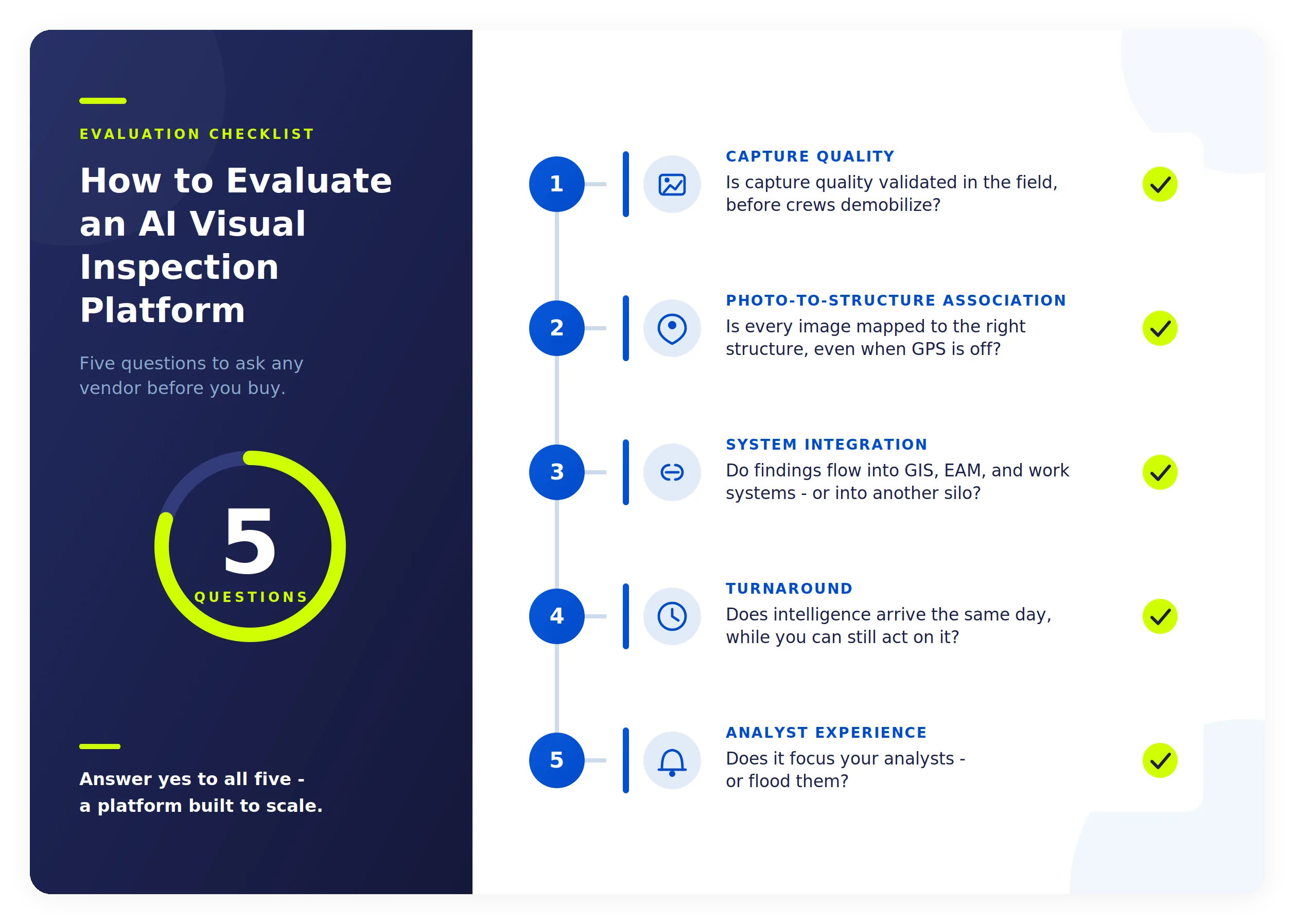
Five questions to ask any vendor, drawn directly from the table:
- Does it validate capture quality in the field, before crews demobilize?
- Does it reliably associate every image to the correct structure, even when GPS is unreliable?
- Does it push prioritized findings into our GIS, EAM, and work management systems, or create another silo?
- Does it deliver intelligence the same day, while we can still act on it?
- Does it focus our analysts, or flood them?
Foundation first, intelligence second
Utilities don't struggle because the AI is bad. They struggle because the imagery feeding it is mis-associated and inconsistent, the platform can't exchange data with the systems they already run, and the output buries analysts instead of pointing them at the few findings that matter.
This is the principle Detect was built on. DetectOS handles:
- Automated photo-to-structure association, so every image maps to the right asset.
- Real-time quality validation while crews are still on site.
- AI-assisted defect classification with expert validation on every finding.
- Prioritized findings routed into the systems utilities already use, with same-day intelligence on high-risk conditions.
The promise is the one operations leaders want: same crew, same equipment, far more structures inspected, and findings you can trust enough to dispatch on.
The grid is older, carries more load, and is maintained by fewer people than at any point in its history. None of those trends is reversing. The utilities that will define the next era of reliability are the ones that can see the true condition of their assets clearly, quickly, and at scale, before a small defect becomes an outage. The technology to do that already exists. Whether it works for you depends on the foundation underneath it.
Related reading: understand how utilities prove ROI on AI asset inspection.
