
How AI Asset Inspection Platforms Improve Grid Reliability
Utilities can capture more inspection imagery than ever. Whether they can act on it before an asset fails is the question the Eaton Fire, the Iberian blackout, transformer lead times and NERC's latest forecast are all asking. The case for AI asset inspection platforms for utilities turns on speed, not detection.
- The marquee grid events of the last eighteen months share one variable: how fast a utility acts on the condition of assets it already monitors.
- The reliability payoff from AI inspection comes from collapsing the lag between capture and repair, not from finding more defects.
- Detection accuracy is now table stakes across vendors. Turnaround and routing into work orders are the real differentiators.
- With transformer lead times stretching to four years, an aging asset is something you have to keep alive, not something you can plan to replace on schedule.
- The investment case should be sized against ignition liability and outage cost, not against per-structure price.
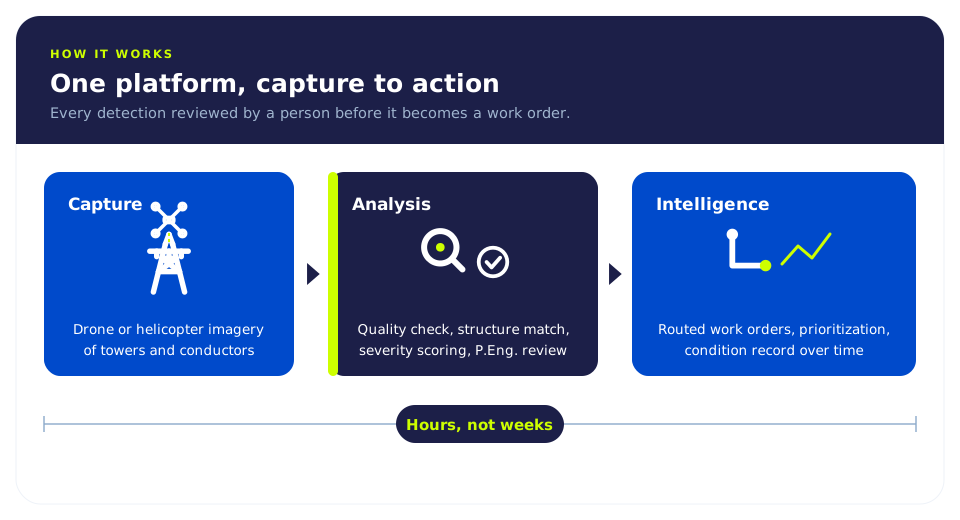
What is an AI asset inspection platform? An AI asset inspection platform is software that converts utility inspection imagery, whether from drones, helicopters, or ground crews, into prioritized, severity-scored repair actions, ideally the same day it is captured, so utilities act on asset condition before failure rather than after.
Why grid reliability now depends on inspection turnaround
Grid reliability has become a function of speed: how quickly a utility can act on the condition of an asset it is already watching. The last eighteen months made that case more forcefully than any vendor could.
What the Eaton Fire, Iberian blackout, and NERC forecast show about grid reliability
Three events defined the period, and none were subtle.
- A fire that investigators suspect may have involved utility infrastructure tore through Altadena, California in January 2025, killing at least seventeen people and destroying more than nine thousand structures.
- The grids of Spain and Portugal collapsed in under ninety seconds in April 2025, dropping more than fifty million people into the dark.
- In January 2026 NERC warned that demand is now forecast to grow sixty-nine percent faster than it projected a year earlier, with thirteen of twenty-three regions facing elevated or high shortfall risk.
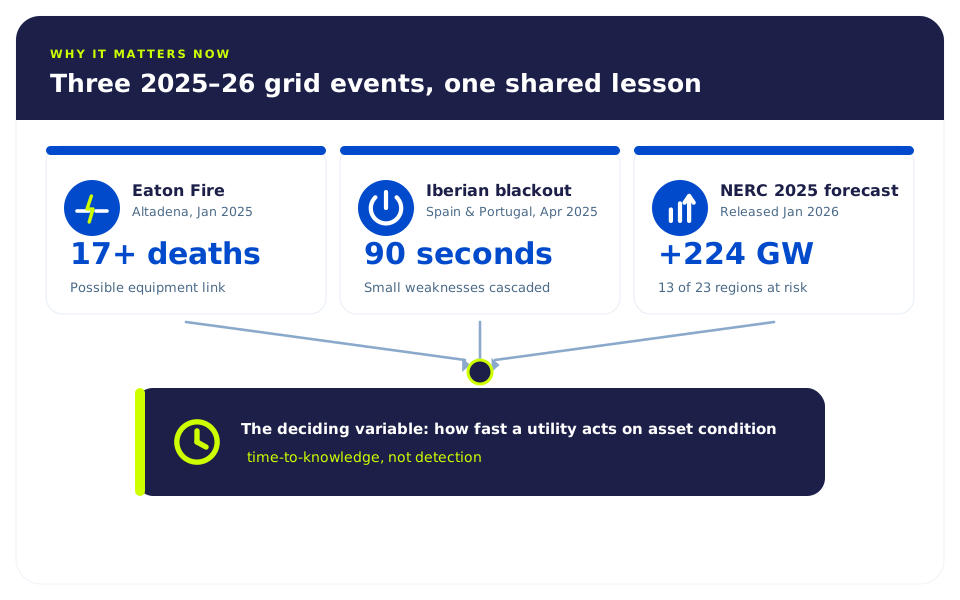
- 90 seconds: time for the Iberian grid to collapse on April 28, 2025
- 224 GW: increase in NERC's ten-year summer peak forecast, most of it data centers
- 178: fires associated with one utility's equipment in 2024
Why time-to-knowledge determines grid reliability
In each case the deciding factor was time: how fast someone could see, and act on, the real condition of an asset. When that lag is short, a defect becomes a scheduled repair. When it is long, it becomes an outage, a shortfall, or a fire. Inspection is where utilities either close that lag or let it run, which is why this is an inspection problem before it is a generation or transmission problem.
How AI asset inspection platforms improve grid reliability
AI asset inspection platforms improve grid reliability by shortening the time between when a defect is captured and when a crew is dispatched to fix it. The reliability gain is in the speed, not the detection.
Why visual inspection software stalls between capture and action
For years the hard part of inspection was seeing the asset. Drones and computer vision solved that, and the constraint moved downstream, from the field to the office. The Electric Power Research Institute states it plainly: the industry's ability to collect inspection imagery has outpaced its ability to analyze it.
A single drone shift produces thousands of images, and each one still has to be matched to a structure, checked, screened, scored, and turned into a work order by an engineer who already has other corridors waiting. The constraint is no longer flying the line. It is everything that happens after, which is why inspecting ten times more assets is a problem of collapsing manual steps, not adding drones.
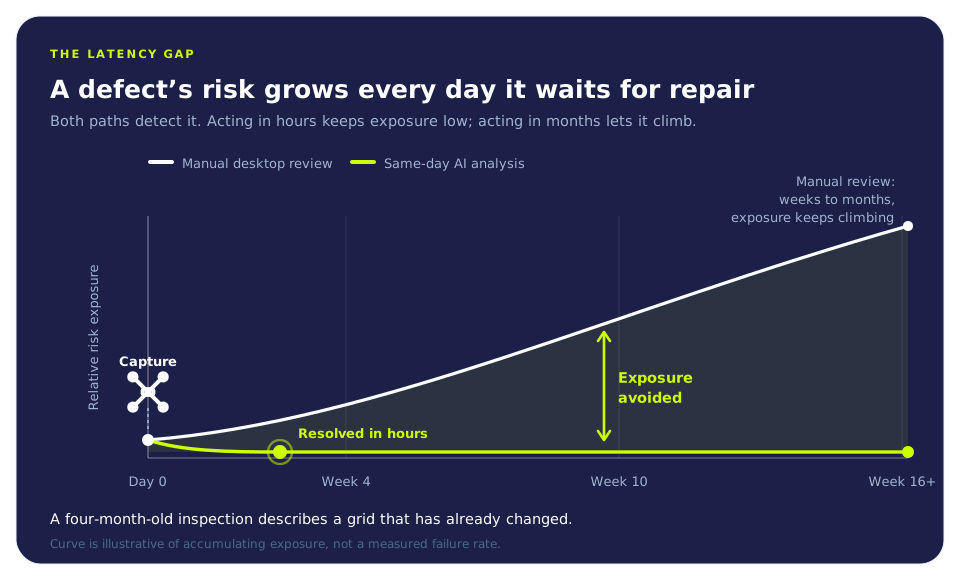
A four-month-old inspection does not describe your grid. It describes a grid that has since weathered storms, carried record load, and aged.
How same-day AI analysis lowers SAIDI and SAIFI
Reliability is reported as SAIDI and SAIFI, and both reduce to one thing: how long, and how often, customers sit in the dark. A defect does nothing to those numbers the day it is photographed. It moves them the day it fails.
- U.S. distribution reliability has worsened over the past decade, before the new load arrives.
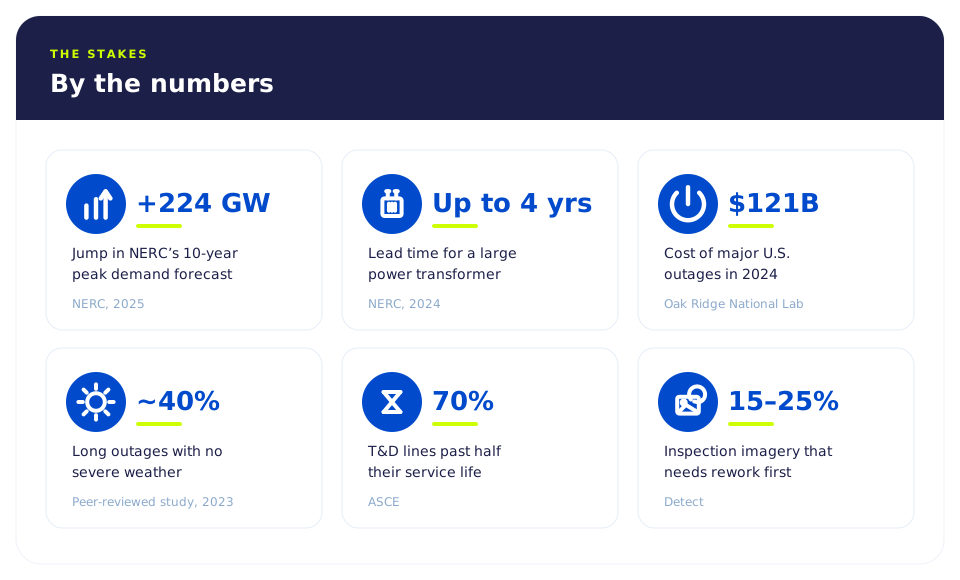
- A peer-reviewed 2023 study attributed close to forty percent of the longest outages, eight hours or more, to causes other than weather, mostly equipment failure.
Those are the failures inspection exists to prevent. Latency is how they slip through.
Detection accuracy vs. analysis speed in AI inspection platforms
The standard objection is that detection accuracy is what matters, and the platform finding the most defects wins. That was the right question a decade ago. Claims of catching several times more issues than a manual crew are now common across the category, which makes accuracy the floor, not the ceiling. When two platforms both find the same loose bolt, the one that surfaces it the same day prevents the outage and the other one documents it. The honest measure of modern visual inspection software is not defects found. It is days saved between capture and repair.
Manual desktop review vs. same-day AI analysis
The two approaches diverge after capture, not at detection.
| Capability | Manual desktop review | Same-day AI analysis |
|---|---|---|
| Turnaround | Weeks to months | Hours |
| Throughput | Capped by reviewer capacity | Scales with imagery volume |
| Prioritization | Inconsistent, reviewer-dependent | Severity-scored and repeatable |
| Work-order routing | Manual re-handling | Routed into existing systems |
| Condition record | Per-inspection snapshots | Continuous, builds over time |
| Reliability impact | Defects age in the queue | Defects reach crews before failure |
Both paths can find the defect. Only one acts on it in time to keep it out of the outage record.
Why utility asset management stakes are rising: load, liability, and lead times
The cost of a slow inspection is rising on three fronts at once, and all three are current.
Data center load growth on aging grid infrastructure
NERC's 2025 assessment raised its ten-year peak forecast by 224 GW and pinned most of it on data centers. The alarm is contested in a useful way: Grid Strategies argues NERC overstates the risk by undercounting projects in the interconnection queue, and that critique deserves weight. But the direction is not in dispute. Load is climbing onto conductors decades past their design life. The American Society of Civil Engineers reports seventy percent of U.S. transmission and distribution lines are in the second half of their service lives, and in 2024 utilities spent sixty-seven percent of their T&D budgets, about $63 billion, replacing and upgrading rather than building new. A missed defect on a newly loaded line is a larger problem than it was in 2010.
Transformer lead times make condition-based maintenance essential
This is the part that changes the math most, and it is the newest. You cannot run an asset to failure when its replacement is years away. NERC reports large power transformer lead times reached as long as four years in 2024, and Wood Mackenzie's mid-2025 survey put the average power transformer at 128 weeks, nearly two and a half years.
- Up to 4 years: lead time for a large power transformer (NERC, 2024)
- 128 weeks: average power-transformer lead time (Wood Mackenzie, Q2 2025)
- 60-80%: rise in transformer prices since 2020
When the replacement clock runs in years, the value of catching an asset's decline early multiplies. Condition monitoring stops being an efficiency measure and becomes risk management for equipment you physically cannot replace on demand. Keeping existing infrastructure healthy is now as important as funding new buildout, and inspection latency is what decides whether you get the warning in time to act.
Power outage costs and utility wildfire liability
Outages are expensive, and the number is climbing. A 2026 Oak Ridge National Laboratory analysis found major outages cost U.S. customers an average of $67 billion a year over seven years, rising to $121 billion in 2024. The Department of Energy separately estimates outages cost American businesses around $150 billion a year. And the wildfire story shows the tail risk: the Eaton Fire's cause is not finally determined, but Southern California Edison has acknowledged its equipment may be linked, plaintiffs allege inadequate inspection of aging equipment, and regulators had questioned the utility's maintenance of aging transmission lines months before the fire, with exposure now running to billions.
Wildfire mitigation plans require documented drone inspection
In high-fire-risk jurisdictions, inspection has moved from an efficiency decision to a regulatory commitment. Drone inspections are a recognized inspection category in major utility wildfire mitigation plans for the 2026 to 2028 cycle, and the data has to meet documentation standards: reliable photo-to-structure association, orientation tracking, image quality assurance, and alignment to the utility's defect taxonomy. Utilities report progress against each commitment in Annual Reports on Compliance, and in California, Energy Safety can refer noncompliance to the CPUC for penalty action under PU Code 8386.1.
The same logic that governs reliability governs compliance here. A finding that arrives late, or imagery that cannot be analyzed, is not only an outage risk. It is a documented gap in a regulatory filing. Utilities even rank mitigations by Risk Spend Efficiency, the ratio of risk reduced to dollars spent, which is the cost-per-usable-finding argument in a different uniform. A fuller breakdown of what a 2026 wildfire mitigation plan asks of an inspection program is worth reading alongside this.
How utilities justify investment in AI inspection software
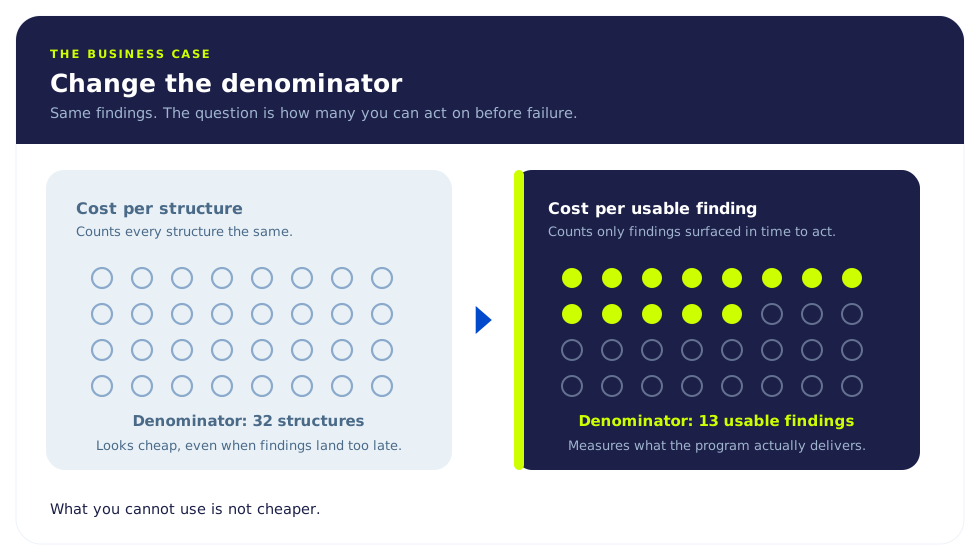
Utilities justify the investment by measuring what the program actually delivers, findings they can act on in time, and sizing the downside against real consequences rather than a per-structure rate.
Cost per usable finding vs. cost per structure
Procurement reaches for cost per structure because it compares cleanly and pushes the price down. It is the wrong number. It hands the decision to whoever quotes the cheapest analysis no one can use in time, and what you cannot use is not cheaper. Measure cost per usable finding instead, where usable means surfaced early enough to act before failure.
Linking inspection ROI to performance-based ratemaking
Because SAIDI and SAIFI increasingly feed performance-based ratemaking, a missed defect lands in a rate case, not just an outage log. Put three numbers in front of leadership:
- Cost per usable finding, not cost per structure.
- Avoided-outage value on critical assets, against the outage costs above and the rate-case exposure they create.
- Time from capture to work order, because every other number depends on it.
A planned five-figure repair that displaces a seven-figure failure pays for the platform many times over, and the saving exists only if the finding arrives in time.
Why utilities struggle to use visual inspection platforms effectively
Most utilities struggle for three reasons that sit beneath the AI model itself, and each one reopens the lag between capture and action.
Inspection data quality and image rework
AI only reads imagery it can use, and somewhere between fifteen and twenty-five percent of captured images need rework before analysis can begin: wrong angle, poor resolution, no structure association, missing metadata. When that cleanup is manual and unplanned, it becomes the new bottleneck.
- 15 to 25 percent of inspection imagery needs rework before AI defect detection can use it.
- DetectOS returns analysis the same day, against turnaround requirements that manual review measures in weeks.
Workflow integration with work order systems
A finding the platform cannot route is a finding that waits. Tools that stop at annotated images leave the mapping, scoring, and work-order entry on a human, and the queue reforms one desk downstream.
Usability for utility maintenance teams
If only a specialist can run the platform, only specialists will, and they are already the constraint. Maintenance leaders need prioritized findings in language a crew can act on, not a spreadsheet of detections to triage.
What to look for in the best AI inspection platform for utilities
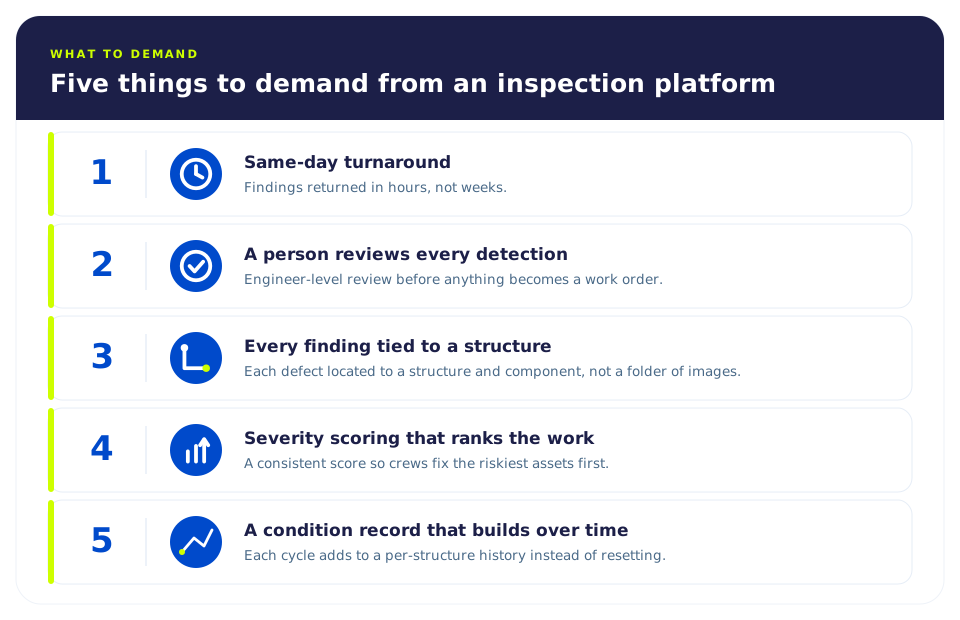
The best platforms are separated by what happens after detection, not by detection itself. Four questions decide it.
- How fast does analysis come back, and is that speed written into the contract?
- Does a qualified human review every detection before it becomes a work order?
- Are findings severity-scored and routed into the system the crew already uses, or handed over as raw images?
- Does the platform build a condition record over time, or report each inspection as if the last one never happened?
Utility pole inspection software at distribution scale
The volume problem is harshest on distribution, where most ignitions and outages begin. A transmission line inspection program covers a few thousand structures; utility pole inspection software at distribution scale covers hundreds of thousands against the same office capacity. A tool that returns a long, undifferentiated list weeks later just relocates the backlog at ten times the scale. The pilot always works. Month six is the test, when last month's batch is still in review.
Predictive maintenance and the commissioning baseline
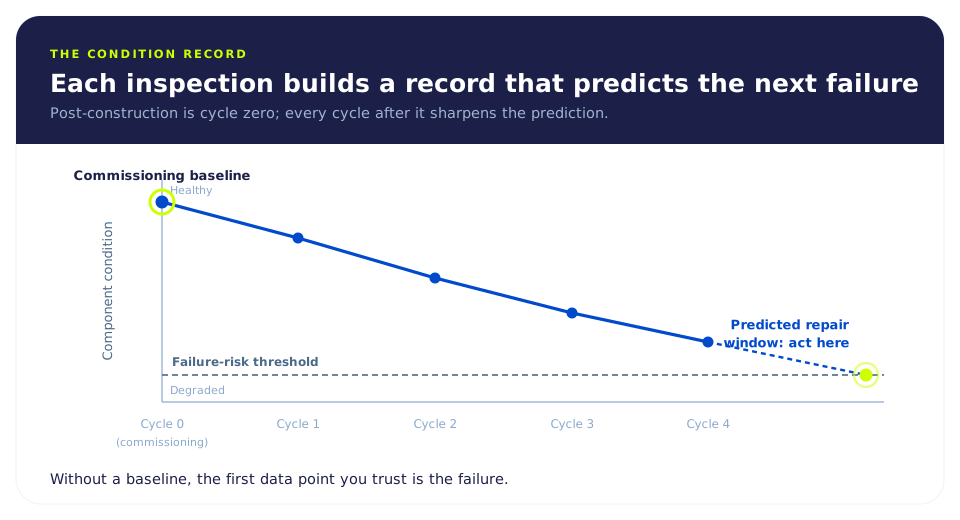
The most useful condition record begins the day an asset is energized. Post-construction inspection is usually filed as a record artifact, a box ticked at handover. It is better understood as cycle zero, the baseline every later inspection is measured against, and the cheapest moment to catch a defect, before anything has failed. A new line is not a low-risk line.
Why grid reliability is a speed problem, not a power grid analytics problem
The grid's problems in 2026, more load on older assets that cannot be quickly replaced and carry higher consequences for failure, are not problems any utility can inspect its way out of slowly. The metric the industry still optimizes is detection accuracy and analytics volume. The metric that now decides reliability is time. Which one is your program built around, and where is that wrong? I would like to read the case for the other side.
Disclosure: the author is Director of Data Quality at Detect, which builds utility inspection software. The argument here is his own.
Frequently asked questions
How do AI asset inspection platforms improve grid reliability?
By shortening the lag between capturing a defect and repairing it. Reliability indices like SAIDI count customer-minutes lost, which a defect drives only when it fails, so cutting the time a known defect stays in service is the most direct lever an inspection program has.
Why do utilities struggle to use visual inspection platforms effectively?
Three reasons beneath the model: imagery often needs rework before analysis, findings are not routed into work-order systems, and tools are built for specialists rather than the maintenance teams who act on them. Each reopens the lag between capture and action.
How do utilities justify investment in AI inspection software?
By framing the case around cost per usable finding rather than cost per structure, and sizing the downside against outage costs, ignition liability and rate-case exposure. The saving exists only when the finding arrives in time to act.
What is the best predictive intelligence software for grid assets?
The strongest options share four traits: fast and contractual turnaround, human review of every detection, severity scoring routed into work-order systems, and a condition record that builds over time. Detection accuracy alone does not separate them; what happens after detection does.
What is the best AI visual inspection platform for utilities?
The best platform for a given utility is the one that turns inspection imagery into routed, prioritized work orders fastest, with human review on every detection and a condition record that builds over time. Because detection accuracy is now common across vendors, evaluate platforms on turnaround speed, work-order integration, and whether that turnaround is written into the contract.
How do transformer lead times affect inspection priorities?
With large power transformer lead times reaching up to four years, utilities cannot quickly replace a failed asset, so catching decline early through condition monitoring becomes risk management rather than efficiency. The longer the replacement clock, the more an early, timely finding is worth.
What is same-day AI analysis?
A pipeline that associates imagery to structures, checks quality, screens for defects, scores severity and routes work orders within hours of capture, rather than the weeks or months manual desktop review takes.
Related reading: see how AI inspection software helps prevent grid outages and Detect's nomination at the 2026 Reuters Energy Industry Awards, AI asset inspection built for utilities, and predictive grid intelligence.
