
Guide: Cutting Rework on Infrastructure Inspections in 2026
On most infrastructure inspection contracts, 15 to 25 percent of delivered imagery needs rework before utility QA or AI defect detection can use it. The cause is rarely the fieldwork. It's a data quality problem - and on a fixed-fee contract, you eat the cost.
If you manage field crews across multiple utility clients, you've felt this. The crews are experienced. The defects are getting caught. But the data going into your systems isn't clean, consistent, or complete enough to protect your margin. Here's where the money leaks, and how to close the gap before the next campaign.
What does rework actually cost on an inspection contract?
Run the math on a typical transmission contract. Bid at $40 per structure across 5,000 structures, that's $200K gross. Direct costs of $150K leave $50K of margin - 25 percent on paper.
Now apply a 20 percent rework rate. Effective margin drops to $20K, or 10 percent. And rework cost isn't just labor. It includes scheduling friction, equipment wear, the opportunity cost of crews who could be on other contracts, and the slow erosion of the utility relationship as turnaround slips. The all-in cost typically runs about 1.5 times the direct rework labor figure, which pulls effective margin closer to 5 percent. The flip side: clean data is also how you inspect 10X more assets without hiring 10X more crew.
Most of that is not a crew performance problem. It's a workflow problem. We go deeper on the five data quality failures costing DSPs millions in a separate breakdown.

Why does inspection data get rejected before AI defect detection runs?
Before any AI defect detection model runs, utilities check three structural foundations of your data. If any one fails, the data is rejected before a model touches it. These are the categories your re-inspection rate sits inside.
Photo-to-structure association
GPS coordinates from field captures are wrong a meaningful share of the time. If images can't be reliably mapped to the correct structure IDs, every downstream finding is suspect. Visual recognition and spatial analysis - not raw GPS - are what utilities now expect.
The cheapest place to remove rework is at capture. Detect's vehicle capture unit shows what that looks like in practice: a review gate on image-to-pole association before analysis, so only frames bound to a verified structure enter the pipeline.
Orientation and component identification
A photo of a structure is only useful if the system knows which component is in frame and from what angle. Without orientation tracking, "which insulator?" can't be answered, and condition data isn't comparable across time or across crews.
Image quality assurance
Blurry captures, missed angles, and incomplete coverage happen. The cost of catching them after demobilization is far higher than catching them on-site. Field-side QA - not office-side review - is the difference between a usable deliverable and a re-inspection. It's also why Detect's Data Quality Program trains crews to validate capture in the field, before they demobilize - the program is now the way into the Detect Partner Network: any pilot, any drone.
Visual inspection: why data quality comes before the model
Most of the industry conversation around grid inspection has been about AI defect detection. Which model finds corrosion fastest. Which vendor has the best demo. None of it matters if the data going into those models is bad.
That's the core principle behind reliable visual inspection: the quality checks run first. AI screens the volume, and your experts focus on the findings that matter - but only after photo association, orientation tracking, and image quality assurance have passed. Visual inspection software that runs those checks at capture, while crews are still on-site, is what keeps clean data moving and stops the re-inspection loop before it starts. That's how DetectOS works: map every photo to the right structure, validate quality before processing, and flag re-captures while crews are still mobile.
AI is the force multiplier here. It is not a replacement for the expert. And it is only as good as the data feeding it.
How this connects to asset performance management and asset integrity
Audits don't test whether the work was done. They test whether the work can be proven. When inspection data lives across disconnected systems - photos in one place, GPS in another, defect reports in a third - a single audit request turns into days of reassembly.
This is where data quality becomes the difference between passing an audit and scrambling to explain gaps. It's also the foundation of any real asset performance management or asset integrity program. Trustworthy condition data is what lets you move from reactive maintenance to risk-based priorities - which matters more every year, as 70% of transmission structures pass their design life. You can't trust condition trends over time if you can't trust that each image maps to the right structure, shows the right component, and was sharp enough to analyze. Trustworthy condition data is the input. Asset intelligence is the output.
7 questions to ask your inspection technology provider
If you're evaluating providers, or building the internal case for a new approach, these seven questions separate platforms that protect your margin from ones that just produce reports. Utilities are increasingly scoring vendors on measured rework rates, and the best AI inspection software validates capture in the field - before the crew leaves the site. Which type of tool can do that at all is a category question first - the four types of asset inspection software carry very different stages of the record.
- Does the platform solve data quality before running defect detection?
- Can it handle imagery from any capture source - drone, helicopter, vehicle-mounted, phone?
- Does it flag quality issues while crews are still in the field?
- Are results reviewed by human domain experts before they reach the utility?
- Does it deliver audit-ready reports formatted for utility stakeholders?
- Can it integrate with your existing CMMS and GIS systems?
- Does it close the loop between inspection, remediation, and re-inspection?
If a provider jumps straight from upload to defect detection, ask what happens when the GPS is wrong, the image is blurry, or the component wasn't captured from the right angle. If the answer involves sending your crews back out, you already know the problem.
Case study: how one bolt saved $1M+
A major North American utility energized a brand-new HVDC transmission intertie - 250 miles, 2,600 steel lattice towers. The assumption was that new infrastructure meant minimal risk. That assumption is exactly what a close-out inspection exists to check - see our guide on how to inspect a construction site.
High in a suspension assembly, imagery flagged an irregular silhouette: a clevis bolt had backed off with only a few threads of engagement, and the retaining cotter pin was missing entirely. Under wind or ice loading, the bolt could have failed and dropped a conductor on a line feeding renewable generation - the kind of failure that makes proactive transmission line inspection non-negotiable.
It was caught because the three foundations did their job. Automated photo association mapped the image to the correct structure. Orientation tracking identified the exact component. Image quality checks confirmed the capture was sharp enough to analyze. The fix took 120 minutes. The cost of missing it: 7-plus days of forced outage and over $1M in lost revenue before emergency mobilization. Read the full HVDC case study.
That's the difference between inspection data and asset intelligence.
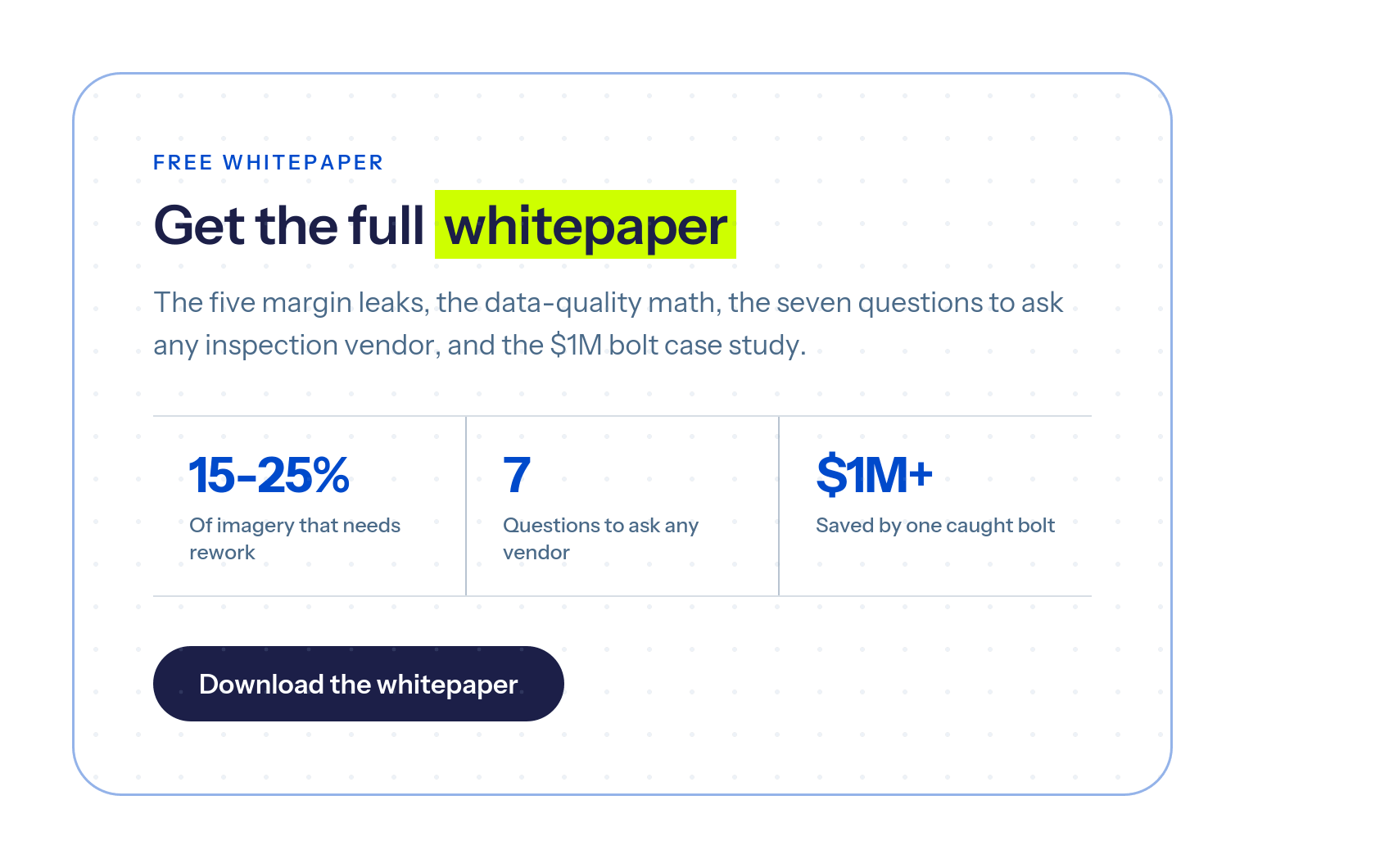
Get the full whitepaper
We pulled the five most common margin leaks, the data-quality math, the seven vendor questions, and the full case study into one whitepaper for contractors and utility teams: How to Cut Rework, Protect Margins, and Win More MSAs in 2026.
Download the whitepaper - free.
Want to see it on your own data? Send 500 images and we'll show you what your current inspection process is missing. Schedule a free asset analysis.
Frequently asked questions
Why does infrastructure inspection data get rejected?Inspection data is usually rejected for one of three structural reasons before any analysis runs: photos can't be reliably matched to the correct structure, the component and viewing angle aren't identified, or the capture quality is too low. These checks happen before AI defect detection, so failing one means the data is rejected upfront.
What is the average rework rate on utility inspections?Across utility inspection programs, 15 to 25 percent of delivered imagery typically needs rework before it can be used. On a fixed-fee contract, a 20 percent rework rate can erase roughly half of pre-rework margin.
What is AI defect detection in infrastructure inspection?AI defect detection uses computer vision models to find and classify defects - corrosion, broken components, structural issues - across inspection imagery. It works best as a force multiplier for expert reviewers, and it's only as accurate as the data quality feeding it.
What's the difference between visual inspection and AI defect detection?Visual inspection is the broader process of capturing and validating imagery of an asset. AI defect detection is one step within it. Reliable programs run data-quality checks - photo association, orientation, image quality - before AI defect detection, not after.
How does inspection data quality affect asset performance management?Asset performance management and asset integrity programs depend on trustworthy condition data over time. If images can't be mapped to the right structure or component, condition trends become unreliable, and audits become difficult to pass.
How do you reduce rework on inspection contracts?Move quality assurance from the office to the field, document capture methodology per structure type, and validate photo association, orientation, and image quality at the point of capture. Programs that do this typically cut rework from the 15-25 percent range to 3-7 percent within two campaigns.
