
What Is a Utility Pole? Types, Components, Defects, and Inspection (2026 Guide)
Materials and classes, the anatomy, the defects that take poles down, and the two inspection disciplines that catch them - the 2026 field reference.
- The US runs on about 180 million utility poles - roughly 130 million of them wood (ORNL, 2021)
- Treated wood lasts 30-50 years; steel and composite run about 80, concrete about 60 (DOE, 2024)
- The failures that take poles down usually start where visual checks can’t reach: internal decay at the groundline, and worn hardware overhead
- Inspection is a two-family discipline - groundline testing on 8-12-year cycles, and visual or aerial condition inspection between them
- The pole may cost under $1,000; a replacement program runs $10,000+ per pole - which is why utilities replace on condition, not age
- What is a utility pole?
- What are the types of utility poles?
- What are the parts of a utility pole?
- How are distribution poles different from transmission structures?
- What defects and failure modes affect utility poles?
- How are utility poles inspected?
- What does it cost to replace a utility pole?
- How do utilities track the condition of millions of poles?
- Frequently asked questions
What is a utility pole?
A utility pole is the vertical structure that supports overhead power distribution - the local lines that move electricity from a substation to homes and businesses. You’ll hear the same object called an electric pole, power pole, or telephone pole; if it carries energized conductors, it’s part of the electric distribution system, whatever else rides on it.
One pole for roughly every two people: the US Department of Energy counts about 180 million utility poles in service. Each one is a small structural engineering problem - wind and ice loading, conductor tension, soil conditions - solved millions of times over, mostly in wood.
Poles matter to grid reliability out of proportion to their price. A failed crossarm or a rotted pole doesn’t just interrupt one span; it can start the cascade that becomes an outage for thousands of customers. That’s why the questions in this guide - what poles are made of, how they fail, how they’re inspected - are asset management questions, not trivia.
What are the types of utility poles?
Utility poles come in four materials - wood, steel, concrete, and composite - and the choice is a trade-off between cost, lifespan, weight, and how crews work on them. Wood remains the default: about 130 million of the nation’s 180 million poles, per ORNL.
| Material | Typical service life | Strengths | Watch for |
|---|---|---|---|
| Treated wood | 30-50 yrs | Cheapest, climbable, easy to drill and frame | Internal decay, woodpeckers, preservative rules |
| Steel | ~80 yrs | High strength, consistent, fire-resistant | Corrosion at the base and welds |
| Concrete (spun) | ~60 yrs | Durable, storm-hardened, low maintenance | Spalling that exposes rebar; heavy to transport |
| Composite (FRP) | ~80 yrs (projected) | Rot-proof, light, insulating | Higher unit cost; shorter field track record |
Lifespans per the DOE’s 2024 pole maintenance guide. Wood poles are cut from three species - Southern Yellow Pine above all, plus Douglas Fir and Western Red Cedar - selected for straight grain and treatability (North American Wood Pole Council).
What are utility pole classes and heights?
Pole strength is standardized by ANSI O5.1, which assigns classes from 10 (the lightest, rated for a 370-pound horizontal load) up through class 1 and the heavy H-classes, H1 to H6, rated to 11,400 pounds (USDA Forest Products Laboratory). Standard lengths run from 20 to 125 feet.
A typical distribution pole is about 40 feet, set roughly 6 feet deep. The rule of thumb for embedment comes from the USDA’s rural utility standards: bury 10% of the pole’s length, plus 2 feet. Transmission structures go far taller - that’s covered below.
How long do utility poles last?
Plan on 30 to 50 years for treated wood, and most utilities assume 30 to 40 in their depreciation schedules (NAWPC service-life bulletin). The preservative treatment is what buys those decades.
The preservative landscape is shifting - a 2026 detail that matters for procurement and disposal alike. Six treatments are in current use, including CCA, copper naphthenate, DCOI, and creosote (NAWPC). The old workhorse, pentachlorophenol, is on its way out: the EPA cancelled penta’s registration in February 2022, and treaters can use existing stocks only through February 2027. If your pole plant records say “penta,” those are legacy assets now.
What are the parts of a utility pole?
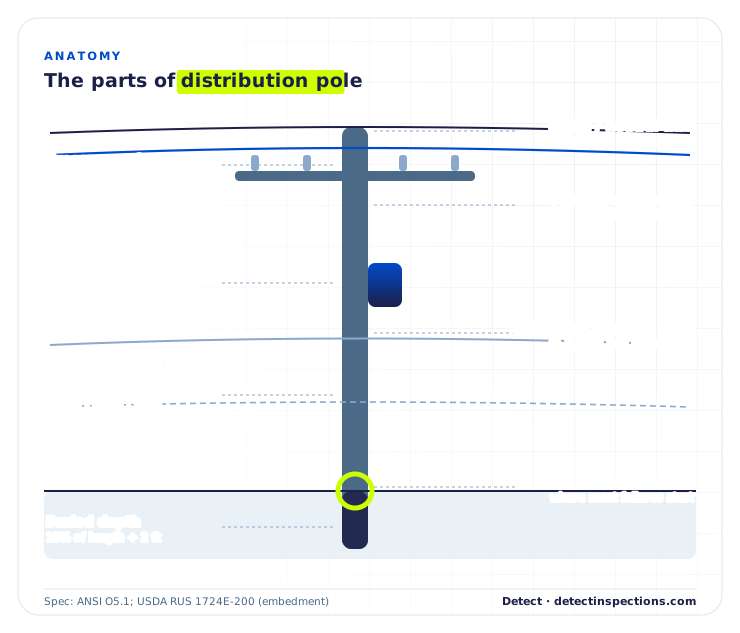
Read a distribution pole from the top down and you get a map of everything it does:
- Static or neutral wire at the peak, for lightning and fault return.
- Crossarms - wood or fiberglass arms that hold conductors apart. Splitting crossarms are one of the most common high-risk findings on aging lines.
- Insulators - porcelain or polymer, isolating energized conductors from the structure. Dead-end and strain insulators take the mechanical tension where lines end or turn.
- Primary conductors - the energized distribution lines, typically 4 to 35 kV.
- Transformers - the gray cans that step voltage down for service drops.
- Secondary and service lines - the low-voltage runs to buildings.
- The joint-use zone - the lower band where telephone, cable, and fiber attach, separated from power by a mandated safety space.
- Hardware everywhere - bolts, braces, pins, guy wires and anchors. Small parts, big consequences: a missing cotter key on one transmission structure was caught in time and averted more than $1M in forced-outage revenue.
Joint use is also an ownership story: the pole owner (usually the electric utility, sometimes the phone company) rents attachment space to everyone else, and the pole tag near eye level says whose asset you’re looking at.
How do you identify the wires and equipment on a utility pole?
Read it from the top down. Power lines and their equipment sit in the supply space at the top, communication lines sit lower in the communication space, and the National Electrical Safety Code requires a safety clearance between the two. These are the things you are most likely to see on a distribution pole:
| Where on the pole | What you see | What it is | Usually owned by |
|---|---|---|---|
| Pole top | A single wire on the peak or a small bracket | Static (shield) wire or neutral - lightning protection and fault return | Electric utility |
| Upper crossarm or pins | Bare wires on insulators | Primary conductors - the energized distribution lines | Electric utility |
| Beside a transformer or tap | Angled tubes hanging from a bracket | Fused cutouts - fuses that protect a transformer or tap line and open to isolate it | Electric utility |
| Next to the cutouts | Small ribbed cylinders | Lightning (surge) arresters - divert voltage surges to ground | Electric utility |
| Upper middle | A gray can | Transformer - steps primary voltage down for customers | Electric utility |
| Below the transformer | Twisted insulated cables running to buildings | Secondary lines and service drops - the low-voltage runs to homes and businesses | Electric utility |
| Lower band | Black cables lashed to a steel strand | Communication lines - telephone copper, cable TV coax, and fiber | Telecom and cable companies |
| Down the length of the pole | A bare or covered wire running to the ground | Ground wire - bonds equipment and the neutral to a ground rod | Electric utility |
| Near the base | A metal or plastic channel up the pole | Riser or U-guard - protects cables where they go underground | Whoever owns the cable |
| Angled to the ground | A steel cable to an anchor, often with a yellow guard | Guy wire - holds the pole against line tension at angles and line ends | Pole owner |
| Eye level | A metal tag and a stamped brand | Pole tag (owner and ID) and the brand or "birthmark" (class, length, species, treatment, year) | Pole owner |
What are the cable loops on utility poles?
Most loops of cable on a utility pole are there on purpose. The two you see along the street belong to the communication lines; the third sits where a service drop meets a building:
- Slack (storage) loops - coils of extra fiber-optic cable, often held on oval brackets nicknamed "snowshoes," left so crews can splice or reroute later without pulling new cable.
- Expansion loops - U-shaped bends in coaxial cable at each pole that let the cable expand and contract with temperature without cracking.
- Drip loops - the downward dip in a service drop just before it reaches a building, so rain runs off the low point instead of into the service entrance.
Loose, low-hanging, or tangled wire is a different matter. Never touch or move it - report it to the utility.
How are distribution poles different from transmission structures?
Distribution poles carry medium-voltage lines (4-35 kV) the last miles to customers; transmission structures carry 69 kV to 765 kV between substations, on much taller frames - steel lattice towers, monopoles, and wood or steel H-frames. High voltage power lines demand bigger clearances, deeper foundations, and different inspection planning at every step.
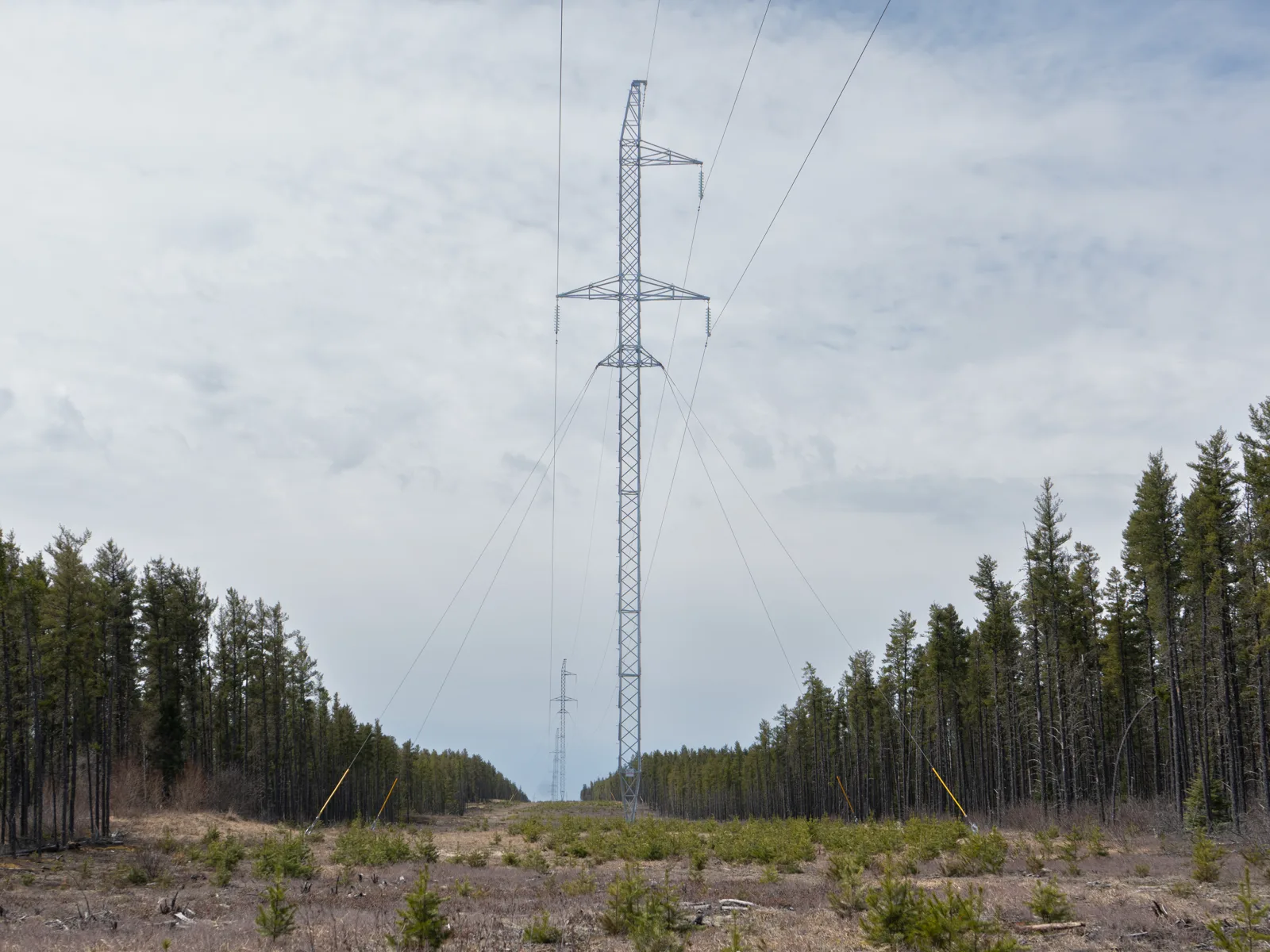
If you work on the transmission side, we keep a separate visual reference: our field guide to transmission structure types covers lattice, monopole, H-frame, and A-frame designs by voltage class, and what each means for a capture plan.
The materials story converges, though. Wood H-frames age like any other wood structure - and on two rural lines, 96 aging wooden H-frames turned out to hold 55 high-risk conditions between them. More on that below, because it’s the clearest picture of how poles actually fail.
What defects and failure modes affect utility poles?
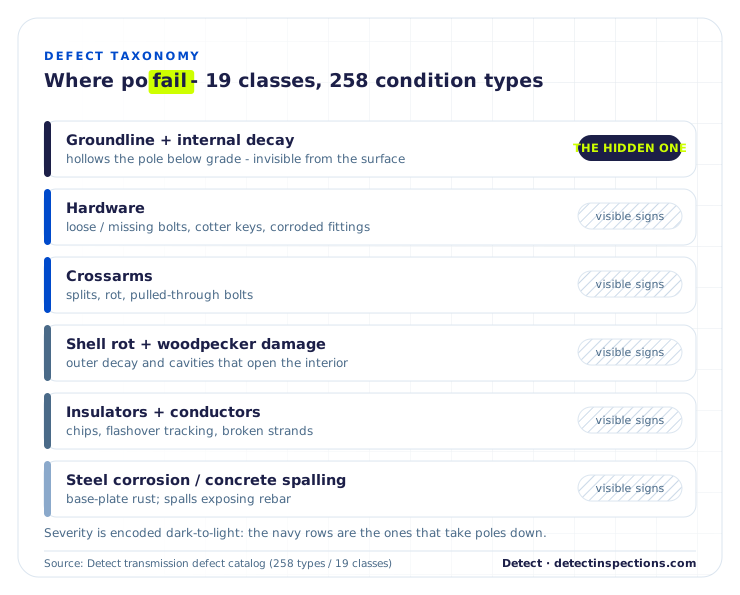
Most pole failures start where you can’t easily look. The two chronic blind spots are the groundline - where moisture and soil chemistry drive internal decay - and the hardware overhead, where bolts loosen and crossarms split one freeze-thaw cycle at a time. Detect’s transmission defect catalog runs to 258 condition types across 19 classes; poles and their hardware account for a large share of the findings that matter.
What does wood pole decay look like?
From the outside, often like nothing at all. Decay fungi work from the inside out, and the USDA Forest Products Laboratory is blunt about the consequence: visual inspection cannot always detect early-stage decay, precisely when treatment could still save the pole. The named conditions:
- Internal and groundline rot - the classic failure path, hollowing the pole below grade while the surface looks sound.
- Shell rot - external decay of the outer shell, common in wet climates.
- Woodpecker damage - cavities that open the pole’s interior to water and accelerate everything else.
- Splits and checks - drying cracks that admit moisture past the treated shell.
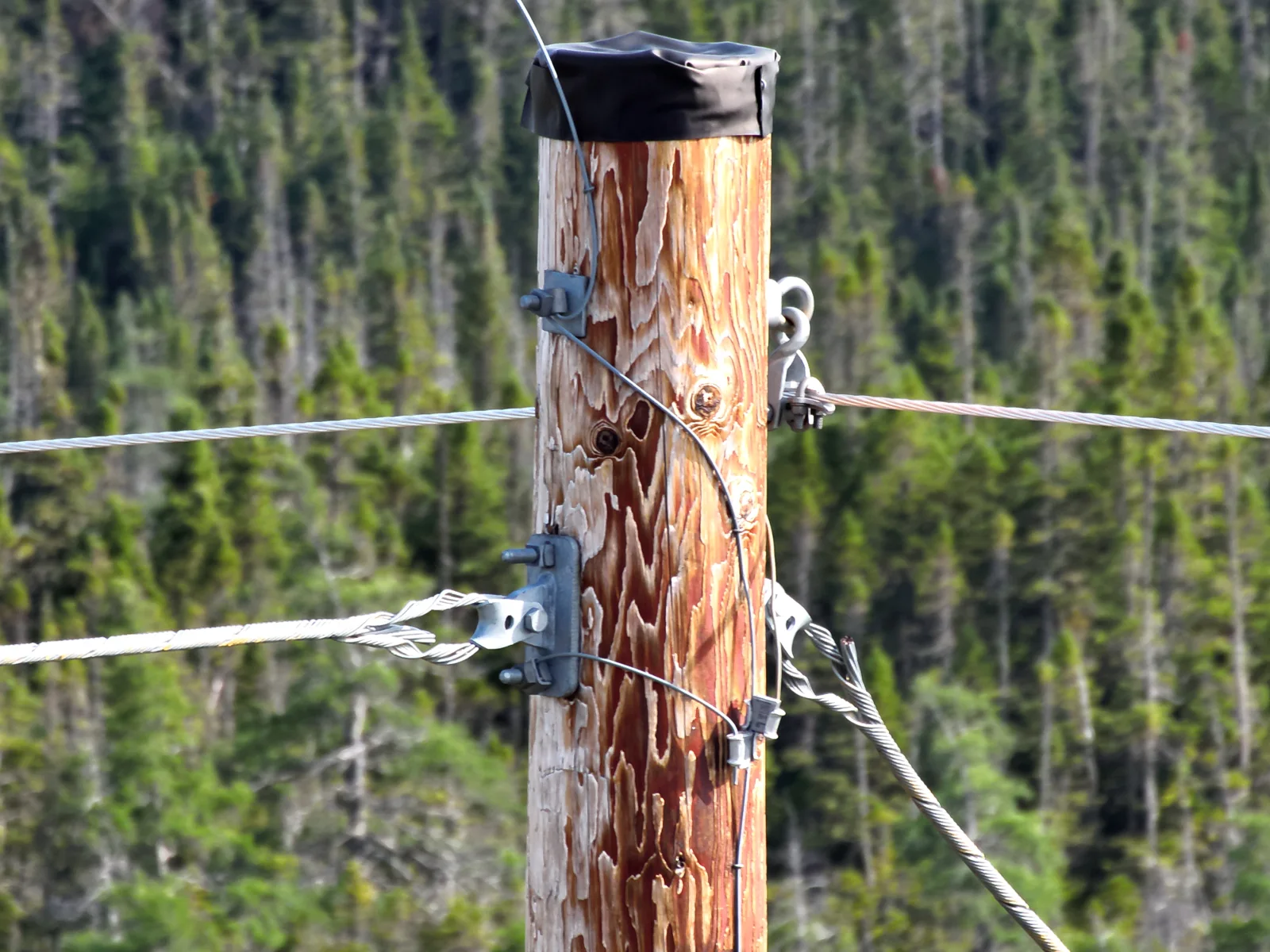
Two rural lines. 96 wooden H-frames. One field day of drone capture found 55 high-risk conditions - rotten poles, corroded hardware, splitting cross-arms - and funded the rebuild a decade of patrol reports couldn’t.
What fails on steel and concrete poles?
Steel fails by corrosion - at the groundline, the base plate, and wherever coatings break. Concrete fails by spalling: surface concrete breaks away, exposes rebar, and the reinforcement corrodes from there. Both are slower than wood decay and both are visible earlier - if something is looking.
How are utility poles inspected?
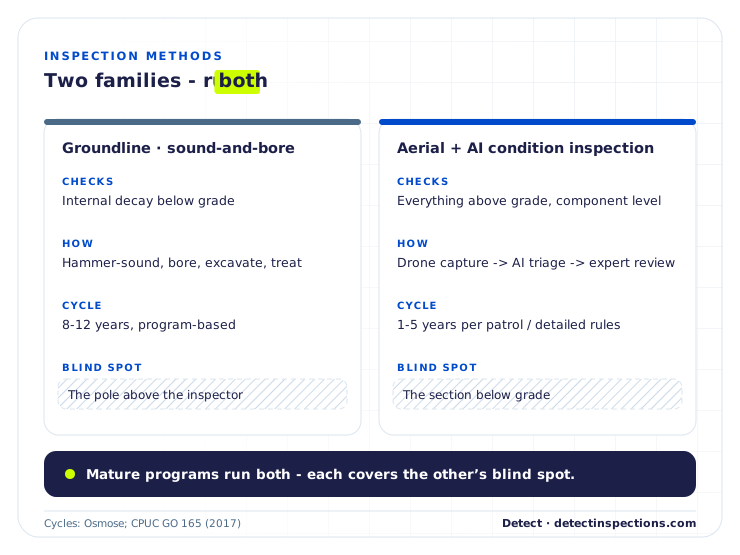
Two families of methods, and mature programs run both. Groundline testing physically checks the below-grade section on a multi-year cycle. Visual and aerial condition inspection covers everything above grade - and modern aerial programs with AI review are turning that from a windshield glance into component-level data.
The inspection cycle is no longer only an internal choice. Texas now requires every electric utility, municipal utility, and cooperative to file a pole management and inspection plan by January 1, 2027, and nine states tie wildfire liability protection to substantial compliance with an inspection-bearing plan - the 2026 utility inspection requirements set out what each rule makes a utility prove.
What is sound-and-bore (groundline) inspection?
An inspector hammers the pole and listens - a hollow or dull report suggests internal decay (USDA FPL) - then drills to measure shell thickness, excavates around the groundline, and applies preservative before backfilling. It’s labor-intensive and it’s the standard, because nothing else directly measures the wood you can’t see. Inspection cycles with comprehensive groundline programs typically extend to 8-12 years, and the USDA’s RUS Bulletin 1730B-121 remains the reference procedure for wood pole inspection and maintenance.
How does drone and AI utility pole inspection work?
A drone crew captures every structure from multiple angles; software classifies conditions and routes the findings that matter to engineers. The sensor package decides what the mission can even find - our guide to drone utility inspection compares RGB, thermal, and LiDAR capture defect by defect. The workflow is the same one we run for transmission line inspection: AI screens the volume, utility-trained experts verify every finding, and the output is a risk-ranked work list rather than a stack of photos - the model behind our distribution network inspection programs.
Utility pole inspection from the air rises or falls on capture quality. In Detect’s Data Quality Program analysis, sharp imagery left 100% of the 258-type defect catalog assessable; blurry imagery left 7%. The camera doesn’t fix the program - the workflow does. The same rule governs power line inspection: the conductor and hardware findings are only as good as the pixels behind them.
How often must utility poles be inspected?
The national code is deliberately unprescriptive: NESC Rule 214 requires inspection “at such intervals as experience has shown to be necessary.” States fill in the numbers. California’s General Order 165 is the reference case:
| GO 165 requirement (distribution) | Interval |
|---|---|
| Patrol inspection - urban | 1 year |
| Patrol inspection - rural | 2 years (annual in high fire-threat districts) |
| Detailed inspection - overhead | 5 years |
| Intrusive (groundline) - poles over 15 yrs old, never bored | 10 years |
| Intrusive - after a passed inspection | 20 years |
Wildfire rules are tightening those cycles across the West; for utilities in fire country, inspection frequency is now a compliance line item, not a maintenance choice.
- Pull the register: age, material, treatment, and last inspection date for every pole.
- Rank by risk - fire-threat districts, the oldest wood, the highest-consequence feeders first.
- Bring overdue poles into the groundline program at the intervals your state sets.
- Fly high-resolution RGB on the priority lines, and have every finding expert-verified.
- Route verified findings into work orders - and let condition, not age, set replacements.
What does it cost to replace a utility pole?
The pole is cheap; the replacement isn’t. A bare 40-foot wood pole typically costs under $1,000 - but Duke Energy Florida’s pole inspection-and-replacement program runs about $10,800 per pole once labor, equipment, traffic control, and transfers are counted, and utility filings put wood-to-steel transmission structure replacements near $26,000 each (DOE, 2024).
That gap is the economic argument for condition-based replacement. Replace a sound 45-year-old pole on age alone and you’ve spent five figures early; miss a hollow 25-year-old and the failure chooses the timing for you. The math only works when the condition data is current - the same logic that drives utility asset management software decisions about every other asset class.
How do utilities track the condition of millions of poles?
The pole record lives in the asset register - location, class, age, treatment, attachments, inspection history - and inspection is what keeps that record honest. At 180 million poles nationally, no utility can carry pole condition in anyone’s head or in last decade’s spreadsheet.
Vehicle capture is how that scale gets covered. Detect's roof-mounted unit averages 1,000+ poles a day at road speed, binding each frame to the pole record as it is taken.
This is the layer Detect works in. DetectOS turns inspection imagery into structured, georeferenced condition records - each finding tied to its structure - verified through the Hybrid AI + Expert Review model before it reaches your queue. Decision-grade grid intelligence from every image, whether the structure is a 40-foot distribution pole or a 140-foot lattice tower - and proven on both.
Frequently asked questions
How long do utility poles last?
Who owns utility poles?
How tall is a standard utility pole?
What are utility poles treated with?
How can you tell if a utility pole is bad?
How often are utility poles inspected?
What is a utility pole made of?
Who do I call about a damaged utility pole?
What are the wires on a utility pole?
What are the loops of cable on utility poles?
Ready to see what your pole population is hiding?
Find the high-risk conditions in your network with a free audit. We’ll analyze a representative section of your system and show you what AI-plus-expert review catches before it becomes a failure. No strings.
Book a free audit →