
Drone Utility Inspection Uncovers High-Risk Decay of 96 Aging Wooden Structures
Visual Audit Accelerates Wooden H‑Frame Line Replacement
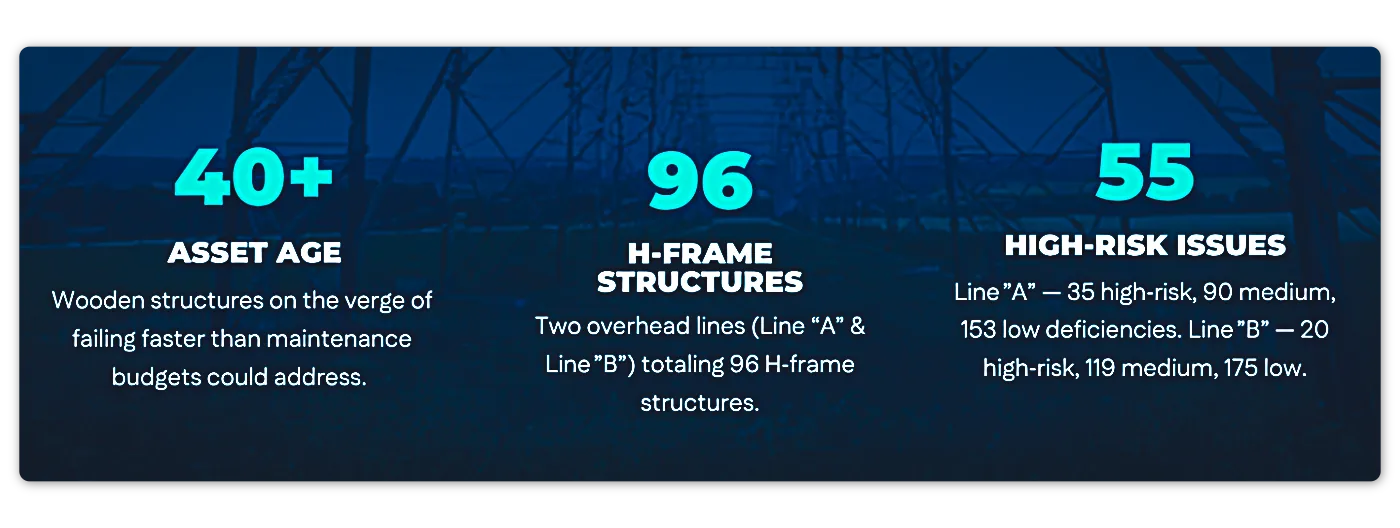
Government‑Owned Rural Transmission Lines in North America. 40‑plus‑year‑old wooden H‑frame transmission lines serving rural customers. 96 wooden transmission structures across two government-owned lines. O&M handled by regional utility under capital constraints.
Conditions Flagged
- Line ”A” — 35 high‑risk, 90 medium, 153 low deficiencies. Line ”B” — 20 high‑risk, 119 medium, 175 low deficiencies.
Actionable Outcome
- Evidence‑rich report convinced the asset owner in a 10‑minute meeting to release multi‑million‑dollar funding for a complete rebuild and scheduled work under the utility management team.
Reliability Impact
- Averted looming unscheduled outages due to rotten poles, missing bolts, and cross‑arm failures.
Why traditional utility asset management couldn't unlock capital for deteriorating wooden poles
For over a decade, a regional utility manager faced the same frustrating cycle: document deteriorating wooden H-frame lines, submit capital funding requests, receive denial stamps.
Two government-owned transmission lines serving rural customers were literally rotting away—rotten poles in soft ground, corroded hardware, splitting cross-arms—yet every spreadsheet and patrol report failed to move the needle.
The problem wasn't the data. It was the delivery.
Forty-year-old wooden structures were on the verge of failing faster than maintenance budgets could address. Yet, aerial fly-bys and ground patrol reports couldn't make the danger visceral to non-technical decision makers.
The Challenge: Making Risk Visible
Visual Proof Was the Missing Link to Executive Decision Makers
The utility needed irrefutable visual evidence to break through bureaucratic inertia and unlock long-delayed capital expenditure for 96 H-frame structures across two lines.
Mission requirements:
- Comprehensive documentation: Every structure captured with zero-gap coverage
- Executive persuasion: Translate technical defects into compelling visual narrative
- Rapid turnaround: Deliver decision-ready evidence before next budget cycle
- Regulatory readiness: Prepare for looming compliance audit
High-risk decay needed to be made visually undeniable. Traditional documentation methods had failed repeatedly—spreadsheets don't convey imminent structural collapse to cabinet committees. AI inspection of photos, not spreadsheets, made the case.
The Solution: Visual Evidence at Executive Scale
Drone Utility Inspection Delivered Zero-Gap Coverage in One Day
DetectOS deployed a rapid, comprehensive imaging campaign designed for storytelling impact, not just technical documentation.
Campaign specifications
- Duration: 1 field day
- Coverage: 100% of 96 H-frame structures (Lines A & B)
- Team: 3-person UAV crew
- Capture method: Four cardinal faces plus detailed imagery of specific equipment at risk in focus
- Processing: AI-assisted defect tagging with executive-ready storyboards
Execution: UAV crew captured four cardinal views + targeted risk imagery
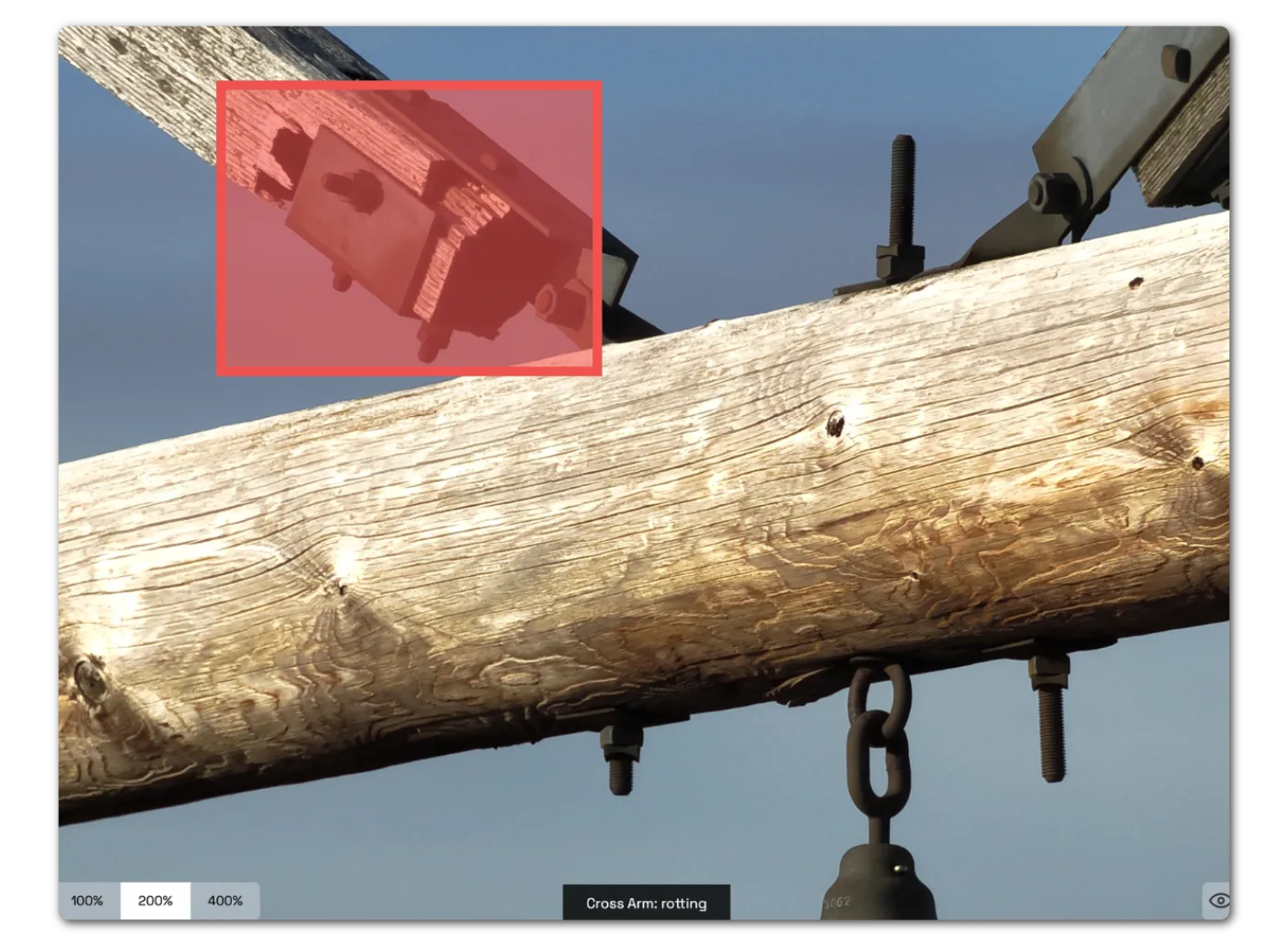
Synchronized UAV sorties captured high-resolution imagery of poles, cross-arms, guy wires, and footings, with every photo auto-organized and AI-tagged for structural defects. DetectOS auto-tagged defects for presentation-ready format.
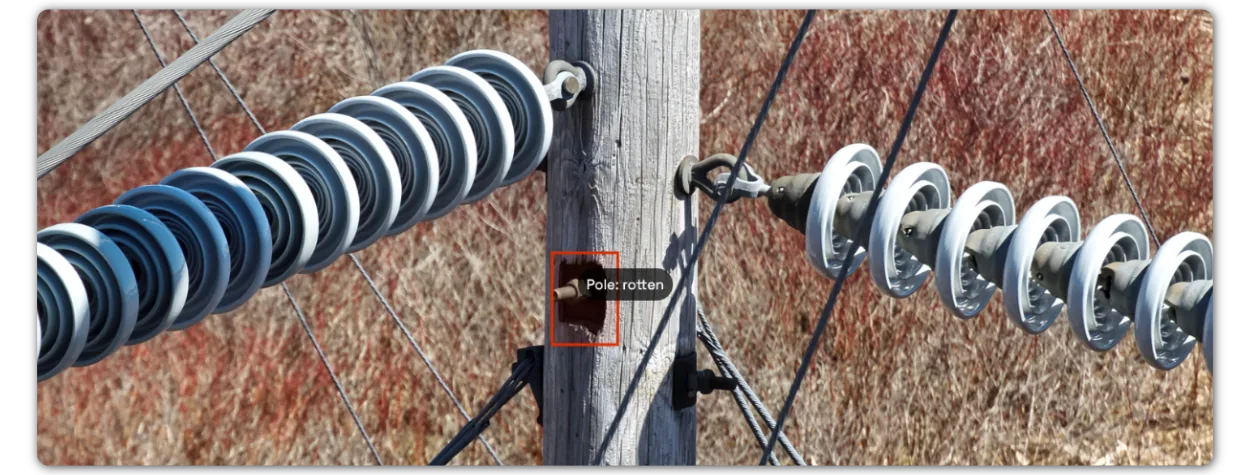
100% UAV Coverage and AI Defect Detection
DetectOS Tagged Defects Like Rotten Poles & Missing Bolts
Scope of Inspection: 96 Wooden H-Frame Structures Across Two Lines
DetectOS analysis revealed systematic structural decay across both lines:
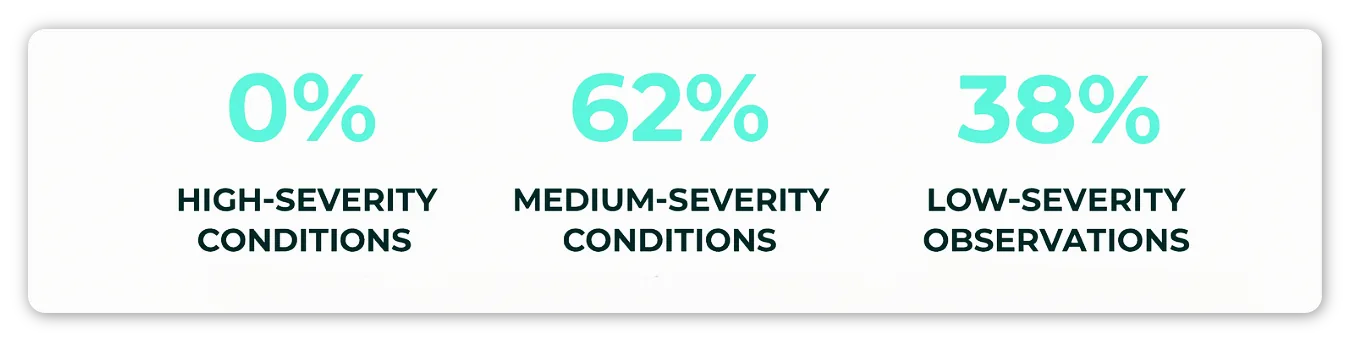
High-risk conditions: Rotten poles, cross-arm failures, and missing bolts
- Rotten poles with peripheral shell loss exceeding 50%
- Bolts fully loosened or pulled through decayed timber
- Missing through-bolts at cross-arm joints causing conductor sag
- Cross-arms splitting under conductor weight
Visual storytelling secures multi-million-dollar capital in 10 minutes
DetectOS distilled thousands of images into a concise, executive-level visual narrative. The evidence was undeniable: structural failures weren't a future risk—they were happening now.
The presentation result:
- Committee approval in under 10 minutes
- Multi-million dollar funding released immediately
- Complete rebuild authorized for both transmission lines
- Utility management now supervising replacement project
Results: Reliability and Safety Delivered
From Outage Prevention to Infrastructure Modernization
While the rapid funding approval made headlines, the comprehensive rebuild addresses broader infrastructure challenges:
Operational benefits: Eliminated emergency failure risk in rural areas
- Service continuity: Prevented unscheduled outages in rural communities
- Public safety: Eliminated risk of structural collapse and conductor drops
- Regulatory compliance: Addressed audit concerns proactively
- Asset optimization: Modern replacement infrastructure reduces long-term maintenance

Strategic impact: Public safety and compliance addressed proactively
- Evidence-driven decision making replaced bureaucratic delays
- Visual storytelling accelerated multi-year budget cycles
- Proactive replacement prevented emergency response costs
Detect’s 6-step playbook when facing funding roadblocks
The playbook the Detect team rolled out works for any transmission owner managing new or recently upgraded infrastructure where latent construction issues hide in plain sight.
- Comprehensive Visual Capture: Capture 100% of new structures post-energization
- AI-Assisted Risk Highlighting: Let DetectOS auto-classify and prioritize anomalies
- Executive-Ready Storytelling: Convert findings into executable tasks with precise resource planning
- Decision-Focused Presentation: Bundle high-severity fixes with planned maintenance windows
- Remediation Audit: Capture post-repair imagery to confirm each issue was resolved and documented properly
- Follow-Through Management: Use evidence to close warranties and refine future construction specs
Free Audit: How to Scale for Aging Power Infrastructure
This utility had the data for years. What they lacked was evidence that stuck. DetectOS delivered that in one day—showing rot, corrosion, and imminent failure in a way that finally moved the needle. With visual documentation in place, they secured funding and launched rebuilds. How evidence-ranked findings become risk-based work plans that a committee can approve in minutes is the playbook this project proved. Now, they’re layering in post-repair verification and long-term monitoring to make sure this investment stays strong.
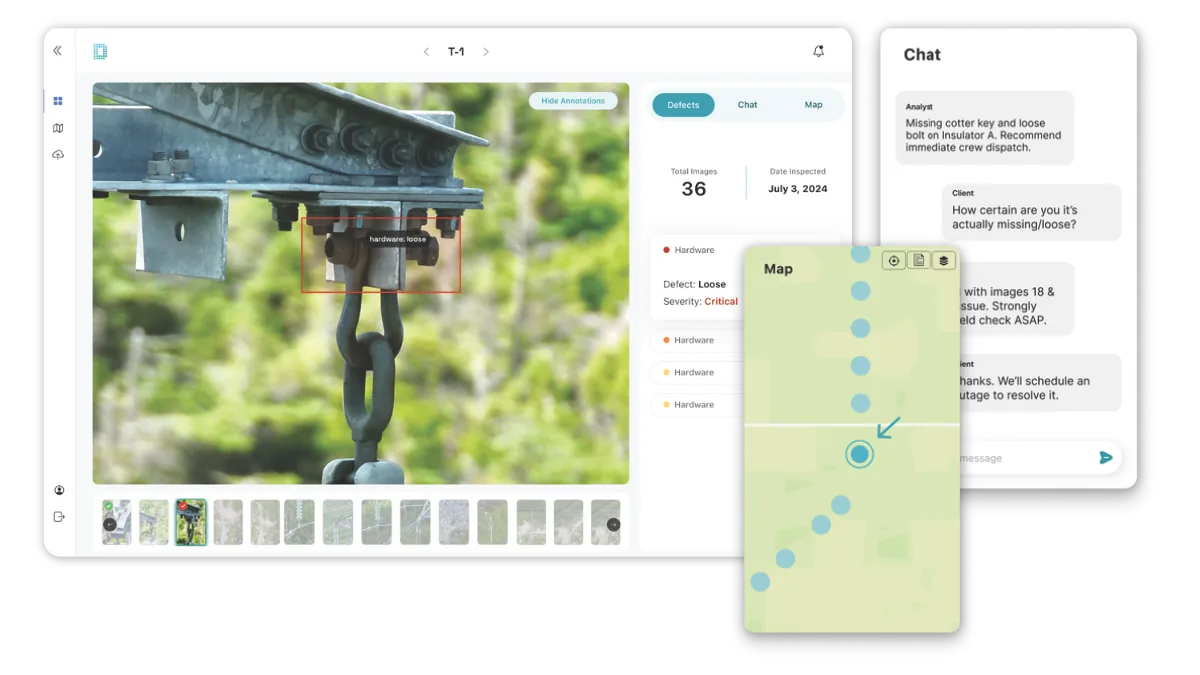
When the risk is real but the data isn’t landing, change the story. Detect helps you verify the fix, ensure it’s done right, and monitor those same assets into the future. That’s how you turn inspection into strategy.
Your team deserves more than another spreadsheet.
Request a free audit and see how visual evidence, traceable fixes, and ongoing monitoring can help you defend your capital plan—and your grid.
Related reading: learn about H-frame and other transmission structure types, transmission line inspection for failure prevention, what happens when structures pass their design life, and justifying replacement spend with AI asset inspection ROI.
