
Utility Drone Pilot Jobs: How to Get Power Line Inspection Work in 2026
Utility inspection is one of the clearest lanes in commercial drone work, and one of the most demanding. Here is what utilities actually pay for, how pilots qualify, and where the work comes from in 2026.
Utility drone pilot jobs require four things. You need a Part 107 certificate (or Transport Canada's Advanced certificate), working knowledge of poles and towers, capture verified against a shot sheet, and contractor prequalification. The work arrives through drone service providers, pilot networks, utilities' own programs, and inspection-data companies that win programs and need pilots.
- The certificate is the floor, not the job. Part 107 in the U.S., or the Advanced certificate in Canada, makes the flight legal. Utilities pay for complete, usable image sets.
- Utilities reject imagery at a measured rate. On utility contracts, 15-25% of delivered imagery typically needs remediation; standardized-capture programs cut that to 3-7% (Detect, State of Utility Drone Inspections, 2026).
- The Utility Pilot Ladder has five rungs: Licensed, Fluent, Verified, Prequalified, Trusted. The hardest climb is from Fluent to Verified.
- Four doors lead to the work: drone service providers, pilot networks, utility in-house programs, and inspection-data companies with partner networks.
- Repeat work follows first-pass acceptance. The pilot whose sets clear review on the first upload is the one who gets the next feeder.
Drone pilot job listings almost always open with the same line: Part 107 required. Utility work asks for more, and pays for more, because the client is not buying a flight. A utility is buying evidence about the structures that keep the lights on. Every insulator, crossarm, and connection has to be photographed well enough that an engineer can decide what to fix without driving out to look.
This guide is the path from that certificate to steady utility inspection work. It covers what the job is, which credentials matter, the capture skills utilities grade, how prequalification works, where the work comes from, and how it pays. It is written by the team that reviews utility inspection imagery for a living. So it is mostly about the frames that get rejected, and why.
What does a utility drone pilot actually do?
A utility drone pilot captures inspection imagery of transmission and distribution structures - poles, towers, and substations - to a written shot sheet. The pilot checks every frame before leaving the site and delivers sets an engineer can review without a second trip. Flying is the smallest part of the job; completeness is the deliverable.
Most days look the same: a list of structures, a shot sheet for each structure type, and a vehicle. On a distribution pole, the sheet specifies the angles that show the pole-top hardware - insulators, crossarms, cutouts, arresters, transformer connections. One recent contract posting for distribution work specified about five shots per pole, all above conductor height, paid per pole inspected.
Transmission structures add elevations, faces, and hardware. The sheet calls for insulator strings from several heights, shield wire attachments, and the small parts that fail big. On a newly commissioned HVDC line, the critical find was one clevis bolt with a missing cotter key, in the line's first operating season. Clearing it took 120 minutes of field time, and more than $1M in forced-outage revenue was averted (Detect, HVDC transmission inspection case).
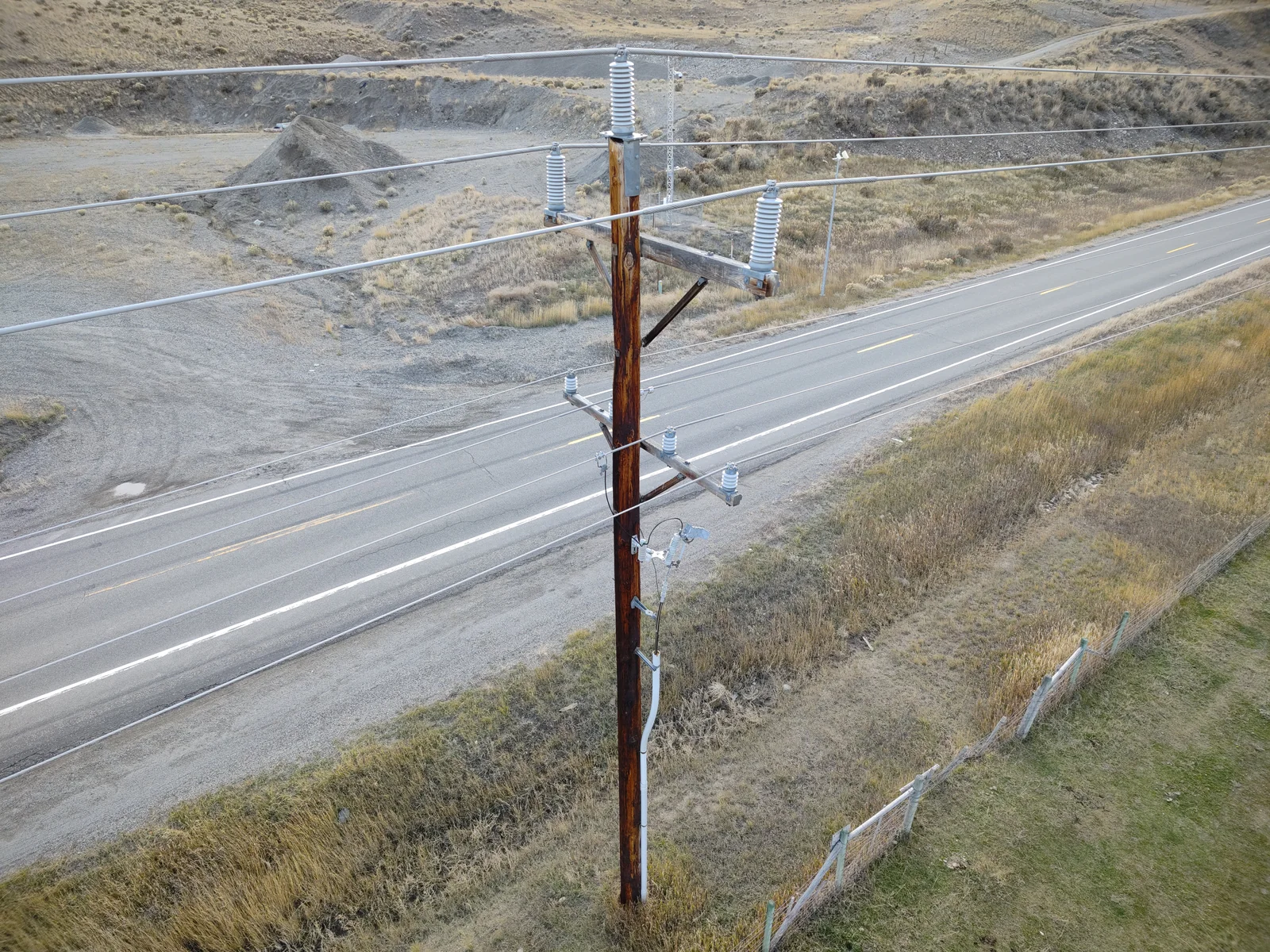
A distribution pole from Detect's utility inspection photo records. A shot sheet specifies every angle on a structure like this in advance. The pilot's job is to deliver all of them, sharp, and tied to the right structure ID.
The job also includes everything around the flight: site access and safety briefings, the standoff distances the utility sets from energized conductors, structure identification, and the upload. On storm duty, it includes all of that at speed, on structures you have never seen.
Which certifications do you need for utility drone work?
In the U.S., the legal minimum is the FAA's Part 107 Remote Pilot Certificate; in Canada, it is Transport Canada's Pilot Certificate - Advanced Operations. Everything beyond that comes from the utility or the contractor, not the regulator: safety prequalification, capture verification, and approvals for beyond-visual-line-of-sight work.
| Credential | What it proves | Who asks for it | Keeping it current |
|---|---|---|---|
| FAA Part 107 Remote Pilot Certificate | Legal to fly commercially in the U.S. | Every U.S. utility job | Free online recurrent training every 24 calendar months |
| Part 107 waiver | Approval for a specific operation outside the standard rules, such as beyond visual line of sight | Long-corridor and docked-drone programs | Per the waiver's terms |
| Transport Canada Advanced certificate | Legal for advanced operations in Canada, including controlled airspace and flights near people | Canadian utility work | Recency requirements apply |
| Transport Canada Level 1 Complex certificate | Lower-risk BVLOS operations, in force since November 4, 2025 | BVLOS corridor work in Canada | Built on 20 hours of ground school, an exam, and a flight review |
| Contractor safety training | Site hazards, energized-line awareness, emergency procedures | Most utility contractors | Per the contractor's program |
| Capture verification | You can deliver a shot sheet completely and consistently | Programs that grade every image | Re-checked on every delivery |
Part 107 itself is accessible. Applicants must be at least 16 and pass the FAA's initial aeronautical knowledge test at an approved testing center. Applicants also clear a TSA security check before the certificate issues (14 CFR Part 107). Staying current takes free online recurrent training every 24 calendar months.
Beyond-visual-line-of-sight work is the open question. Part 108, the FAA's rule to make BVLOS operations routine, had not been published as a final rule as of early October 2026. It has been under White House review since July 10, 2026, and the FAA has said it hopes to publish by the end of the year. Until then, routine BVLOS still runs on Part 107 waivers. For contractors, Part 108 will reshape utility drone contracts as much as flight operations.
In Canada, the Advanced certificate requires a 50-question online exam (80% to pass) and a flight review. Since November 4, 2025, a Level 1 Complex certificate has covered lower-risk BVLOS flights in sparsely populated areas. It requires 20 hours of ground school, an exam, and a flight review. The operator also needs an RPAS Operator Certificate (Transport Canada, 2025 summary of changes to Canada's drone regulations). Canadian utility work then adds written procedures. A utility drone SOP in Canada runs to five documents, from the operations manual to the field QA checklist.
Industry certificates sit above the regulator's. Certification platforms fall into three tiers - legal to fly, safe to operate, qualified to deliver - and only the qualified-to-deliver tier measures the dataset a utility actually buys.
What skills do utilities pay drone pilots for?
Utilities pay for complete, consistent, usable image sets: every specified angle, sharp enough to assess, tied to the right structure, with metadata intact. Five skills produce that.
- Structure fluency. Knowing what you are looking at, and why each shot exists. A pilot who can name every wire and component on a utility pole frames the defect; one who cannot frames the pole. On transmission work, flight paths change by structure type - lattice, H-frame, monopole, dead-end.
- Shot-sheet discipline. Fly the whole sheet, in order - not just the shots that look good.
- A settings floor. Shutter speed, focus, and exposure that hold when wind, light, and distance change. Sharpness decides what review can see at all. In Detect's grading data, sharp imagery leaves 100% of a 258-type defect catalog assessable, soft imagery 69%, and blurry imagery 7%.
- Association. Every image tied to the right structure ID and location before you leave the site.
- On-site review. Check every frame against the sheet before you pack up. It is the cheapest re-fly you will ever make.
None of these are stick-and-rudder skills. They are delivery skills, and flight hours alone do not teach them. That is why utility photo data quality is graded image by image, before any defect model runs.
Why do utilities reject drone inspection imagery?
Mostly for reasons the pilot controls. Detect's industry research breaks delivered-imagery rework into five causes (Detect, State of Utility Drone Inspections, 2026). GPS misassociation leads at 35%, then missing component coverage at 30%, resolution and focus at 18%, metadata mismatch at 12%, and lighting or weather artifacts at 5%. On utility contracts, 15-25% of delivered imagery typically needs remediation. Standardized-capture programs cut that to 3-7% within two campaigns.
Every cause on that list has a field habit that prevents it. Confirm the structure ID before the first frame. Fly the full sheet. Hold the settings floor. Use the client's naming spec. Reshoot glare before you leave. Each of the five data quality failures behind rejected utility inspections starts as one of these skipped habits and ends as unpaid rework.
~30% of ad-hoc inspection imagery is rejected as unusable. Ad-hoc means no shot sheet, mixed settings, and grading after the fact. The fix is not a better drone. It is a written standard, flown every time, and checked before you leave the site.
Source: Detect, State of Utility Drone Inspections, 2026.
What is the Utility Pilot Ladder?
The Utility Pilot Ladder is Detect's five-rung model of how a drone pilot becomes someone utilities dispatch again and again: Licensed, Fluent, Verified, Prequalified, Trusted. Each rung is a different kind of proof, and someone different checks each one.
What does each rung prove?
- Licensed - legal to fly commercially. The regulator checks it once, and recurrent training keeps it valid.
- Fluent - you know what to capture and why. A course can teach it; your first set reveals whether it stuck.
- Verified - you have delivered a shot sheet completely and consistently, graded by someone who reviews utility imagery.
- Prequalified - insurance, safety records, background checks, and aircraft documents are in order. The contractor checks before dispatch.
- Trusted - your sets clear review on the first upload, campaign after campaign. The utility's QA checks it on every delivery.
Why is Verified the hardest rung?
Because it is the first rung measured by output rather than by a test or a document. Knowing the components is not the same as delivering them - every angle, on every structure, at the same quality on the fortieth pole as the first. Verification is where that gets measured. It is also the one rung a pilot can climb before anyone has hired them, which makes it the best place to start.
Can you skip rungs?
Not for long. A pilot who reaches Prequalified without Verified tends to be dispatched once and rejected once, and the contractor remembers the rework, not the paperwork. The order matters because each rung is what makes the next one worth checking.
Where do utility drone inspection jobs come from?
Utility drone inspection jobs come from four doors: drone service providers, pilot networks and marketplaces, utilities' in-house programs, and inspection-data companies with partner networks. Each door screens for something different.
| Door | How the work arrives | What they screen for | Watch for |
|---|---|---|---|
| Drone service providers and inspection contractors | Subcontract or staff roles on utility contracts | Utility experience, prequalification, insurance | Standards change contract by contract; your quality rides on their QA |
| Pilot networks and marketplaces | Job-by-job dispatch across many industries | Part 107, insurance, equipment, location | Utility jobs sit beside roofs and real estate; capture standards vary job to job |
| Utility in-house programs | Staff or contract roles at the utility itself | Utility background; some train new hires on their own standards | Fewer openings, usually regional |
| Inspection-data companies with partner networks | Verified pilots fly the utility programs the company wins | Verified capture against the company's shot sheets, then prequalification | Verification comes first; work follows the programs won |
The fourth door maps most directly onto the Ladder: verification first, then prequalification, then work. The Detect Partner Network is the pool of verified pilots Detect draws from when it wins utility inspection projects. Partners fly that work, and the work pays their firms. The way in is free utility drone pilot training in two parts, closed by a 30-minute review call. Part 1 is a self-guided course; Part 2 is about two hours of capture on any quadcopter, flown manually against a pre-built shot sheet. There is no cap on attempts, and re-flies are free. In September 2026, the Partner Network opened to any pilot and any drone, with the equipment rules removed.
Storm rosters cut across all four doors, and they are signed before the season, not during the event. Storm rosters are the fastest-growing door into utility work, and they reward pilots who deliver first-pass-accepted imagery in the worst week of the year.
How do drone pilots get prequalified for utility work?
Prequalification is the paperwork that lets a contractor put you on a utility site. It covers insurance, safety records, background checks, and proof that your aircraft and data handling meet the contract. Build the file before you need it. Prequalification runs on the contractor's timeline, not yours.
- Insurance. Aviation liability at minimum, with limits that utilities set as insurance thresholds for drone inspection vendors in each contract.
- Safety prequalification. Many utilities run contractors through safety-prequalification platforms such as ISNetworld. A drone service provider or network may carry you under its own account.
- Background and drug screening. Common on utility contracts and pilot postings alike.
- Aircraft documentation. Registration, Remote ID compliance (enforced since March 2024), and maintenance and flight logs. Where the contract requires it, you also need an NDAA-compliant platform; which drones are NDAA compliant is its own short list.
- Data handling. NDAs, data residency, and cyber insurance increasingly sit on the same scorecard. Detect's 2026 industry report lists NDAA documentation, data residency, ISNetworld, and cyber insurance among the items utilities score (Detect, State of Utility Drone Inspections, 2026).
How are utility drone pilots paid?
Utility drone work is usually paid one of four ways: per structure (common on distribution work), per day, per mile on corridor programs, or as a salaried in-house role. Published pay figures vary too widely to serve as a benchmark. What moves a pilot's effective rate is first-pass acceptance.
The arithmetic is simple. On per-structure pay, every re-fly is unpaid time. Re-flying 20% of a set means doing 120% of the work for 100% of the pay - about a one-sixth cut to the effective rate, before travel. On day rates and fixed-fee contracts, the same rework lands on the contractor's margin, and contractors remember who caused it. That is why the Ladder ends at Trusted. The best effective rates rarely go to the fastest flyers; they go to pilots whose sets do not come back.
Specialized capture widens the work a pilot can take: storm availability, BVLOS-waiver experience, and thermal or LiDAR payloads. RGB, LiDAR, and thermal capture find different defects, and each sensor brings its own shot-sheet rules.
How do you land your first utility drone inspection job?
Six moves, in order. Skip one, and the next door stays closed.
- Get legal and stay current. Earn Part 107 - or Transport Canada's Advanced certificate - and put the 24-month recurrent training on your calendar the day the certificate arrives.
- Learn the structures. Study poles, towers, and the components on them until you can say why every shot on a sheet exists.
- Get your capture verified. Fly a real shot sheet and have it graded by people who review utility imagery. Detect's free utility drone pilot training does this on any quadcopter, with free re-flies.
- Build your prequalification file. Insurance certificates, safety-prequalification readiness, background-check readiness, registration and Remote ID, and flight and maintenance logs - plus an NDAA-compliant aircraft if you are targeting those contracts.
- Open every door. Apply to drone service providers with utility contracts, join pilot networks, watch utility postings, and join a partner network that routes utility programs to verified pilots. Get on storm rosters before the season.
- Protect first-pass acceptance. Review every frame on site, track why sets come back, and fix the cause rather than the symptom.
Most of the six cost time rather than money. Verification is the step that turns the other five into evidence.
The bottom line: utilities hire datasets, not flight hours
Utility drone pilot jobs go to pilots who deliver complete, usable sets every time. The certificate gets you considered, verified capture gets you dispatched, and first-pass acceptance gets you called back. Climb the Ladder in order, and finding work stops being a search.
The quickest test of where you stand: fly one shot sheet and have it graded. The result tells you which rung you are on.
Fly utility inspection work with Detect
The Detect Partner Network is the pool of verified pilots who fly the utility programs Detect wins. The way in is free utility drone pilot training: a self-guided course, about two hours of capture on any quadcopter, and a 30-minute review call.
Apply to the Partner Network →