
A Beginner's Guide to Utility Drone SOPs in Canada
Transport Canada certifies that a pilot can fly. It does not tell five pilots how to fly the same structure the same way. Here is what Canadian drone service providers write down to standardize flight procedures, training expectations, and safety compliance - and what a utility should ask to see.
A utility drone SOP in Canada is five documents: an operations manual that matches Transport Canada's rules, a site and safety procedure for utility hazards, a capture standard with a shot sheet per structure type, a field QA checklist that runs before the crew leaves, and a data handling standard in the utility's format. Drone training services that help Canadian DSPs enforce repeatable flight procedures are the ones that train to that capture standard and verify it in the air - the certificate is the floor, not the procedure.
- The certificate is the floor. Transport Canada's pilot certificate covers airspace, rules, and safe operation. It does not cover coverage, camera settings, or which structure a photo belongs to.
- Five documents, not one binder. Operations manual, site and safety procedure, capture standard, field QA and demob checklist, data handling and delivery. Most DSPs have the first two.
- 83% of imagery rework is closed by one document. Missing coverage (30%), GPS misassociation (35%), and focus (18%) all trace to the capture standard (Detect, State of Utility Drone Inspections 2026).
- Canadian conditions belong in writing. Cold, ice, wildfire season, and remote access are go/no-go thresholds in the SOP, not judgment calls in the truck.
- Standardized capture cuts rework from 15-25% to 3-7% within two campaigns - the number that makes an SOP a margin line.
- Require outcomes, name programs as ways to meet them. A flown verification per pilot and acceptance criteria at ingest keep the field open and the data consistent.
- What standard operating procedures are for utility drone work
- Flight safety compliance under Transport Canada's rules
- The Five-Document SOP Set
- Why repeatable flight procedures matter more than the certificate
- What drone operations training should cover
- Which training services enforce repeatable procedures
- How to write your first SOP set
- The bottom line · FAQ
A Canadian utility hires a drone service provider whose pilots all hold advanced certificates, whose insurance is current, and whose safety record is clean. The first campaign comes back with a quarter of the imagery unusable: the angle that shows the cotter key was never flown on Line B, the exposure drifted as the light changed, and two hundred photos are tagged to the wrong structure because the towers stand closer together than the GPS can tell apart.
Nothing in that outcome broke a rule. The gap is not certification and it is not competence. It is that nobody wrote down how the work is done, so each pilot did it their own way. This guide is about closing that gap: what standard operating procedures look like for utility drone work in Canada, what they must say, and which training actually makes crews follow them.
What are standard operating procedures for utility drone inspection?
Standard operating procedures are the written instructions a crew follows so that the same job produces the same result regardless of who flies it. For utility inspection, that covers four things: how the operation stays legal, how the crew stays safe on a utility site, how the imagery is captured, and how the data is handled after landing.
The reason utilities care is simple. An inspection record is only useful if this year's photographs can be compared to last year's. A nine-step utility drone inspection workflow describes the sequence a job moves through; the SOP is what makes each step repeatable across pilots, crews, and seasons. Without it, the utility receives photographs. With it, the utility receives a record.
How does flight safety compliance work for utility drones in Canada?
Commercial drone operations in Canada run under Part IX of the Canadian Aviation Regulations, administered by Transport Canada. Pilots hold a pilot certificate for basic or advanced operations - advanced operations require a flight review in addition to the knowledge exam - and aircraft in the standard weight class are registered. Operations that fall outside the standard rules require a Special Flight Operations Certificate. Transport Canada's 2025 RPAS amendments (SOR/2025-70) opened routine lower-risk beyond-visual-line-of-sight operations to certified operators (Transport Canada, 2025).
That framework is the legal floor, and the operations manual - document one of the five - is where a DSP writes down how its fleet and its people meet it: which certificates each pilot holds and when they lapse, which aircraft are registered, how airspace is checked before every flight, and which of the DSP's routine operations would trigger an SFOC so the question is settled before a bid, not on site. Flight safety compliance is a documentation discipline first: if the manual cannot show it, the utility's procurement team cannot verify it.
Two things the floor does not cover matter to a utility more than the floor itself. The regulations say nothing about clearances from energized conductors, crew communications with a control centre, or what happens when ice changes what a camera can see - that is document two. And they say nothing about the photograph - which angle, which settings, which structure it belongs to. That is document three, and it is where most of the cost lives.
What goes into the Five-Document SOP Set?
Detect groups utility drone procedures into five documents, each answering one question a utility will eventually ask. Most Canadian drone service providers already have the first two. The three that follow are the ones that decide whether the data is usable.
| Document | What it contains | Anchored to | What it prevents |
|---|---|---|---|
| 1. Operations manual | Certificates and recency per pilot, aircraft registration, airspace and NOTAM procedure, SFOC trigger conditions, incident reporting | Canadian Aviation Regulations Part IX (Transport Canada) | A grounded crew, a failed procurement check |
| 2. Site and safety procedure | Minimum distances from energized lines, crew roles, utility contact and lockout coordination, go/no-go thresholds for wind, cold, ice, and wildfire restrictions, remote-access plan | The utility's safety rules and the DSP's own risk assessment | Incidents, weather-driven rework, stranded crews |
| 3. Capture standard | Shot sheet per structure type (required angles and components), camera-settings floor, overlap and altitude for mapping, image-to-structure association method | The utility's photo spec and defect taxonomy; EPRI guidance | Missing coverage, soft imagery, photos on the wrong structure |
| 4. Field QA and demob checklist | Frame review against the sheet before leaving the site, re-shoot rules, sign-off | Document 3 | Re-mobilization to a remote line |
| 5. Data handling and delivery | Naming, metadata fields, coordinate reference, retention and access controls, delivery format and timing | The utility's asset systems and data policy | Rejected deliveries, records that cannot be trended |
Read as a set, the documents nest: two depends on one, four depends on three, five depends on both. A DSP that writes them in that order ends up with an SOP a utility can audit line by line - and, more usefully, with a training curriculum, because each document is also the syllabus for the crew that has to follow it.
Why do repeatable flight procedures matter more than the certificate?
Because the rework data says so. In Detect's analysis across utility inspection programs, delivered-imagery rework breaks down into five causes: GPS misassociation 35%, missing component coverage 30%, resolution and focus 18%, metadata format mismatch 12%, and lighting or weather artifacts 5% (Detect, State of Utility Drone Inspections, 2026). Map each cause to the document that closes it and the pattern is hard to miss.
Coverage, association, and focus - 83% of rework - all belong to document three, the capture standard. They are not certificate questions and they are not competence questions. They are the difference between a pilot who decides what to shoot and a pilot who flies a sheet. The five data quality failures behind rejected utility inspections are the same five causes seen from the DSP's side of the invoice.
The financial version of the same finding: across the contracts in that research, 15-25% of delivered imagery needs remediation before the utility can use it, and programs that adopt a standardized capture workflow bring that to 3-7% within two campaigns. For a fixed-fee contract on a remote Canadian line, the difference is not a quality metric. It is whether the crew flies back.
83% of delivered-imagery rework - missing coverage, GPS misassociation, and focus - is closed by one document: a capture standard the pilot has flown, not just read.
Source: Detect, State of Utility Drone Inspections, 2026; document mapping by Detect.
Canadian geography raises the stakes on every line of that table. The warranty audit of 618 lattice structures across two remote transmission lines - muskeg, permafrost, boreal forest, and a deadline set by winter freeze-up - was completed in nine days with documentation delivered within 72 hours of the last flight, protecting service to 17 communities. A coverage gap found back at the office would have meant a second mobilization into terrain the ground crews could not safely reach. The SOP that puts QA at the truck is the only one that survives that geography - and the same structure-level record is what lets storm damage photos be triaged into a ranked work list when the event has already happened.
What should drone operations training cover for Canadian utility work?
Three layers, in order. Certificate preparation gets a pilot legal under Part IX. Operator safety training - site rules, energized-line awareness, cold-weather and remote-operations procedure - gets a crew onto a utility site. Capture training gets the deliverable right: the shot sheet for each structure type, the camera-settings floor, the association check, and the field QA habit. Most drone operations training in Canada stops after the first layer, sometimes the second. The third is the one the utility is paying for.
Capture sharpness sets a ceiling on what any analysis can find. In Detect's Data Quality Program analysis, sharp imagery left 100% of a 258-type defect catalog assessable, soft imagery 69%, and blurry imagery 7%. Low winter sun, snow glare, and cold-shortened flight windows push a crew toward soft imagery unless the settings floor is written down and the go/no-go call is made from the procedure rather than from optimism.
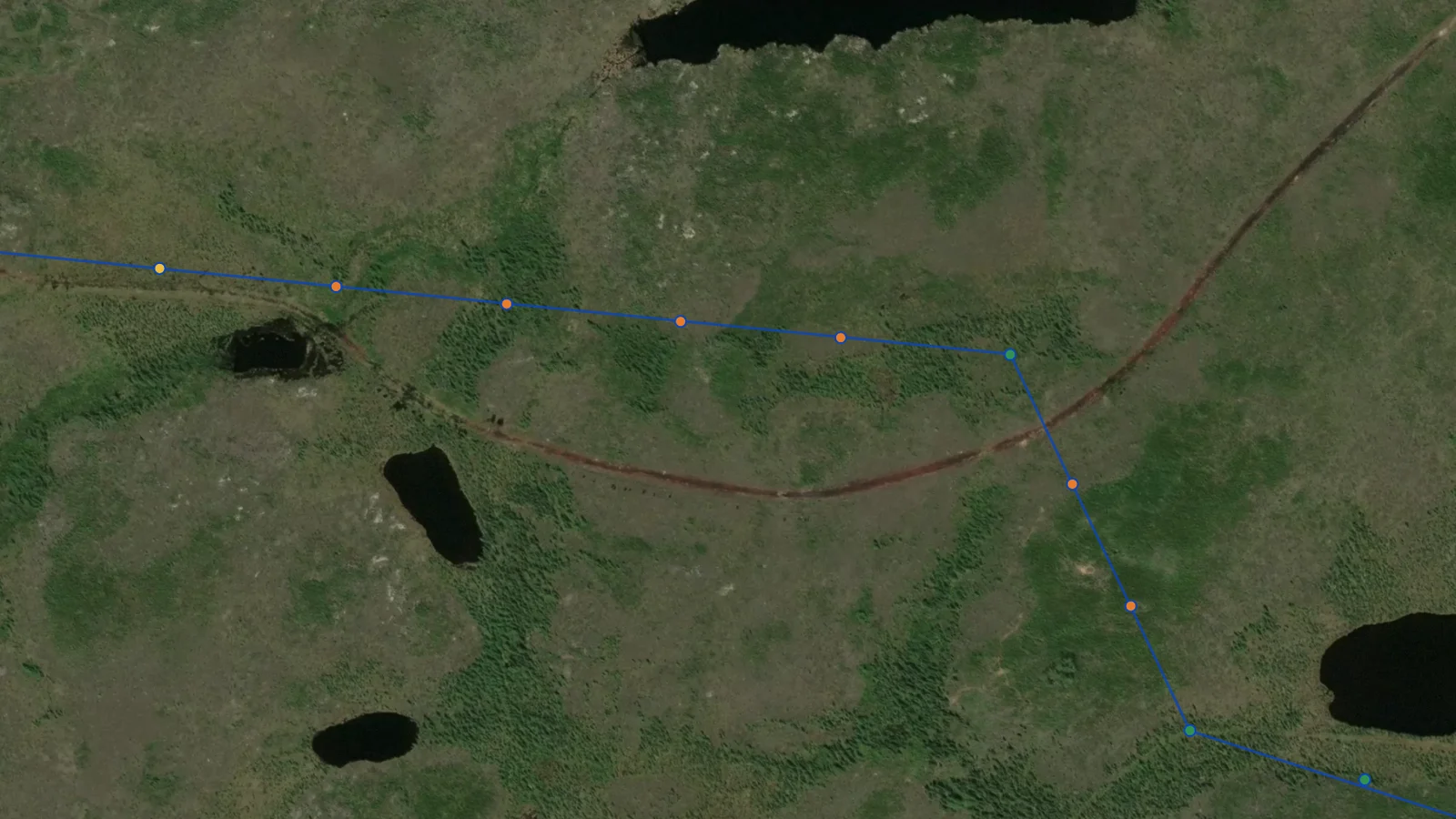
Mission planning is where the SOP set meets the map: route, structure IDs, airspace, and access, settled before the truck rolls.
Training expectations also belong in the SOP itself. Document three should say how a new pilot is qualified on the capture standard - a flown verification of one shot sheet, reviewed before the first billable structure - and document one should say how currency is tracked. That is what "training expectations" means in practice: not a course a pilot once took, but a verification the DSP can show for every pilot on the contract. The drone pilot training built for utility inspection describes why most DSPs hit a quality wall around their fifth pilot, and why moving the standard out of the founder's head and into the program is the fix.
Which drone training services help Canadian DSPs enforce repeatable flight procedures?
Sort any drone training service by which of the three layers it certifies, and the answer becomes obvious. Certificate-prep providers teach the Transport Canada exam and flight review - necessary, and silent on the deliverable. Operator-safety programs, insurance prequalification, and manufacturer training address risk on site. A capture-standard program with a flown verification is the only kind that makes flight procedures repeatable, because it is the only kind that tests whether two pilots return the same record of the same structure.
Detect's Data Quality Program is built as that third layer: free, sensor-agnostic, flown manually with any quadcopter against a pre-built shot sheet, and closed out with a review call rather than a written exam. Its standard is inherited rather than invented - the utility's spec, EPRI guidance, and the utility's defect taxonomy, expressed as shot sheets per structure type and a four-step pattern: calibrate, standardize, grade every image, validate (Detect Data Quality Program, 2026). A qualification check - insurance, licences, documents - comes before a pilot's first project, and passing both parts is the way into the Detect Partner Network. It does not replace Transport Canada certification; it adds the layer the certificate does not cover.
For a utility writing an RFP, the practical form of this is to require the first two layers as gates and the third as an outcome: a documented capture standard, a flown verification per pilot, and acceptance criteria at ingest, with named programs listed as ways to meet the outcome rather than as the requirement itself. How the same three tiers stack under U.S. rules - and why most comparisons stop at the first - is the subject of the drone pilot certification platforms comparison. How the requirement fits into a full vendor scorecard is covered in how utilities evaluate drone vendors; what Canadian utilities should add to any platform shortlist - capture quality proven in cold and low light, risk models tuned for wildfire and ice - is in the guide to evaluating AI grid inspection platforms. Which platform categories a Canadian DSP should deliver through, and the four decision criteria that sort them for utility contracts, are ranked in our guide to the best AI visual inspection platforms for utilities and DSPs.
One note on hardware. The NDAA restrictions that shape U.S. utility fleets are U.S. law; a Canadian utility's hardware rule is whatever its own procurement policy says. Document one should record which aircraft the DSP flies and document five which data controls apply, so the answer is on file before the question is asked. The NDAA compliance guide explains what the U.S. rule currently means for a fleet that works both sides of the border.
How do you write your first utility drone SOP set?
In the order the documents nest, starting from the regulatory floor and ending with the delivery format. The asset-owner side of the same standard - what a utility writes into its own photo spec - is laid out in the guide to utility photo data quality; the DSP's SOP set is the mirror image of it.
- Write the operations manual from the regulatory floor. Certificates held, registration, recency, airspace procedures, and the conditions that trigger a Special Flight Operations Certificate - stated for your fleet and your routes.
- Write the site and safety procedure for utility hazards. Clearances from energized conductors, crew roles, communications with the utility, and written go/no-go thresholds for cold, ice, wind, and wildfire season.
- Adopt one capture standard per structure type. A shot sheet with required angles and a camera-settings floor, plus an image-to-structure association check - inherited from the utility's spec and defect taxonomy.
- Put field QA before demobilization. Frames reviewed against the sheet on site, so a coverage gap costs a re-shoot on the spot rather than a re-mobilization to a remote line.
- Define data handling and delivery, then verify each pilot. Naming, metadata, retention, and the delivery format the utility's systems read. Each pilot flies the standard once and has the frames reviewed before the first billable structure.
A first version can be short. What matters is that every line a crew follows exists on paper, that every pilot has flown document three once under review, and that after each campaign the rework review asks one question of every rejected image: which document should have prevented this? If no document did, the SOP set has a gap, and the next version closes it. That review loop is how the same five documents that read as compliance in year one read as a margin line by year two - and how visual predictive maintenance for Canadian utilities gets the condition record it depends on: two cycles of the same structure, captured to the same standard, through ice season.
Write it down, fly it the same way, prove it at the truck
Canadian drone service providers do not have a certification problem. Transport Canada's framework is clear, the training to meet it is available, and the crews flying utility lines are competent. What most programs lack is the document set that turns competent individuals into a repeatable operation - and the training that verifies each pilot against it before the first billable structure.
Write the five documents. Fly the capture standard once per pilot under review. Check the frames before the crew leaves the site. The utility gets a record it can compare year over year, and the DSP gets the one thing fixed-fee contracts on remote lines cannot survive without: no second mobilization.
See what your current SOPs are letting through
Send Detect a recent inspection set from a Canadian line. The free audit grades assessability and association image by image - the first measure of how much field variability your procedures are catching, and how much they are not.
Book a free audit →