
The Complete Guide to Canadian Utility Drone Certification
Transport Canada's certificate tells a utility one thing: this pilot may legally fly. It says nothing about whether five of your pilots will bring back the same data. Here are the certificate categories, the November 2025 rule changes, and the program design that makes multi-pilot inspection data defensible.
Canadian utility drone certification starts with a Transport Canada RPAS pilot certificate - basic, advanced, or Level 1 Complex, depending on the operation - plus an SFOC beyond those categories. The certificate makes one pilot legal. A defensible program also needs an operator certificate, written procedures, and a capture standard every crew flies to.
- Canada now has three certificate categories, not two. Basic, advanced, and the Level 1 Complex certificate that Transport Canada's November 4, 2025 rules added for lower-risk flight beyond visual line of sight. Everything else still runs on a Special Flight Operations Certificate (Transport Canada, 2025 Summary of changes to Canada's drone regulations).
- The pilot certificate is one credential of four. A program that produces defensible inspection data also carries an operator credential, a procedure credential, and a data credential. Transport Canada issues only the first two.
- Multi-pilot consistency is engineered, not assumed. On one 345kV program, structure-specific flight plans and shot sheets held 927 structures to a single capture standard across field crews working two segments in parallel (Detect x CompassData case study, 2026).
- The data credential decides margins. Standardized capture cuts rework from 15-25% of delivered imagery to 3-7% within two campaigns (State of Utility Drone Inspections 2026).
- Canadian proof it works: a 618-structure remote audit reached 100% coverage in 9 field days, with claim documentation delivered 72 hours after the last flight.
- What drone certification does Canada require for utility inspection work?
- Which pilot certificate does a utility inspection mission need?
- What should a Canadian utility drone certification program include?
- How do you build a multi-pilot certification program that holds up?
- Why doesn't a pilot certificate guarantee defensible inspection data?
- What does defensible inspection data look like on a Canadian line?
- The bottom line
- Frequently asked questions
What drone certification does Canada require for utility inspection work?
Canada requires every pilot flying a drone of 250 grams or more to hold a Transport Canada RPAS pilot certificate. The level is set by the operation: basic, advanced, or - since November 4, 2025 - Level 1 Complex for lower-risk flight beyond visual line of sight. Operations outside those categories need a Special Flight Operations Certificate, an SFOC (Transport Canada, drone operation categories and pilot certificates, 2025).
The category is set by the operation, not by the pilot or the business. Where you fly, how close to bystanders, which airspace, and whether the aircraft stays in sight decide which certificate the mission needs. The drone itself must be registered with Transport Canada, and the registration carried on every flight.
What each level asks of the pilot:
| Category | The operation it covers | What the pilot needs | Typical utility use |
|---|---|---|---|
| Basic operations | Uncontrolled airspace, at least 30 m horizontally from bystanders, visual line of sight | Small Basic Exam (online) | Remote corridor segments, rural structure checks |
| Advanced operations | Controlled airspace, flight near or over bystanders, VLOS | Small Advanced Exam plus an in-person flight review | Distribution feeders in towns, substations, most storm work |
| Level 1 Complex | Lower-risk BVLOS: uncontrolled airspace, away from population centres | Level 1 Complex exam plus an RPAS Operator Certificate (RPOC) for the organization | Long transmission corridors flown beyond visual line of sight |
| SFOC | Everything beyond the three categories | Case-by-case application to Transport Canada | Higher-risk BVLOS, special operations, foreign operators |
What changed in Canada's drone rules on November 4, 2025?
The largest package of RPAS amendments since 2019 came into force on November 4, 2025, after publication on March 26, 2025 (Transport Canada, 2025 Summary of changes to Canada's drone regulations). For utility work, four changes matter most.
- Level 1 Complex operations. A new certificate for lower-risk BVLOS, with an exam and an organizational RPAS Operator Certificate (RPOC). Routine corridor inspection beyond visual line of sight no longer automatically means an SFOC.
- Medium drones. Aircraft from 25 kg up to 150 kg came under the certificate framework with added conditions, instead of SFOC-only. That covers the heavier LiDAR and survey platforms utility programs increasingly fly.
- Sheltered operations. New allowances for certain flights close to buildings - relevant to substation and storm-damage work.
- More weight on currency. Pilots keep their certificate privileges only with recency: a recurrent training activity, flight review, or exam within the previous 24 months (Canadian Aviation Regulations, Part IX).
When does a utility mission still need an SFOC?
When the operation falls outside all three categories. The common utility cases: BVLOS that does not meet the Level 1 Complex conditions - near population centres, in controlled airspace, or at higher risk profiles. Add flight above the altitude allowances, and any commercial flying by a foreign pilot or operator (Transport Canada, permission for special drone operations, 2026). The SFOC is not a failure state. It is the instrument for the missions the categories cannot yet absorb. But it is approved case by case, and a program that depends on SFOCs for routine work carries avoidable schedule risk.
Which pilot certificate does a utility inspection mission need?
Most Canadian utility inspection work needs the advanced certificate. Distribution corridors run through built-up areas, near crews and the public, and often through controlled airspace - all advanced-category conditions. Basic covers genuinely remote VLOS segments; Level 1 Complex unlocks long BVLOS corridors; the SFOC covers the rest.
Mapped to the missions a DSP actually bids:
- Rural transmission corridor, flown VLOS: basic can be enough - until the corridor crosses an aerodrome's airspace or a public road crew. Most operators certify to advanced anyway so one crew covers the whole route.
- Distribution feeders in towns: advanced. Bystanders and controlled airspace are the norm, not the exception.
- Substations: advanced, with the new sheltered-operations allowances worth reading before the site visit.
- Long corridor programs flown BVLOS: Level 1 Complex where the route stays in uncontrolled airspace away from population centres; an SFOC where it does not.
- Storm response: plan for advanced. Damage assessment happens where people are, on compressed timelines, and is no moment to discover a pilot only holds basic.
The practical rule for a DSP hiring into utility contracts: make the advanced certificate the hiring floor, and decide deliberately which routes justify the Level 1 Complex exam and the RPOC that comes with it.
What should a Canadian utility drone certification program include?
A Canadian utility drone certification program should carry four credentials, and Transport Canada issues only the first two. That is the Four-Credential Framework - Detect's test for whether a multi-pilot program will produce inspection data a utility can defend.
- 01 - The pilot credential. The right RPAS certificate per pilot for the operations flown, verified at hiring and tracked for recency. This is the floor everything else stands on.
- 02 - The operator credential. The organizational layer: the RPAS Operator Certificate where Level 1 Complex flying demands it, insurance that matches the operation, registration and fleet records in order.
- 03 - The procedure credential. Written, versioned operating procedures every crew signs and flies. The Five-Document SOP Set covers what those documents are and how to write the first set; the short version is that an undocumented procedure does not exist at audit time.
- 04 - The data credential. A capture standard with per-image grading and written acceptance criteria. This is the credential no regulator issues, no flight school teaches - and the one that decides whether the campaign's imagery can carry a maintenance decision.
Field note: when a utility audits a DSP, the first two credentials take ten minutes to verify. Contracts are won and lost on the second two - because they are the only ones that predict what the delivered data will look like.
How do you build a multi-pilot certification program that holds up?
Set the certificate floor, then standardize everything the certificate does not cover: one flight plan per structure type, one shot sheet, one acceptance gate, and records that prove all of it. Certification gets five pilots legal. Standardization gets five pilots interchangeable - and interchangeable is what a utility is buying.
- Set the certificate floor by mission profile. Advanced for utility corridor work as the default hire. Decide which routes justify Level 1 Complex, and start the RPOC work before the contract that needs it.
- Track credentials centrally. Certificate numbers, flight-review dates, and each pilot's 24-month recency clock in one register - not in five inboxes. An expired recency date discovered mid-campaign grounds a crew.
- Write the SOP set. Versioned, signed, and short enough to be followed. Procedures that live in a binder nobody opens are the procedure credential in name only.
- Standardize capture, not just flight. Structure-specific flight plans and a per-structure shot sheet, so every required angle is captured the same way by every pilot on every structure type.
- Gate data at the truck. Grade imagery against written acceptance criteria before the crew demobilizes. A soft frame found at the truck costs a reflight of one structure; found in review two weeks later, it costs a mobilization.
Step four is where most programs are decided. On a 345kV construction-quality program, field crews from the DSP CompassData worked two line segments in parallel against structure-specific automated flight plans and per-structure shot sheets. The standard held 927 structures to one capture spec - 65,701 images - and when early findings forced the shot sheets to evolve mid-program, the crews absorbed a 73% growth in imagery scope without breaking schedule (Detect x CompassData 345kV case study, 2026). That consistency is not a certification outcome. It is a program outcome, and it is what certification platforms compared by tier cannot deliver on their own.
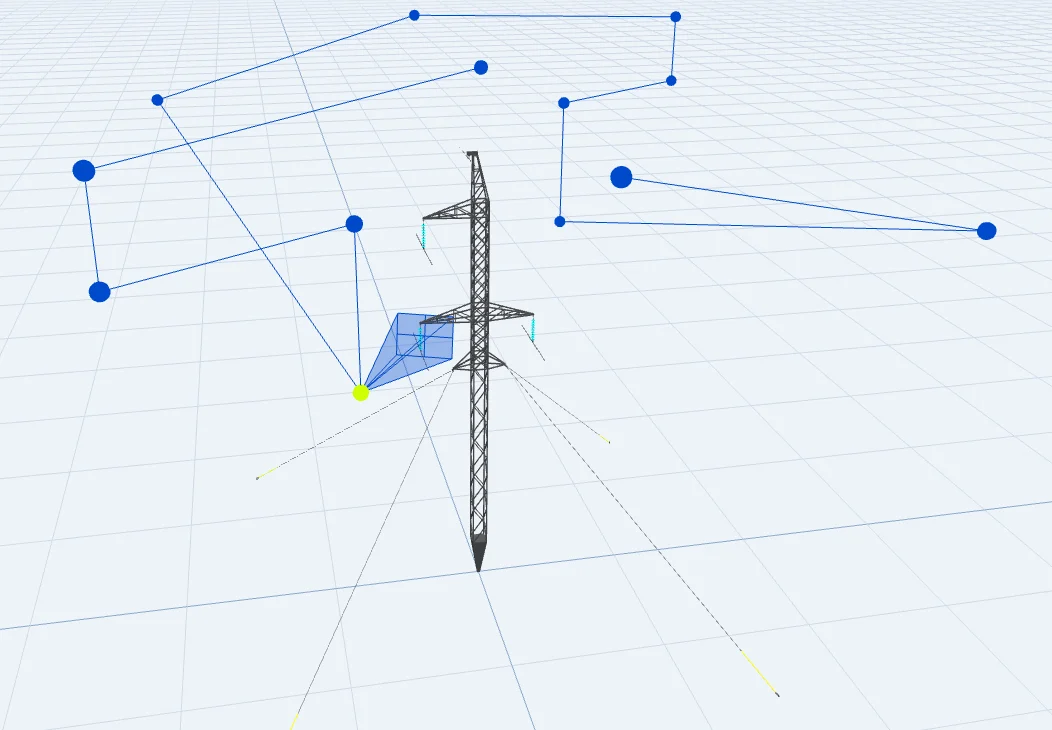
The shot sheet is the standard a pilot flies against: required views per structure type, so five pilots return one dataset.
Why doesn't a pilot certificate guarantee defensible inspection data?
Because the certificate tests whether flight is safe and legal - not whether the imagery that comes back can be analyzed. Capture quality is the gap. On the 258-type, 19-class utility defect catalog, sharp imagery leaves 100% of defect types assessable. Soft imagery drops that to 69%. Blurry imagery leaves 7% (Detect Data Quality Program, 2026). Every pilot in that comparison can be fully certificated.
The economics land on the DSP. Across utility drone contracts, 15-25% of delivered imagery typically comes back as rework, and roughly 30% of ad-hoc capture is rejected outright (State of Utility Drone Inspections 2026). The causes are program gaps, not certificate gaps: GPS-based misassociation drives 35% of rework, missing component coverage 30%, resolution and focus issues 18%, metadata format mismatches 12%, lighting 5%. Not one of those is tested on the Small Advanced Exam.
On a $200K fixed-fee campaign, a 20% rework rate absorbs $30,000 and squeezes effective margin to 5-10%. A standardized workflow running at 5% absorbs $7,500 and holds margin at 18-22% - and gets there within two campaigns (State of Utility Drone Inspections 2026). The playbook for closing that gap is cutting rework on inspections, and the fastest way to train crews to the data credential is a utility-specific pilot training program built on real inspection data rather than generic flight instruction.
What does defensible inspection data look like on a Canadian line?
It looks like evidence a counterparty cannot argue with, delivered inside a deadline that matters. On a newly energized northern transmission extension serving 17 formerly diesel-reliant Indigenous communities, helicopter flybys had missed early tower lean and flooded footings. The utility needed documentation strong enough to carry warranty claims - across 618 lattice structures on two lines, before winter closed the window.
618 structures. 9 field days. Claim documentation 72 hours after the last flight. A two-operator crew reached 100% coverage, and the utility submitted time-bound warranty claims with visual evidence before the deadline. Source: Detect remote utility inspection case study, 2026.
The campaign that produced it was the Four-Credential Framework working in order: certificated pilots, an organized operator, written procedures for remote work at safe standoff distances, and a capture standard graded as the data came in. The 618-structure remote audit flagged 322 medium-risk and 196 low-risk conditions with zero high-risk surprises left for winter - and the warranty claims it supported were filed before the time-bound terms expired.
That is the test to hold any certification program to. Not "were the pilots legal" - they were. Whether the data could compel a contractor to fix what it showed.
The bottom line
Canadian utility drone certification is the floor, not the program. Transport Canada's three categories - basic, advanced, Level 1 Complex - plus the SFOC tell you who may fly which mission. They say nothing about whether five pilots return one dataset, whether the imagery can be graded against a defect catalog, or whether a claim stands up when a contractor pushes back.
Build to four credentials: certificates matched to missions, the operator layer in order, procedures in writing, and a capture standard with acceptance criteria. The first two make you legal. The second two make you worth hiring - because they are what turns certified flight into decision-grade inspection data, screened by AI and verified by utility inspection experts before anyone acts on it.
Grade your program's data credential
Send us one campaign's worth of inspection imagery. We will grade its assessability against the 258-type defect catalog and show you exactly what your current capture standard is letting through - before your next bid depends on it.
Book a free audit →Frequently asked questions
Do you need a license to fly a drone commercially in Canada?
Canada issues drone pilot certificates, not licenses - and the requirement does not change with payment. Any drone of 250 grams or more needs a certificated pilot and a registered aircraft, whether the flight is paid or recreational. What sets the certificate level is the operation's risk: airspace, proximity to bystanders, and visual line of sight (Transport Canada, drone operation categories and pilot certificates, 2025).
What is the difference between basic and advanced operations in Canada?
Basic operations stay in uncontrolled airspace, at least 30 m horizontally from bystanders, within visual line of sight - and need only the online Small Basic Exam. Advanced operations cover controlled airspace and flight near or over bystanders, and require the Small Advanced Exam plus an in-person flight review. Most utility inspection work is advanced-category flying.
What is the Level 1 Complex operations certificate?
The certificate Transport Canada added on November 4, 2025 for lower-risk flight beyond visual line of sight - uncontrolled airspace, away from population centres. Pilots pass a dedicated exam, and the organization holds an RPAS Operator Certificate (RPOC). For utilities, it moves routine long-corridor BVLOS inspection out of the SFOC queue and into a repeatable certificate path.
Can a U.S. Part 107 pilot fly utility inspections in Canada?
Not on the Part 107 certificate alone. Canada does not recognize it: a foreign pilot flying a drone of 250 grams or more in Canada needs a Canadian pilot certificate, and a foreign pilot or operator flying for hire needs an SFOC (Transport Canada, permission for foreign pilots and operators, 2026). Cross-border DSPs should plan certification well before bidding Canadian utility work.
How long is a Canadian drone pilot certificate valid?
The certificate itself does not expire, but its privileges depend on recency: within the previous 24 months the pilot must have passed the relevant exam or flight review, or completed a recurrent training activity (Canadian Aviation Regulations, Part IX). A multi-pilot program should track every pilot's recency clock centrally - an expired date grounds the crew, not just the pilot.
What should a utility require from a DSP's certification program?
Evidence of all four credentials, not just the first: certificates matched to the missions bid (advanced as the floor), the RPOC where BVLOS is proposed, written operating procedures, and a capture standard with per-image acceptance criteria. A Canadian utility drone certification program that stops at legal flight predicts nothing about the data. Ask every bidder how they grade imagery before demobilizing.
Does Transport Canada certification cover inspection data quality?
No. The exams and flight review test aviation knowledge and safe flight, not capture quality. Nothing in the certificate path checks whether imagery is sharp enough to assess a cotter key or complete enough to cover every component - which is why capture standards exist as a separate layer. On the 258-type defect catalog, sharp capture leaves 100% of defect types assessable; blurry capture leaves 7% (Detect Data Quality Program, 2026).
