
Visual Predictive Maintenance for Grid Assets in 2026
Sensors will never reach most of the grid. The condition data that predicts failures on poles, hardware, and insulators is the imagery you already capture - if it is captured to a standard.
- Sensors cover substations. The roughly 180 million poles and 5.5 million miles of distribution line between them are, in the Department of Energy's words, "predominantly analog" - visual capture is their only condition signal.
- Prediction is a ladder, not a feature. Programs mature through four rungs - Snapshot, Baseline, Trend, Forecast - and each rung depends on the one below it.
- The P-F interval applies to imagery: most grid failures announce themselves visually first, and capture cadence plus capture quality decide whether you see the announcement.
- Image quality sets a hard ceiling on prediction. In Detect's Data Quality Program analysis, sharp imagery left 100% of a 258-type defect catalog assessable; blurry imagery left 7%.
- The pipeline is the product: capture to a standard, gate quality at ingest, screen with AI, validate with named experts, and land ranked findings in the systems that schedule work. A validated finding in your EAM is the unit of value - not an image count.
- The economics favor the switch: the U.S. Department of Energy puts predictive maintenance savings at 8-12% over preventive programs and 30-40% over reactive ones.
- The barriers are workflow, not science. Capture quality, association, verification, and the last mile into your EAM are the four implementation challenges that decide whether visual data ever changes a maintenance plan.
- What visual predictive maintenance is
- Why sensors alone can't predict grid failures
- How imagery becomes a forecast
- The P-F curve for visual data
- The data prediction requires
- Sensor vs visual, by asset class
- From images to work orders
- Preventing outages in practice
- What it saves · Preventive vs predictive
- What makes it hard in practice
- What to look for · Canadian utilities · FAQ
A transformer tells you when it is starting to fail. It runs hot, it gasses, its dissolved-gas numbers drift - and the monitors bolted to it report every change. A wood pole tells no one. Neither does a crossarm, an insulator, or the cotter key holding a conductor plate together.
That silence is the real gap in grid reliability programs. The industry has spent a decade building predictive models for the small share of assets that carry sensors, while the assets that cause most outages produce no data at all - except when someone photographs them.
This guide is about that second category: how repeat inspection imagery becomes a condition record, a degradation trend, and ultimately a failure forecast. It is written for the asset managers and operations leaders who own the outcome.
What is visual predictive maintenance for grid assets?
Visual predictive maintenance forecasts asset failures from repeat, standardized inspection imagery - drone, helicopter, or ground capture - rather than from embedded sensor telemetry. It applies the same logic as sensor-based programs: establish a condition baseline, measure change against it, and act before a defect becomes a failure.
The term bridges two disciplines that rarely talk to each other. Sensor-based predictive maintenance grew up in substations, where SCADA points, dissolved-gas analysis, and thermal monitors stream continuous data into models. Visual inspection AI grew up in the field, where crews and drones photograph structures and software classifies the defects. The first discipline predicts but only sees instrumented equipment. The second sees everything but has mostly been used to find today's defects, not forecast tomorrow's.
This is not the same thing as condition based maintenance in the classic sense - CBM triggers work when a measured condition crosses a threshold, and the maintenance strategy behind it is well established. Visual predictive maintenance is what makes CBM possible for assets that have no gauges to read. And it is distinct from reactive maintenance for the obvious reason: the run-to-failure model treats the first sign of trouble as the outage itself.
Why can't sensors alone predict power grid failures?
Because almost none of the grid outside substations is instrumented. Sensors and SCADA cover generation and substation equipment; the poles, conductors, insulators, and hardware that span the miles between them carry no telemetry and generate no data between inspections.
The numbers describe the problem plainly. The U.S. grid runs on roughly 600,000 miles of transmission line and 5.5 million miles of distribution line (ASCE Infrastructure Report Card), carried on about 180 million utility poles, 130 million of them wood (DOE Grid Deployment Office / LBNL, 2024). Between 60 and 80 million distribution transformers hang on those poles (NREL, 2024). Almost none of it reports its own condition.
The industry's answer to date has been infrastructure monitoring hardware: line sensors, smart reclosers, fault indicators. Those help, but the economics stop them at the feeder level. No utility will instrument 180 million poles. Retrofitting sensors onto every crossarm and insulator string is not a program any rate case will carry.
Which leaves visual capture as the only condition signal most grid assets will ever produce. Utilities already collect it - every patrol, every drone flight, every post-storm assessment. The waste is that most programs treat those images as disposable: look once, file, forget. The asset produced its one data point of the year, and the program threw the trend away.
How does inspection imagery become a failure forecast?
Through four rungs that each depend on the one below: Snapshot (find today's defects), Baseline (standardize the record), Trend (compare cycles), Forecast (project time-to-failure and escalation risk). Most utility programs today stand on rung one.
Call it the Snapshot-to-Forecast ladder. It is the maturity path for visual predictive maintenance, and it explains why "we already do drone inspections" and "we can predict failures" are very different claims.
What is a condition baseline?
A condition baseline is the first standardized, assessable record of an asset's state - the reference every later inspection is measured against. "Standardized" is the load-bearing word. A baseline is only useful if the next cycle can be compared to it: same components visible, same angles covered, consistent quality. One-off imagery, captured however that day's crew happened to fly, produces findings but no baseline.
This is also why post-construction inspection matters more than a closeout formality: it is cycle zero of the condition record, the entry every future comparison starts from.
How does multi-cycle change detection work?
Change detection compares the same component across inspection cycles and flags what moved: a crack that lengthened, corrosion that spread, a tilt that grew. The comparison is what turns defect classification into electrical grid analytics - a single flagged defect tells you what exists, while a cycle-over-cycle comparison tells you the direction and speed of travel. Degradation rate is the input every forecast needs, and it cannot be computed from one visit.
This is where AI earns its keep: screening millions of image pairs for meaningful change is exactly the volume problem machines handle well, ranking what surfaced so your engineers judge the findings that matter instead of paging through the ones that don't.
How do platforms forecast time-to-failure from images?
By trending condition against thresholds. Once an asset has a baseline and at least one comparison cycle, the platform can project when a degrading component crosses the line from low-priority to critical - and rank the fleet by that projected date rather than by inspection order.
Honesty matters here, because this is where vendors overclaim. Visual forecasting today is strongest at risk escalation - which assets are moving toward critical, and how fast - and at replacement timing: trend a component's condition, schedule the work before failure. Predicting an exact failure date for a specific bolt is not the state of the art, and anyone selling that is selling past the evidence. The human stays in the loop for a reason - the model surfaces and ranks; your engineers confirm and decide.
When can visual data catch a failure before it happens?
Inside the P-F interval - the window between the moment a failure becomes detectable (P) and the moment it becomes functional failure (F). Most grid asset failures announce themselves visually during that window; capture cadence and capture quality decide whether anyone sees the announcement.
Why grid assets fail follows patterns - and the practical question for a visual program is whether your inspection cadence samples the window often enough, and sharply enough, to catch the P point.
Today's cadence is set by the calendar, not the asset. California's GO 165 requires distribution patrols every year in urban areas and every two years in rural ones, detailed inspections every five years, and intrusive wood-pole inspections on 20-year cycles (CPUC). NERC FAC-003-4 requires vegetation inspection of applicable transmission lines at least once per calendar year (NERC). Those cycles exist because regulators needed a floor - but a fixed interval samples a fast-moving defect too slowly and a healthy asset too often.
Visual predictive maintenance inverts the logic. The trend tells you which structures are degrading fast, and cadence follows condition: tighten the cycle on the corridor that is moving, relax it where nothing changes. Calendar compliance becomes the floor, not the strategy.
What data do you need for predictive maintenance of grid assets?
Three things: imagery sharp enough to assess, correctly associated to the asset it shows, and captured to a repeatable standard across cycles. Miss any of the three and the forecasting math has nothing to stand on.
Start with quality, because it sets a hard ceiling. In Detect's Data Quality Program analysis of transmission inspection imagery, capture sharpness determined how much of a 258-type, 19-class defect catalog could be assessed at all: sharp imagery left 100% of the catalog assessable, soft imagery 69%, and blurry imagery just 7%. That is a drop from 258 identifiable defect types to roughly 18 - 93% of the catalog gone before analysis even starts.
Association is the quiet killer. A perfect photograph tied to the wrong structure poisons two condition records at once - the asset that looks healthier than it is, and the asset that inherits a defect it doesn't have. In Detect's State of Utility Drone Inspections 2026 research, GPS misassociation alone drove 35% of imagery rework, and 15-25% of delivered imagery across the industry needed rework of some kind. Multi-cycle comparison compounds the stakes: one misfiled image in cycle two can register as a false "change" against cycle one.
Source flexibility matters more than source purity. Your condition record should absorb drone, helicopter, fixed-wing, and ground capture into one per-asset history - because that is how real programs collect. The visual inspection AI layer has to classify defects consistently across all of them, or every equipment change resets your baseline.
None of this requires exotic hardware. It requires capture standards, quality control at ingest, and the discipline to reject imagery that can't be assessed - before it enters the record, not after an engineer wastes an hour on it.
Which grid assets suit sensor-based vs visual prediction?
Sensors win where telemetry already exists - power transformers, breakers, substation equipment. Visual wins everywhere telemetry will never exist: poles, crossarms, insulators, hardware, and conductor systems. A serious grid asset management program runs both and knows the boundary.
| Asset class | What sensors see | What imagery sees | The predictive play |
|---|---|---|---|
| Power transformers | DGA, temperature, load - continuous | External corrosion, bushing condition, oil leaks | Sensor-led; visual confirms externals |
| Breakers & substation equipment | Operation counts, timing, SF6 pressure | Physical damage, contamination, corrosion | Sensor-led; visual on outage-window inspections |
| Wood & steel structures | None at fleet scale | Rot, splitting, corrosion, woodpecker damage, tilt | Visual-led; intrusive inspection confirms |
| Insulators & hardware | None | Cracking, flashover marks, corroded pins, missing cotter keys | Visual-only - here, imagery is the sensor |
| Conductors & shield wire | Fault events (after the fact) | Broken strands, splice condition, sag anomalies | Visual-led between fault recordings |
| Pole-top distribution transformers | Rarely instrumented | Rust, leaks, bushing damage | Visual-led - 60-80M units (NREL, 2024) |
Two facts sharpen the boundary. First, the instrumented minority is aging into its own crisis - roughly 70% of large power transformers and transmission lines are 25 years or older (DOE Quadrennial Energy Review), and replacement lead times for large power transformers averaged around 120 weeks in 2024 (Wood Mackenzie). Sensor data helps you nurse that fleet. Second, the un-instrumented majority is where outages start - which is why the visual layer isn't a nice-to-have on top of grid asset management; for most of the fleet, it is the only condition layer there is.
How do utilities convert asset images into actionable predictive maintenance insights?
Through a five-stage pipeline: capture to a standard, gate quality at ingest, screen the volume with AI, validate findings with named experts, and land the ranked result in the systems that schedule work. An image enters as pixels and leaves as a work order - and every stage exists to protect the one decision that matters: which structures get attention first.
Most writing about predictive maintenance describes the model and skips the middle. In practice the middle is the product. Detection is cheap; a finding your planners can act on - validated, located, ranked, and routed - is the expensive, valuable thing. Here is the pipeline, stage by stage.
1. Capture to a standard. A shot list per structure type - components, angles, and a quality floor - so every asset produces a comparable record. Throughput is no longer the excuse it was: Detect's truck-mounted capture program inventories roughly 800 distribution poles a day on average, where USDA guidance budgets a full groundline inspection program at 150-200 poles per inspector per week (USDA Rural Utilities Service, Bulletin 1730B-121). The two inspections answer different questions - one visual, one invasive - but the condition record that once took a month now accumulates in a day, and no one goes up the pole to collect it: one recent 1,000+ structure program eliminated 100% of climbs. The camera also keeps seeing what the road angle hides. Georgia Power's drone program logged 5,174 abnormal conditions on lines where traditional ground inspection had recorded 1,150 (T&D World, 2024). Drone, truck, helicopter, and ground capture each earn a different place in that standard - choosing capture methods is a program decision, not a flight-day one.
2. Gate quality at ingest. Score every image for assessability before it enters the record, and reject what fails - the assessability ceiling above is the whole argument. A blurry image is not a weaker data point; it is a deleted one, and if it slips into the record it corrupts the next cycle's comparison too. The gate is also where association is checked - image to structure ID, audited - so a good photograph cannot poison the wrong asset's history.
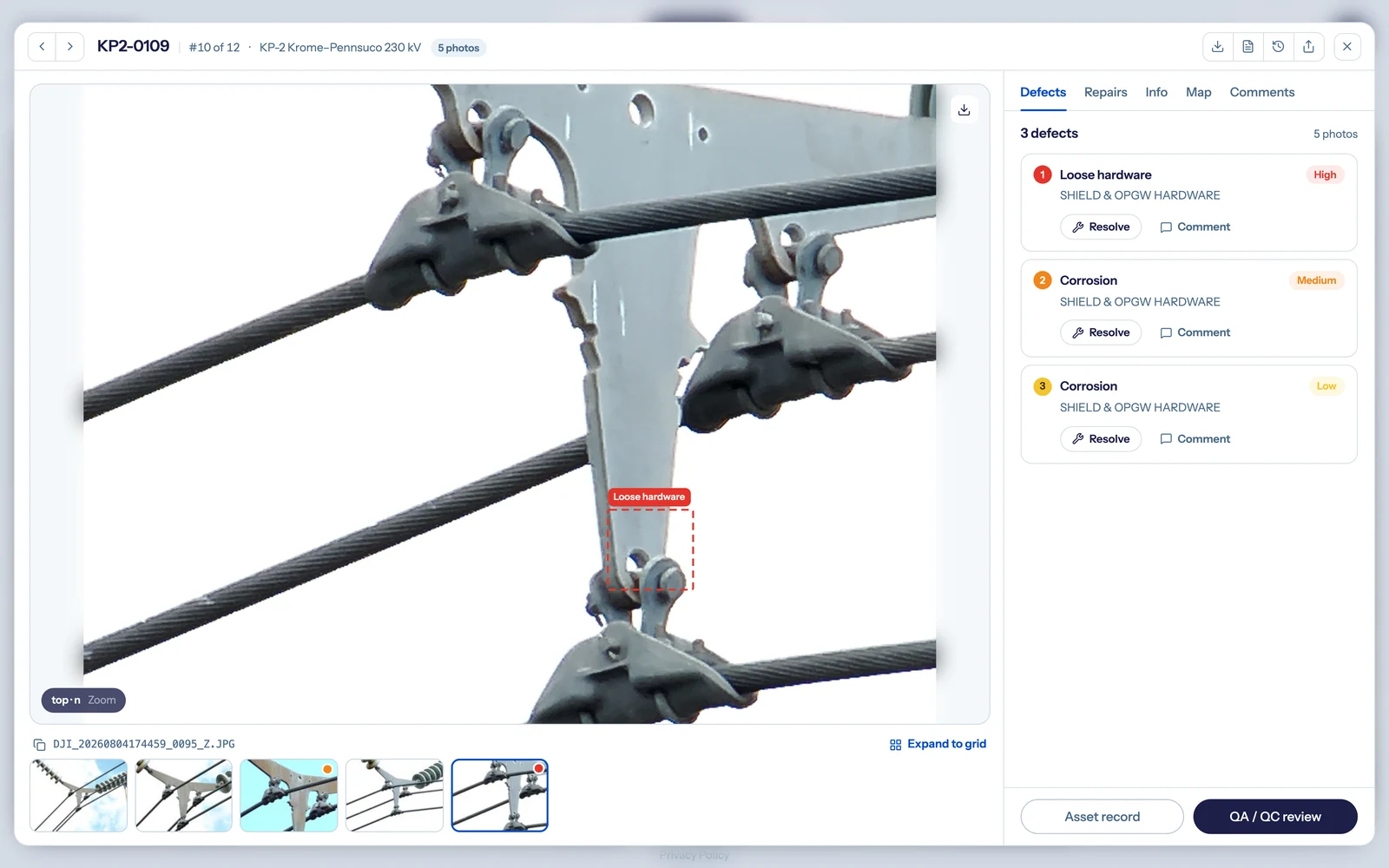
3. Screen the volume with AI. Standardized capture produces more imagery than any engineering team can read, which is exactly the job for the model layer. AI screens the volume; your experts focus on the findings that matter. The deliverable is not more data - it is terabytes of raw imagery translated into a concise, prioritized list of the defects that actually matter.
4. Validate with named experts. Every finding that could become a work order gets a human signature - Detect runs this as its Hybrid AI + Expert Review model. Validation is what turns a detection into a risk signal a planner can trust: confirmed defect, confirmed severity, confirmed location. It is also what makes the record auditable. Binoculars don't leave evidence; a validated finding carries its image, its location, and its reviewer - verifiable by anyone, comparable next cycle, ready for the regulator.
5. Land it in the maintenance workflow. A validated risk signal becomes a maintenance action when it reaches the system that schedules crews: a risk-ranked queue in the platform, and work orders in the EAM and GIS tools a utility already runs, from IBM Maximo and SAP to Esri ArcGIS. Ranking is the step that turns condition monitoring into a budget - the fleet ordered by projected risk, so the next truck roll goes to the structure most likely to fail, not the next one on the list. How condition findings sit alongside asset performance management systems - and the preventive-maintenance software covered below - is an integration question, not a rip-and-replace one.
That pipeline is the operating core of visual predictive maintenance for utilities. Run once, it is a defensible inspection. Run every cycle to the same standard, it becomes the trend engine the forecasting rungs stand on - and the difference shows up in practice.
How does visual prediction prevent outages in practice?
By catching the defect while the repair is still small - the entire economic argument compresses into the gap between a hardware fix and a forced outage.
One example from Detect's work makes the point. On a roughly 250-mile HVDC intertie - about 2,600 lattice towers, newly commissioned - an AI-screened campaign processed 122,714 images and flagged 1,270 findings in 30 days with a three-person review team. One finding was a missing cotter key on a clevis bolt at a conductor attachment. Caught in the line's first operating season, the fix was a crew visit; missed, engineering assessed the likely result as a dropped conductor and a forced outage.
The pattern generalizes. In a 345 kV construction-quality campaign across 927 structures, 67 findings out of 45,335 were critical - and 51 of the 67 clustered in a single line segment. That concentration is the forecast in embryo: the trend data didn't just find defects, it told the operator where the next ones would come from. Risk that clusters can be planned against.
Reliability metrics move the same way, cycle over cycle rather than overnight - fewer equipment-caused interruptions as the worst actors exit the system early. No credible program promises to prevent every outage. The promise that holds is narrower and better: fewer surprises, found earlier, fixed cheaper.
How much does predictive maintenance save utilities?
The U.S. Department of Energy's benchmark: a functioning predictive maintenance program saves 8-12% over a preventive program and 30-40% over reactive maintenance (FEMP O&M Best Practices Guide).
Cross-industry studies land in the same range. PwC's survey of 268 companies found predictive programs cut maintenance costs 12%, improved uptime 9%, and extended asset life by 20% (Predictive Maintenance 4.0, 2018). Deloitte's analysis put breakdown reduction at up to 70%. And the market is voting: predictive maintenance in the energy sector is projected to grow from $2.25 billion in 2025 to $7.08 billion by 2030 (Mordor Intelligence).
For the grid specifically, the upside is bigger than the percentages suggest, because the alternative is not a tidy preventive program - for the un-instrumented fleet it is run-to-failure with a calendar patrol on top. The full return math deserves its own treatment; the short version is that a $15,000-class hardware repair found early against a $1M-class forced outage is not a percentage improvement. It is a different category of outcome.
How does visual prediction work with preventive maintenance software?
As the trigger it can’t generate itself. Preventive maintenance software - the scheduling side of a CMMS - plans work on time and usage rules: service the recloser every N months, patrol the line every spring. Visual predictive maintenance supplies what those rules can’t see: the actual condition of the asset. The two are complements, not competitors - the verified finding becomes a work order in the software you already run.
| Preventive maintenance software | Visual predictive maintenance | |
|---|---|---|
| Trigger | Time or usage intervals | Measured asset condition |
| Data source | Schedules, meter readings, history | Inspection imagery, expert-verified findings |
| Output | Scheduled work orders | Risk-ranked findings that become work orders |
| Where it lives | Your CMMS / EAM | The inspection layer feeding it |
Maintenance tracking software keeps the history honest - what was done, when, to which structure - and that history is exactly where condition triggers belong. For utilities the pairing looks like this: visual prediction decides which structure needs attention and how urgently; the preventive maintenance system schedules, dispatches, and documents the work. How findings land in the CMMS and EAM platforms utilities already run is covered in our guide to utility asset management software.
What makes it hard to use visual data for predictive maintenance?
Four barriers, and none of them is the model: capture quality that caps what analysis can see, imagery tied to the wrong structure, findings nobody has verified, and results that never reach the systems that schedule work. Each one is a data-and-workflow problem before it is a technology problem - which is why each one can be fixed.
Capture quality comes first. Roughly 40% of utility inspection imagery is rejected or unusable somewhere in the pipeline (Detect Data Quality Program, 2026), and the assessability ceiling above shows what the surviving images give up: soft capture surrenders a third of the defect catalog before analysis begins. The fix is contractual, not heroic - a written photo standard decides whether imagery can support failure prediction before the first flight, not after the first rejection.
Association is second. The quiet killer covered above - imagery filed against the wrong structure - has a sibling: missing component coverage, where the angles a shot list requires simply were not flown. It accounts for another 30% of delivered-imagery rework (Detect, State of Utility Drone Inspections, 2026). Both fail silently. The record looks complete until the cycle-over-cycle comparison asks a question it cannot answer.
Trust is third. Planners will not commit a crew on an unverified machine finding, and they should not have to. AI screens the volume; named experts confirm what matters. A utility that wants to test that discipline can run the seven checks for AI inspection results against any platform's output - capture-quality gates and named reviewers separate the systems that survive them.
The last mile decides adoption. A validated finding that never reaches the maintenance queue changes nothing in the field, and this is where implementation actually stalls: integration fails at the data layer before it fails at the API layer. If structure IDs, locations, and defect taxonomies do not agree across inspection platform, EAM, and GIS, every downstream number inherits the disagreement.
None of this requires new science. Programs that standardize capture and gate quality at ingest cut rework from the industry's 15-25% range to 3-7% within two campaigns (Detect, State of Utility Drone Inspections, 2026). The implementation challenges are real - but they are workflow disciplines, not research problems.
What should utility leaders look for in a visual predictive maintenance platform?
Judge the data layer before the model. A platform that cannot enforce capture standards, score assessability, and hold a per-asset condition record across cycles cannot forecast - whatever its detection accuracy claims say.
The market has no shortage of platforms that analyze visual data for grid assets. The evaluation question is which of them are built to climb the ladder. For utility software carrying a predictive claim, six capabilities separate the contenders:
- Capture standards and ingest QA. The platform should score assessability at ingest and reject what can't be assessed - not average it into the record.
- Asset association you can audit. Every image tied to a structure ID, with the misassociations caught before they poison the condition record.
- A per-asset condition record. Not a folder of flight files - a queryable history per structure, absorbing drone, helicopter, and ground capture alike.
- Multi-cycle comparison. Before/after views and change flags across inspection cycles; this is the rung most "predictive maintenance software" claims quietly skip.
- Expert review built into the loop. AI screens the volume; named engineers confirm the findings. Detect runs this as its Hybrid AI + Expert Review model, and some version of it should be non-negotiable anywhere - defect calls that reach a work order need a human signature.
- A security posture you can show your regulator. Inspection data maps your grid's weak points; SOC 2 Type II attestation is the floor for handling it.
- Pick one corridor or district and define its capture standard - components, angles, quality floor.
- Run a full baseline cycle against that standard; score assessability and reject what fails.
- Classify and rank the findings; fix the criticals - the snapshot pays for itself while the baseline builds.
- Fly cycle two to the same standard; review the change report, not just the new-defect list.
- Let the trends set next year's cadence and budget - condition first, calendar as the floor.
What does visual predictive maintenance look like for Canadian utilities?
The same ladder, climbed under harsher conditions. Ice loading, freeze-thaw cycling, and wildfire exposure accelerate the visible degradation Canadian grids run on, regulators are moving from deterministic rules to probabilistic risk models, and 2025's drone regulations widened what aerial capture can collect - three shifts that point at the same requirement: a standardized visual condition record.
The reinvestment wave makes the timing concrete. Hydro Ottawa closed 2025 with its largest-ever distribution capital program - close to $190 million, aimed squarely at aging infrastructure and reliability (Hydro Ottawa, 2026) - part of a wider Canadian grid build-out. Every structure that capital touches is a cycle-zero opportunity: photograph it to a standard as it enters service, and the condition record starts on day one instead of a decade in.
Risk practice is shifting with the money. NERC's review of Canadian wildfire mitigation documents utilities moving from deterministic mitigation to probabilistic, data-driven risk management, naming AI, LiDAR, and satellite monitoring as the tools making the shift possible (NERC, Wildfire Mitigation - Canadian Perspectives). A probabilistic model is only as good as its condition inputs, and for the un-instrumented majority of a Canadian fleet those inputs are the validated visual findings the pipeline above produces. The same record feeds wildfire mitigation planning directly - ignition-risk hardware is a visual defect class.
Capture economics moved in 2025 as well. Transport Canada's RPAS amendments (SOR/2025-70) opened routine lower-risk beyond-visual-line-of-sight operations to certified operators (Transport Canada, 2025). Longer legs per flight lower the cost of the repeat, standardized capture that trending depends on - and move the constraint back to capture quality and association, exactly where the pipeline puts its controls.
Selection criteria change less than conditions do. Platforms on a Canadian shortlist should prove capture quality in cold and low light, risk models tuned for wildfire and ice, and evidence that stands up with provincial regulators - the three Canada-specific tests in how to evaluate AI grid inspection platforms. The forecasting layer adds one more: ask any predictive maintenance platform that works from visual data to show a per-asset condition record surviving a Canadian winter - two cycles of the same structure, captured to the same standard, through ice season.
The asset record is the sensor
The grid's instrumented minority will keep getting better models. The un-instrumented majority - the poles, hardware, insulators, and spans where most outages start - will never get sensors. What it can get, starting with the next inspection cycle you already have budgeted, is a condition record.
That is the practical meaning of predictive maintenance for power grid fleets in 2026: not new hardware on old structures, but discipline applied to data you already collect. Capture to a standard. Reject what can't be assessed. Compare every cycle to the last. Rank the fleet by where it's heading, not where the calendar says to look.
Do that, and every image compounds - which is the whole promise of decision-grade grid intelligence from every image, across your entire network. The utilities that treat this year's inspection as cycle one of a forecast, rather than this year's paperwork, will spend the next decade fixing hardware instead of explaining outages.
Find out what your imagery could already predict
Detect's free audit reviews a sample of your existing inspection imagery and scores what it could support - snapshot, baseline, or trend - before you spend anything on new capture.
Get a free audit