
Utility Inspection Requirements in 2026: What Co-ops, Municipals, and Mid-Size Utilities Now Have to Prove
Between mid-2025 and today the rules moved from "inspect your system" to "prove you inspected it." Texas now requires a pole inspection plan from every utility of every size by January 1, 2027. Nine states tie wildfire liability protection to substantial compliance with a plan that names inspection procedures. NERC is pointing its vegetation standard at 100 kV lines, and FEMA wants pre-incident photographs. One record satisfies all of them, if it is built the right way.
Utility inspection requirements in 2026 arrive from four directions: state utility pole inspection laws (Texas plans due January 1, 2027, no size exemption), wildfire mitigation plan safe harbors judged on substantial compliance, NERC's move toward 100 kV lines, and FEMA's pre-incident evidence rule. Each asks a utility to prove three things: coverage, cadence, and condition.
- Texas is the deadline. Every electric utility, municipal utility, and co-op with distribution assets files a pole management and inspection plan by January 1, 2027, updates it annually, and faces a structural integrity rule with serviceability grading and an annual compliance report (PUCT Projects 59431 and 59432).
- Safe harbors run on records. Idaho, Montana, Washington, Utah, Wyoming, South Dakota, Hawaii, Oregon, and Texas condition liability protection on substantial compliance with an approved plan. Montana covers every utility; Utah puts co-ops on a three-year cycle.
- Sub-200 kV transmission is coming into scope. NERC found 100 to 199 kV lines account for 86% of vegetation-contact outages and recommends extending FAC-003 to 100 kV (NERC wildfire report to FERC, May 1, 2026).
- FEMA and insurers want the before picture. Public Assistance guide v5 asks large-project applicants for pre-incident photographs or maintenance records; co-op wildfire insurance is shrinking as premiums rise (NRECA, 2026).
- Coverage, cadence, condition. Every instrument reads the same three things. Build one structure-keyed record once and it answers the plan auditor, the warranty claim, FEMA, and the rate case.
- What changed in utility inspection requirements in 2026?
- What are the new utility pole inspection requirements in Texas?
- What does substantial compliance with a wildfire mitigation plan require?
- Why is NERC looking at 100 kV lines, and what would NERC compliance ask?
- What do FEMA and insurers expect before the storm?
- How do drone fleet rules change inspection volume?
- What is the Substantial-Compliance Record?
- How should a co-op or municipal utility prepare?
- The bottom line · FAQ
What changed in utility inspection requirements in 2026?
The obligation shifted from doing inspections to proving them. Four instruments did the shifting, and they land on utilities of every size at once: Texas pole statutes with a January 1, 2027 filing date and no small-system exemption; a wave of state wildfire laws that trade liability protection for substantial compliance with an inspection-bearing plan; a NERC report that points the federal vegetation standard at 100 kV lines; and a FEMA policy guide that asks for pre-incident photographs before it reimburses storm repairs.
None of them wrote "use drones" or "use AI" into law. All of them raised the number of structures a utility has to be able to speak for, the frequency with which it has to speak, and the evidence it has to produce when asked. That is why this guide is organized around what each rule makes you prove, not what it says.
What are the new utility pole inspection requirements in Texas?
Two laws from the 2025 session, both now in rulemaking, and both reaching every electric utility, municipally owned utility, and electric cooperative in the state. House Bill 144 took effect June 20, 2025; Senate Bill 1789 took effect September 1, 2025 (Texas Legislature, 89th Regular Session).
Who has to file a pole management and inspection plan, and when?
Every utility that owns or operates a distribution asset in Texas, with no de minimis exception, files a distribution pole management and inspection plan with the Public Utility Commission by January 1, 2027, under rule 16 TAC 25.63 adopted July 30, 2026. The plan carries an annual compliance update and is refiled every three years with implementation and cost detail (PUCT Project 59431; Burns and McDonnell 1898 blog, 2026; AcreSeal, 2026).
The plan has to state its scope and objectives, the roles and responsibilities of the people running it, the processes for managing and inspecting poles, how inspection personnel are trained and certified, how complaints are handled, a budget, and deadlines for inspections, repairs, and record submission. Texas Electric Cooperatives filed comments agreeing with the objective (PUCT Project 59431). The fiscal note left the cost to municipals and co-ops indeterminate because it depends on each system's existing inspection capacity, which is a polite way of saying the systems with the least capacity carry the largest step.
What does the structural integrity rule add? Pole condition assessment, graded
SB 1789 directs the PUCT to set transmission and distribution pole structural integrity standards and gives it authority to act when a utility fails to address degraded infrastructure. The rule, 16 TAC 25.61, was adopted September 18, 2026 and took effect October 8, 2026 (PUCT Project 59432). It applies to each electric utility, municipally owned utility, and electric cooperative that operates an in-service pole or tower. Every structure at 60 kV and above gets a visual inspection every 12 months, counted from its last inspection. Comprehensive inspections run every 10 years for wood transmission structures and every 12 for non-wood. Distribution wood runs on an 8-year cycle in coastal counties and 10 years elsewhere, and non-wood on 12. Every inspection ends in a Pass, Remediate, Replace, or Emergency grade, with fix deadlines from 2 days to 12 months, extendable with notice. Structures affected by a storm or fire get a visual within 45 days, and each utility files a public report every May 1, starting in 2027. Co-op and municipal boards must adopt the standards within 120 days.
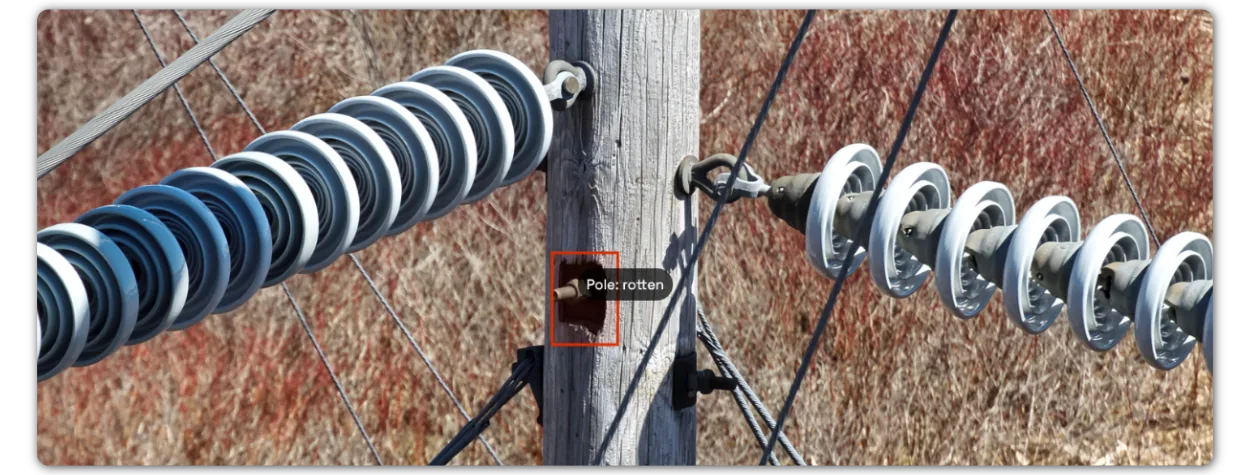
Put the two together and a Texas co-op owes the PUCT, every year from 2027, a statement of which poles it inspected, what grade each received, what was corrected and by when, and the records to back it. For most systems the first filing year starts with a distribution pole audit: every pole located, identified, and assessed once, so the annual report has a baseline to count from. The components and defects that drive those grades are well known; what is new is that the grade is now a regulatory record rather than an internal note.
What does substantial compliance with a wildfire mitigation plan require?
It requires evidence that the inspections the plan promised actually happened, on every structure, on schedule, with findings acted on. The phrase is the hinge of the new state wildfire laws: a utility that substantially followed an approved plan is shielded from negligence or strict-liability claims, or gains cost recovery, and one that cannot show it is not. What a plan is and what goes into it are covered in our wildfire mitigation plan reference; this section is about the test.
| State | Law | Who is covered | Cadence | Protection |
|---|---|---|---|---|
| Montana | HB 490 (2025) | all electric utilities | first plan Dec 31, 2025; every 3 years | civil liability protection if substantially followed |
| Utah | HB 66 and successors | qualified utilities; electric co-ops | annual; co-ops every 3 years | not negligent if plan followed |
| Idaho | Wildfire Standard of Care Act (2025) | IOUs required; co-ops and munis voluntary | annual PUC approval | standard of care |
| Washington | ESHB 1522 (2025) | IOUs | updates at least every 3 years; UTC rules pending (UE-250777) | plan approval |
| Wyoming | HB 192 (2025) | utilities incl. co-ops | regulator-approved plan | litigation protection on substantial compliance |
| South Dakota | SB 36 (signed Mar 12, 2026) | utilities | plan authorized | strict liability barred |
| Oregon | HB 3666 (2025) | IOUs must apply; consumer-owned may | 12-month certification; PUC independent inspections | certification, not immunity |
| Hawaii | PUC WMP orders | HECO; KIUC (a co-op) | 2025-2027 plans approved; areas for improvement | plan compliance |
| Texas | wildfire risk area WMP | utilities in elevated-risk areas | approval plus substantial compliance | liability protection if not negligent and plan-compliant |
Sources: NCSL wildfire mitigation tracker; McGuireWoods, October 2025; S&P Global, August 2025; Montana Free Press, May 2025; South Dakota Searchlight, March 2026; Idaho PUC Orders 36774 and 37120; Washington UTC docket UE-250777. Colorado, New Mexico, and Oklahoma each tried a version in 2026 and failed or withdrew; all three are expected back in 2027.
Three things follow for a mid-size utility. First, "voluntary" is a legal word, not a practical one: when Idaho and Oregon let consumer-owned utilities opt in, insurers and lenders will ask why a co-op did not. Second, the test is retrospective. It is applied after the fire, to the record that existed before it. Third, most plans promise more than patrol notes can prove. A plan that says "annual inspection of all facilities in the high-risk area" is substantially complied with only if every structure in that area has a dated inspection record. The reasons manual programs fall short of that are set out in why manual grid inspections miss failure risks; the point here is that the law now reads those shortfalls as liability.
Why is NERC looking at 100 kV lines, and what would NERC compliance ask of them?
Because that is where the outages are, and NERC compliance for those lines would mean documented vegetation and facility programs that most of their owners have never had to keep. NERC's wildfire report to FERC, filed May 1, 2026 under Executive Order 14308, found that transmission lines rated 100 to 199 kV accounted for 86% of vegetation-contact outages in 2025 data, yet sit largely outside FAC-003, the mandatory vegetation management standard that applies at 200 kV and above. The report recommends extending FAC-003 to all facilities at 100 kV and above, commits to a wildfire reliability guideline in 2027, and schedules a review of one or more reliability standards from 2028 (NERC filing, May 1, 2026; American Public Power Association summary, 2026).
For generation and transmission cooperatives, public power, and mid-size investor-owned utilities, those are exactly the lines they own: 115 kV and 138 kV sub-transmission that has never carried federal inspection and documentation duties at that rigor. The vegetation side of that scope is a right-of-way discipline; Detect's lane is the structures and hardware the conductor hangs from, and the two are inspected from the same flight. The practical consequence is a documentation program for lines that may not have one, starting two years before the first standard changes.
What do FEMA and insurers expect before the storm?
Proof of what the facility looked like before the event. FEMA's Public Assistance Program and Policy Guide version 5, effective for disasters declared on or after January 6, 2025, provides that for large projects, where necessary to validate that the declared event caused the damage, applicants must provide pre-incident photographs of the site or facility or documentation of its pre-disaster condition, such as maintenance records (FEMA PAPPG v5; Baker Donelson, 2026). Public power and cooperative utilities are eligible applicants, and appeal decisions have turned on whether a rural cooperative could show pre-disaster condition.
Insurance is tightening in the same direction. Cooperative wildfire coverage is shrinking as premiums rise, and co-op leaders describe a single fire as an existential event (NRECA; POWER magazine, 2026). DBRS warns that ambiguous liability frameworks leave utility insurers exposed, while approved plans and cost recovery are credit-supportive (Insurance Business, 2026). What a photograph has to carry to stand up in front of a contractor, an insurer, or a commission is the subject of our guide to claim-ready inspection photos: hash, timestamp, reviewer, and structure key. FEMA's rule and the insurers' questions are the same requirement from two more directions.
The pre-incident record is also only half of the equation. Turning the post-storm sweep into a damage register that feeds those same FEMA, insurer, and warranty filings is the subject of the storm damage response guide.
How do drone fleet rules change inspection volume?
They multiply it and make it less uniform at the same time. The FCC added all foreign-made drones and critical components to its Covered List on December 22-23, 2025: existing fleets keep flying, new models cannot be authorized, and procurement is being rewritten around market access (DroneLife; Wiley, 2026). The FAA's Part 108 rule for routine beyond-visual-line-of-sight flight has been under White House review since July 10, 2026, and when it publishes it removes the per-corridor waiver that has rationed linear-asset inspection for a decade (UAS Dashboard; Airdata, 2026).
The result for a co-op or its regional drone contractor is a mixed fleet flying more structures per year, with more variance in the imagery. Across observed programs, 15 to 25% of ad-hoc delivered imagery needs rework before a utility can use it, and the largest cause is a photo filed to the wrong structure, at 35% of rework; programs that run every crew to one capture standard bring rework to 3 to 7% within two campaigns (Detect, State of Utility Drone Inspections 2026). What the fleet transition costs and how to plan it is in our DJI ban guide for utility inspection; the point for the record is that more imagery is only more evidence if it is graded and associated on the way in.
What is the Substantial-Compliance Record?
It is the set of pole maintenance records and condition findings, keyed to each structure, that every instrument above reads: coverage (every structure, not a sample), cadence (inspected on the schedule the rule sets), and condition (graded, verified, and dated). Build it once and it exports as a plan compliance report, a warranty register, a pre-disaster condition file, and a rate-case exhibit, without re-keying.
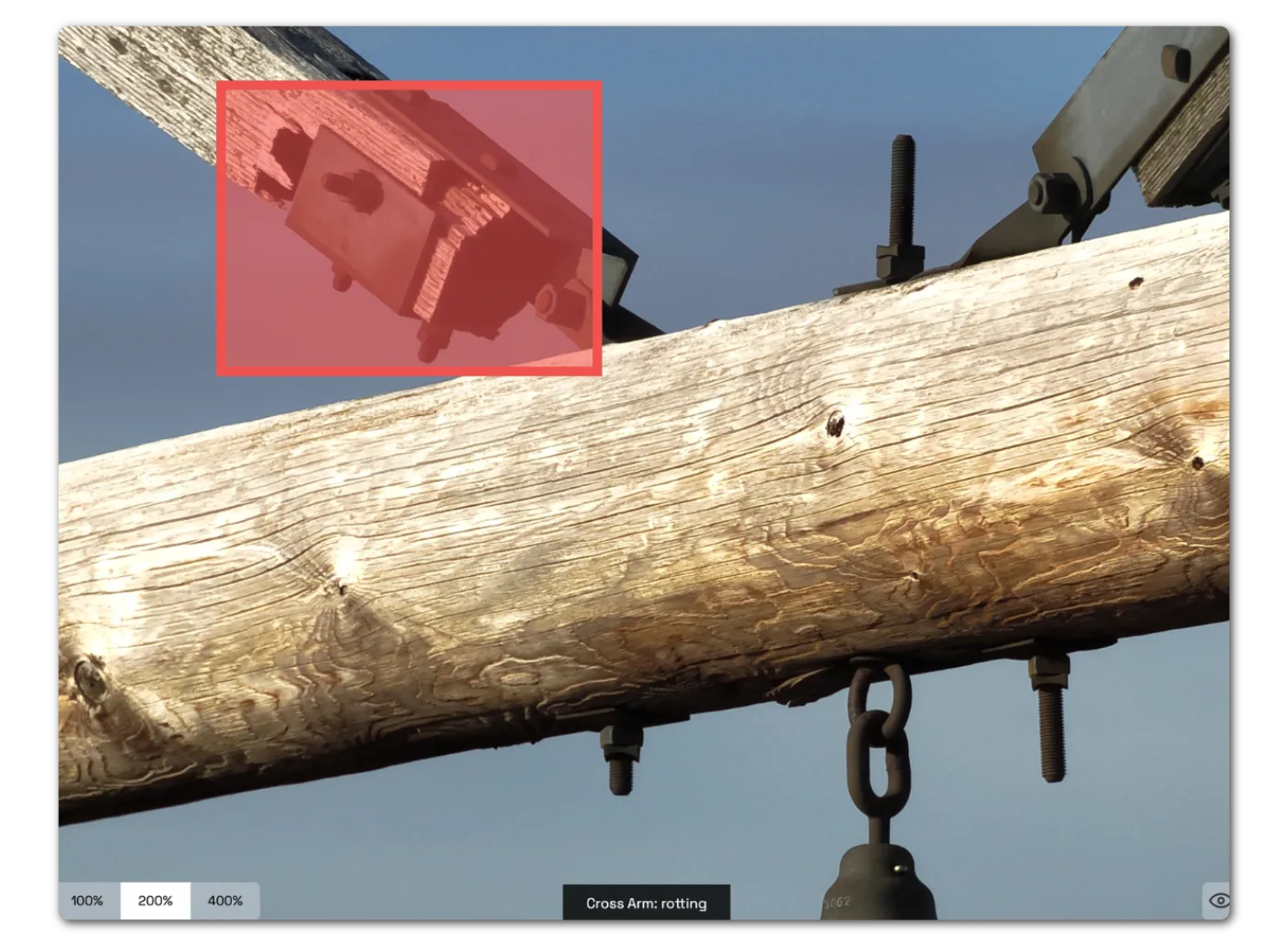
96 of 96 structures on two 40-year-old wooden H-frame lines, 100% coverage in a single field day with a 3-person crew; 55 high-risk conditions found. Rotten poles, loose bolts, splitting crossarms. That is what a complete baseline looks like at co-op scale, and it is the record a substantial-compliance test, a FEMA claim, and a rebuild case all read. Source: Detect wooden H-frame case study, 2026.
Each of the three is measurable, and Detect's programs show the scale at which each has to work. Coverage: the 96-structure audit above. Cadence: on a newly commissioned HVDC intertie, 122,714 images were screened in 30 days by three people, 1,270 flagged for expert review, and the one confirmed critical finding, a clevis bolt with its cotter key missing, was cleared in 120 minutes and averted a $1M+ forced outage (Detect Data Quality Program, 2026). Condition: on Detect's 258-type, 19-class defect catalog, sharp capture keeps the full catalog assessable, soft capture 69%, blurry capture 7%, which is why grading happens at ingest and not at the audit (Detect Data Quality Program, 2026). On a new 345kV line, the image-linked register reached the utility within 72 hours and turned a $15,000 repair into a warranty claim the contractor paid (Detect and CompassData, 2026). The same record also closes the Permit-to-Baseline Gap on the lines the Senate's permitting bill would build faster.
How should a co-op or municipal utility prepare?
Five steps, in the order the deadlines arrive. The first two are the ones most programs discover late.
- Map your obligations by instrument. List every rule that reaches your system: state pole law, wildfire plan statute, PUC inspection order, RUS guidance, NERC applicability, FEMA, insurer. Write down what each one makes you prove and by when.
- Baseline every structure once. Treat it as a distribution pole audit: before the first annual report or certification audit, image every structure to one shot sheet and grade the capture. Coverage is the one obligation you cannot back-fill after the fact.
- Set the cadence to the strictest rule and check capture at ingest. Annual patrols before fire season, three-year detailed cycles, annual Texas reports: pick the tightest and plan to it. Grade sharpness and structure association as imagery arrives, so a bad frame becomes a re-shoot, not a gap in the record.
- Key every finding to the asset ID. Structure ID, component, severity, image, reviewer, timestamp. A finding that cannot join your GIS and EAM record is a photo, not evidence.
- Keep the record where the auditor, the insurer, and FEMA can read it. One structure-keyed record, exportable as a plan compliance report, a warranty register, a pre-disaster condition file, or a rate-case exhibit, without re-keying.
Intrusive pole-testing contractors and pole inspection software each cover part of this: the first grades the wood below the groundline on a long cycle, the second stores the forms. Neither produces the structure-level condition evidence the rules above read, every year, for every structure. The money question is cost per structure per year across every obligation, not the price of one inspection. A co-op that baselines once and then flies the strictest cadence with graded capture is paying for one record; a co-op that answers each rule separately is paying for the same structures several times and still cannot join the results. Where Detect fits is the layer between the camera and the report: capture quality measured up front, an engineer on every flagged finding, one record per structure keyed to the asset IDs the GIS and EAM already hold, across hundreds of thousands of structures. The crews, the drones, and the plan stay yours.
The bottom line
Utility pole inspection requirements in 2026 did not add a new kind of inspection. They added a burden of proof: every structure, on schedule, with a graded and verified condition on file, readable by a regulator, an insurer, a contractor, and FEMA. Texas set a date for it. Nine wildfire states made it the price of liability protection. NERC is extending it to lines that never carried it. The utilities that will be fine in 2027 are the ones whose record already answers the question before anyone asks it.
Find out what your current record can prove
Send Detect a recent inspection set from one feeder or one line. The free audit grades assessability and structure association image by image, so you know your coverage, your cadence, and your condition evidence before the first filing is due.
Book a free audit →