
Guide: The DJI Ban and Utility Drone Inspection in 2026
Updated October 1, 2026 - status re-verified against the FCC Covered List.
As of October 2026, DJI is not banned outright - the drones you already own are still legal to fly. But on December 22, 2025, the FCC added DJI communications equipment to its Covered List, along with all foreign-produced drones and critical drone components. New DJI models can no longer get the equipment authorization they need to enter the US market. For drone inspection work in the electric utility space, that one change is already rewriting how contracts get scored.
If you run a drone service provider (DSP) that inspects power lines, substations, or transmission corridors, the practical question isn't whether DJI is "banned." It's what the restriction does to your fleet, your bids, and your margins this year. Here's the honest version.
Is DJI actually banned in the US?
Not in the way the headline suggests. The restriction came from section 1709 of the FY2025 NDAA. On December 21, 2025, the FCC received an interagency national security determination under that section. The next day, December 22, it added all foreign-produced drones and critical drone components, plus DJI and Autel communications equipment, to its Covered List (Public Notice DA 25-1086). Separately, since December 22, 2025, the American Security Drone Act has barred federal grant and cooperative-agreement funds from buying or operating covered drones. That includes FEMA Public Assistance and DOE awards (FEMA IB 551; DOE FAL 2026-04).
What that means in plain terms:
- Existing DJI hardware is still flyable. You are not grounded.
- New DJI models cannot receive FCC equipment authorization for the US market.
So the market access closed, not the airspace. But for utility work, market access is the part that matters - because utilities are rewriting procurement around it.
The restriction is also not retroactive: per the FCC’s public notice (DA 25-1086, Dec 2025), drones already owned can keep flying, and previously authorized models can still be sold. Firmware and software updates remain allowed under a waiver until at least January 1, 2029 (DA 26-454). Blue UAS and Buy American products are exempt from the listing until January 1, 2028 (DA 26-761). What stays closed is FCC authorization for new models.
What NDAA compliance now means for drone inspection
Three things shifted in utility procurement, and all three affect how you bid.
Risk review. Risk teams now ask DSPs where flight telemetry is stored and what servers touch the data between capture and delivery. Two years ago, no one asked. Now it sits in vendor reviews, alongside attestations like SOC 2 Type II that prove how your inspection data is handled.
Bid scoring. Procurement rubrics quietly award points for compliant equipment. Non-compliant operators lose points without being formally banned. Compliant hardware is only one line in the rubric, though - it pays to know what utilities actually evaluate when choosing a drone inspection vendor before you bid.
Board optics. Utilities are critical infrastructure operators. Using Chinese-manufactured hardware to inspect the power grid carries weight in boardrooms and regulatory filings.
An NDAA-compliant drone is one cleared under the Blue UAS or Green UAS frameworks, with documented data residency. That phrase is now a line item in RFP scoring. Our guide to NDAA compliant drones breaks down which platforms qualify, the Blue UAS vs. Green UAS distinction, and what each clearance actually requires.
The NDAA-compliant alternatives - and what they cost
Here are the platforms most utility DSPs are moving to, with starting price ranges as of Q2 2026.
- Skydio X10 / X10D - Blue UAS Cleared. Starting price: $15K - $22K. AI autonomy, GPS-denied flight.
- Freefly Astro Prime - Green UAS Cleared. Starting price: $25K - $35K. Modular open ecosystem.
- Inspired Flight IF800 Tomcat - Blue & Green UAS Cleared. Starting price: $22K - $30K. Heavy-lift, customizable payloads.
- Parrot ANAFI USA GOV - Blue UAS Cleared. Starting price varies. Primary non-US Western option.
Equivalent-class compliant platforms run 50 to 100 percent more than the DJI Matrice gear they replace. For a DSP transitioning a fleet of ten drones, that's six figures of capital outlay before retraining, software, and insurance review. Since September 3, 2026, imported thermal drones and docking stations have also carried a 100 percent Section 232 duty.
The output gap nobody warns you about
Here's the part the hardware guides miss - and the part that gets a contract canceled.
An operator invests six figures in a compliant fleet. Retrains the crew. Wins the work. Then the utility flags 30 percent of the deliverables on the first campaign. Not for compliance - for image quality. The new platform handles differently than the DJI rig the crew spent years dialing in. Nobody budgeted time to close that gap.
By the time the rework is done, the relationship is damaged. The follow-on contract goes to someone else.
The fix is not to demand better pilots. Capture quality has always been pilot-dependent, and muscle memory does not transfer when the platform changes. The fix is to remove pilot judgment from the variables that affect deliverable quality - by standardizing capture methodology across platforms, in software, before the prop spins. That starts with something as basic as recognizing your transmission structure types and the exact angles each one needs.
So the right question isn't "which compliant drone do I buy?" It's "which capture methodology produces utility-grade output regardless of which drone I'm holding?"
Part 108 is coming, and it multiplies your data
FAA Part 108 - the standardized framework for BVLOS flight - is still a proposed rule as of October 1, 2026. The FAA published the proposal (NPRM) on August 7, 2025. Once final, it would replace the per-flight waiver system that has constrained corridor inspection for a decade.
For a transmission corridor, the economics of transmission line inspection shift sharply. Inspections that used to need ten launch points and multiple visual observers can be flown from one or two strategic sites. The throughput math is settled.
The part nobody is writing about: a long BVLOS corridor mission doesn't capture more area at the same image density. It captures the same area at higher density. The imagery arrives in your office in one batch, often from multiple sensors, at several times your current volume.
The question your ops lead should be asking now: at materially higher image volume, what does our QA workflow look like? Who reviews, on what timeline, at what cost? If the honest answer is "the same way we do it now, just more of it," the contract will not be profitable.
What this means for your drone inspection business in 2026
The DJI ban, Part 108, and tier-graded utility scoring are three separate trends arriving at the same time. Treated as one problem, they point to the same answer: the workflow is the product, not the drone fleet. In Western territories, wildfire mitigation plan requirements add a fourth pressure - and often move to the top of the scoring rubric.
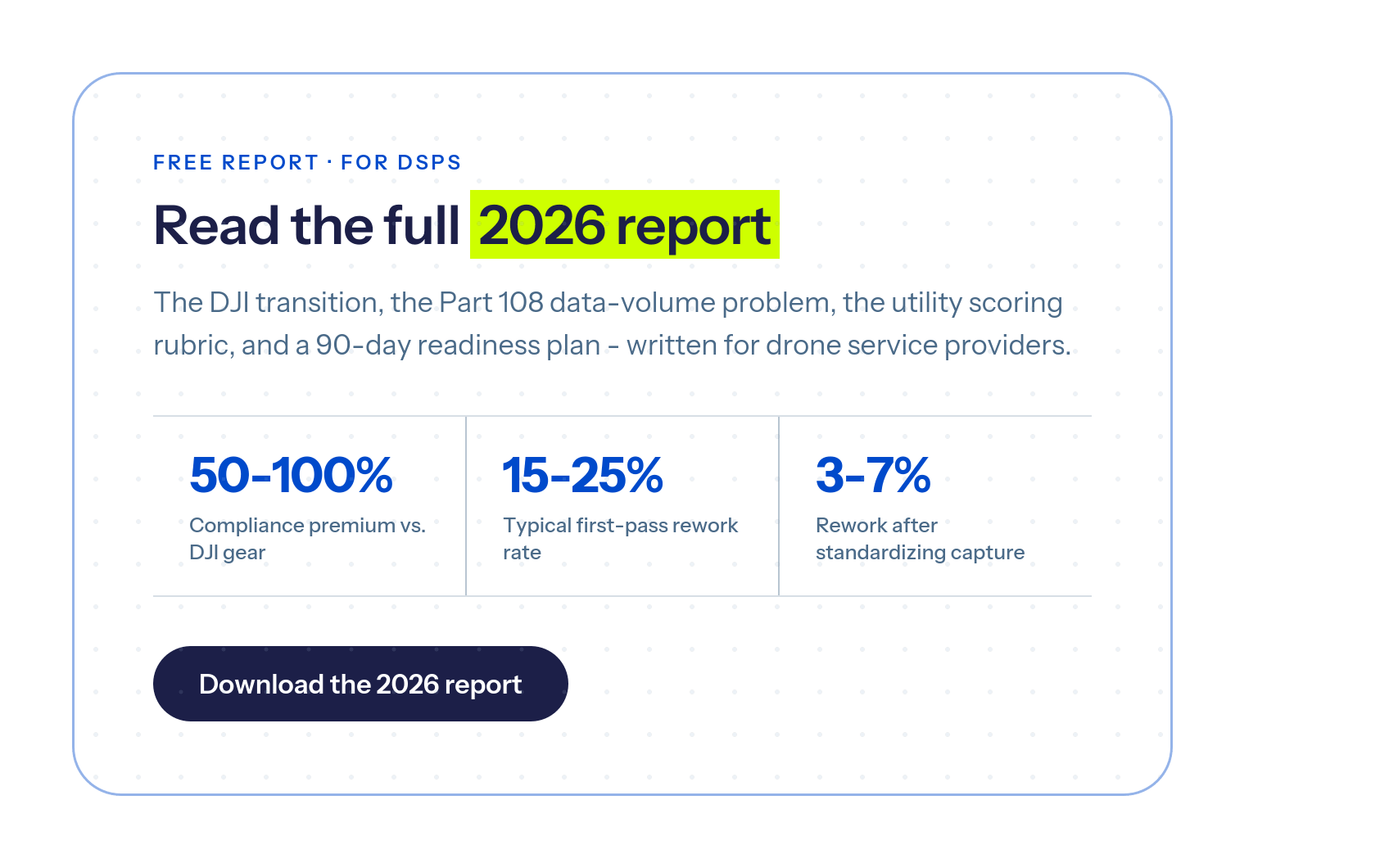
The numbers back it up. Across the contracts we analyze, a 15 to 25 percent rework rate erases roughly half of pre-rework margin. A capture workflow built around standardized, structure-specific shot sheets and field-side QA typically reduces rework to the 3 to 7 percent range within two campaigns. That recovery is what funds the compliance investment, the platform transition, and the BVLOS-readiness build-out.
Without it, every 2026 trend is a cost. With it, they're opportunities.
Get the full 2026 drone inspection trends report
We pulled the regulatory timeline, the compliant-platform pricing, the margin math, and the utility scoring rubric into one report for drone service providers: The State of the Utility Inspection Drone Industry 2026.
It covers the Part 108 data-volume problem, the DJI transition output gap, why utility data gets rejected, and the six things to do in the next two quarters - with a 90-day readiness plan.
Download the 2026 report - free, no gate beyond your email.
There's also Detect's Pilot Partner Program - free, self-paced certification for working DSP teams that covers structure identification, component-level awareness, and standardized capture. Here's how the drone pilot training works.
Frequently asked questions
Is DJI banned in the US in 2026?Not entirely. As of October 2026, existing DJI drones remain legal to fly, and previously authorized models can still be sold. On December 22, 2025, the FCC added all foreign-produced drones and critical drone components, plus DJI and Autel communications equipment, to its Covered List. That blocks new DJI models from receiving the equipment authorization needed to enter the US market.
Can I still fly my DJI drone for utility inspections?Yes, existing hardware is still flyable. For most work the risk is commercial, not legal: utility procurement now awards scoring points for NDAA-compliant equipment, so DJI-based bids increasingly lose on points even where they aren't formally barred. The exception is work paid for with federal grant or cooperative-agreement funds, such as FEMA Public Assistance or DOE awards, which cannot be used to buy or operate covered drones.
What is an NDAA-compliant drone?An NDAA-compliant drone is one cleared under the Blue UAS or Green UAS frameworks, with documented data residency. Examples include the Skydio X10, Freefly Astro Prime, Inspired Flight IF800 Tomcat, and Parrot ANAFI USA GOV.
What are the best NDAA-compliant drones for power line inspection?The most common compliant platforms for utility corridor and power line inspection are the Skydio X10 / X10D, Freefly Astro Prime, and Inspired Flight IF800 Tomcat. Expect to pay 50 to 100 percent more than equivalent DJI Matrice gear.
When does FAA Part 108 take effect?Not yet. As of October 1, 2026, Part 108 is still a proposed rule, published as an NPRM on August 7, 2025. Once final, it would replace the per-flight BVLOS waiver system.
Why do utilities reject drone inspection data even from compliant fleets?Because compliance and capture quality are separate problems. A new compliant platform handles differently than the gear a crew is used to, and roughly 30 percent of first-campaign deliverables get flagged for image quality unless capture methodology is standardized in software.
