
What the Senate Permitting Bill Means for Transmission Inspection: The Permit-to-Baseline Gap
The bill introduced in the Senate on September 30 would make interstate transmission faster to site, review, and build. It does nothing to make a new line faster to know. That gap - between the permit and the first condition record - is where the next decade of reliability is decided.
Transmission permitting reform, as written in the Senate's September 30 bill, compresses the time to a permit and the time to build: FERC permits for transmission project by project on public-interest grounds, no more national-interest corridors, no federal right of first refusal, and a NEPA exclusion for in-corridor upgrades. It leaves the inspection record untouched. Utilities that treat energization as cycle zero of that record will own the lines this bill builds.
- The bill shortens the front of the line's life, not the middle. Siting, review, and build get faster. Knowing what was built, and what it becomes, stays the utility's job.
- New lines carry concentrated construction defects. On one new 345kV line, 67 of 45,335 findings were critical and 76% of the criticals sat in one segment (Detect and CompassData, 2026).
- Reconductoring puts new conductor on old structures. About 70% of U.S. transmission lines are 25 years old or more (DOE, 2015). The exclusion speeds the wire; it says nothing about the steel and wood under it.
- Costs that follow benefits need evidence that follows costs. A structure-level condition record is what shows a line was built and kept to the standard its allocation assumed.
- Interregional means multi-contractor. One capture standard and one record per structure, or the data from one state will never join the data from the next (rework 15-25% ad hoc, 3-7% standardized - Detect, 2026).
- What does the Senate permitting bill do for transmission?
- What is the Permit-to-Baseline Gap?
- Why do faster-built lines need a commissioning baseline?
- What does reconductoring mean for the structures underneath?
- Why does beneficiary-pays cost allocation raise the evidence bar?
- What do interregional lines demand from inspection data?
- How should a utility prepare for permitting reform?
- The bottom line · FAQ
What does the Senate permitting bill do for transmission?
The Bipartisan American Affordability and Jobs Act of 2026, introduced September 30 by Senators Capito, Lee, Heinrich, and Whitehouse, the chairs and ranking members of the Senate energy and environment committees, expands the federal role in getting interstate lines sited and built. Six provisions matter for anyone who owns transmission (Utility Dive, Oct. 1, 2026; Senate ENR committee release, Sept. 30, 2026; Holland & Knight bill summary, Oct. 2026):
- FERC siting, project by project. The bill eliminates National Interest Electric Transmission Corridors and lets FERC permit the construction or modification of transmission facilities one project at a time, where the work is consistent with the public interest (Utility Dive).
- FERC as lead federal reviewer. Bill summaries describe FERC coordinating the federal environmental review for covered lines, with federal review able to run alongside state processes (Holland & Knight; Niskanen Center, Sept. 30, 2026).
- Consolidated planning and cost allocation. FERC must require every planning region to file a consolidated interconnection and regional transmission planning process, on the model FERC approved for the Southwest Power Pool in March; the sponsors describe costs following benefits across regions. Transmission costs for computational loads of 20 MW or more are assigned fully to the data center, with exit charges, and cannot be recovered from other customers (Utility Dive).
- In-corridor upgrades without new NEPA review. A categorical exclusion covers capacity upgrades inside existing rights of way: reconductoring with advanced conductors, grid-enhancing technologies, storage (Solar Power World and Niskanen Center summaries, Sept. 30, 2026).
- Permit certainty. In most cases, previously issued federal permits for energy projects cannot be revoked or suspended, and applicants gain a right to sue over disparate treatment by project type (Utility Dive). Summaries also report judicial review windows narrowed to 150 days (Holland & Knight).
- No federal right of first refusal. Incumbent utilities lose the automatic right to build new regional lines (Utility Dive).
The bill is introduced, not passed. Senator Whitehouse said amendments will be considered when the Senate reconvenes in November, Advanced Energy United expects a Senate vote after the elections, and the renewable-permitting dispute with the administration is still open (Utility Dive, Oct. 1, 2026). Treat the detail as a direction, not a statute.
The direction is clear enough. Grid Strategies president Rob Gramlich called the transmission title the set of changes that could actually expand and decongest the grid, in a post Utility Dive quoted the day the text dropped. For the first time in two decades, Congress is moving the bottleneck. More lines, built faster, with more of the schedule set in Washington and less of it set by a state commission's calendar. What follows is Detect's read on where that lands, which is not on the permit desk. It lands on the inspection record.
What is the Permit-to-Baseline Gap?
The Permit-to-Baseline Gap is the interval between the day a line is permitted and the day it has a complete, structure-level condition record. Permitting reform shortens the first part of that interval. Nothing in the bill touches the second, and most utilities have never measured it.
Here is why that matters more after this bill than before it. A line that takes eight years to permit and three to build arrives slowly, segment by segment, with time for people to notice what the contractor got wrong. A line that arrives on a compressed federal timeline, across several states, built by several EPCs, arrives all at once. The only thing that keeps pace with that is a record that is built as the structures go up, not reconstructed from a folder after the first outage. Building it starts with how crews inspect a construction site: findings tied to structures, so the close-out inspection becomes the condition record's first entry instead of a closeout file.
We call the first entry in that record the commissioning baseline: cycle zero. Every inspection for the life of the line is measured against it. Lines without one spend their first years finding out what they are. The 345kV construction QA program below is what cycle zero looks like when it is done on purpose.
Why do faster-built lines need a commissioning baseline?
Because new transmission construction carries defects that are small, concentrated, and only cheap to fix while the contractor still owns them. On a new 345kV line, a drone service provider and Detect inspected all 927 structures over roughly five months of construction: 65,701 images, 45,335 findings, 67 of them critical. Fifty-one of the 67 criticals - 76% - came from one construction segment (Detect and CompassData, 2026).
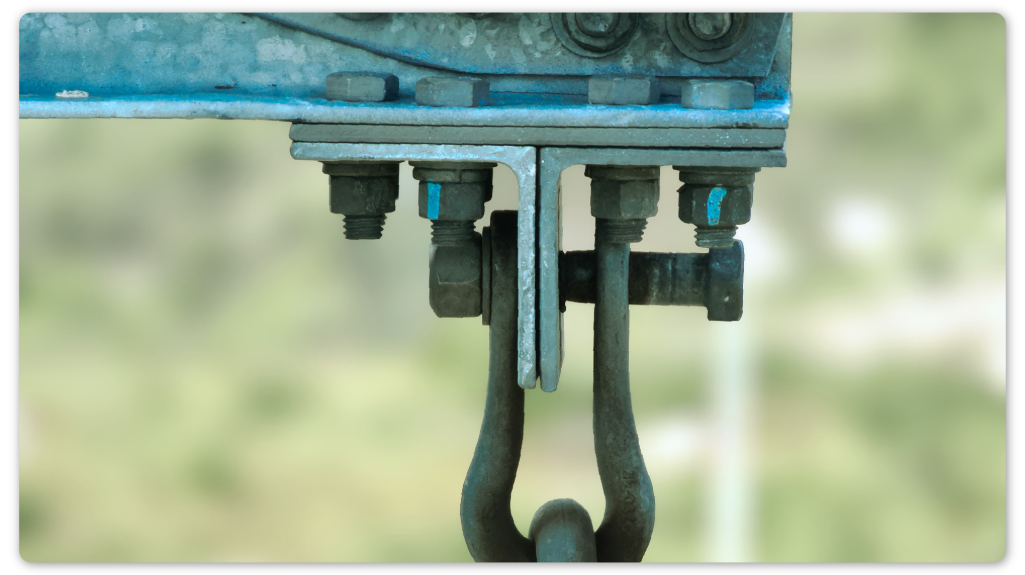
$15,000 of planned repair avoided $150,000 of statistical risk inside the six-month warranty window. The finding was a clevis pin whose cotter key had never been installed. The image-linked defect register reached the utility within 72 hours, and the EPC paid for the fix. Three years later the same defect would have been the utility's outage. Source: Detect and CompassData 345kV case study, 2026.
Two things in that program are the point for a permitting-reform world. First, the register was image-linked: structure, component, severity, frame. That is what makes a warranty claim the contractor cannot argue with, and it is what a utility needs when a line was approved on a cost allocation that assumed it was built to standard. Second, the concentration. Three quarters of the criticals in one segment means a crew-level problem, not a random one. A record that is keyed to structures finds that pattern in a week. A set of PDFs never finds it.
Faster permitting does not make construction worse. It makes the window to catch construction defects shorter relative to everything else, and it puts more lines into that window at the same time. The baseline is how a utility keeps pace. It also shortens the transmission line inspection cycle for the next 40 years, because every later inspection compares against a known state instead of starting from zero.
What does reconductoring mean for the structures underneath?
Reconductoring replaces the conductor on an existing line with advanced conductor that carries more current, inside the existing right of way and mostly on the existing structures. It is the fastest capacity the bill creates, because the categorical exclusion removes the federal environmental review for in-corridor upgrades. It is also the provision with the most direct inspection consequence, because the structures that will carry the new conductor are the old ones.
About 70% of U.S. transmission lines are 25 years old or more (U.S. Department of Energy, Quadrennial Technology Review, 2015). A new conductor changes the mechanical and thermal loading on crossarms, insulator hardware, and foundations that were designed for the old one. The exclusion is a judgment that the environmental footprint does not change. It is not a judgment about the condition of the steel and wood, and nothing in the bill makes one.

Detect's position is simple: image the structures before you reconductor them, grade the capture so the fastener- and splice-level defects are assessable, and compare the post-work capture against the pre-work one. On two 40-year-old wooden H-frame lines, one three-person crew covered all 96 structures in a single field day and the review flagged 55 high-risk conditions - rotten poles, loose bolts, splitting crossarms (Detect case study, 2026). That is the scale of what sits under a line that looks fine from the road, and it is exactly what a reconductoring crew will be hanging new load on. The structure types and components that fail first are known; the question is whether anyone imaged them before the work order.
The same logic held on a brand-new line. In its first operating season after spring commissioning, a ~250-mile HVDC intertie of roughly 2,600 lattice towers had one clevis bolt backed off with its cotter key missing. The AI screened 122,714 images in 30 days, flagged 1,270 for expert review, and that one finding, cleared in 120 minutes of field time, averted a $1M+ forced outage the following winter (Detect Data Quality Program, 2026). New hardware fails early. Old hardware fails under new load. Both arguments end at the same place: know the structure before you change what it carries.
Why does beneficiary-pays cost allocation raise the evidence bar?
Because every dollar allocated to a customer class on the theory that a line benefits them invites the question of whether the line was built and maintained to the standard that benefit assumed. The bill requires costs to follow benefits and requires the largest new loads to pay their full transmission costs. Those are rate-case arguments, and rate cases run on evidence.
The evidence a utility can produce today is mostly paper: a commissioning sign-off, a periodic patrol report, a maintenance log. The evidence it will be asked for is structural: this structure, this component, this condition, this date, this reviewer. The claim-ready inspection photo standard describes what that record has to carry - hash, timestamp, reviewer, structure key - so that a finding stands up in front of a contractor, an insurer, or a commission. Permitting reform does not create that requirement. It raises the number of lines and the number of dollars the requirement applies to.
There is a quieter consequence. When data centers pay their full transmission cost, they become the most sophisticated ratepayer on the line, and they will ask the questions a residential class never did. The utility that can answer with a condition record answers once. The one that cannot answers in discovery.
What do interregional lines demand from inspection data?
One standard. An interregional line crosses state commissions, planning regions, and usually several EPCs and several drone contractors, each with its own shot sheet, file naming, and GPS habits. The findings from segment A have to join the findings from segment C in one record, keyed to one set of structure IDs, or the utility ends up owning a line it cannot see end to end.
The cost of not standardizing is measured. Across observed programs, 15-25% of ad-hoc delivered imagery needs rework before a utility can use it, and the largest single cause is GPS misassociation - a photo filed to the wrong structure - at 35% of rework. Programs that run every crew to one standard, with capture checked in the field, bring rework to 3-7% within two campaigns (Detect, State of Utility Drone Inspections 2026). The five-document SOP set we published for Canadian programs is one version of that standard; the principle does not change at the border.
The standard has to extend past capture into the handoff. Findings that arrive as structure-keyed records with severity and location become work orders; findings that arrive as PDFs get re-keyed or ignored. The Asset-Record Contract is the specification for that handoff into the EAM and GIS the utility already runs. For a line that three states paid for, that contract is also the audit trail.
How should a utility prepare for permitting reform?
Close the Permit-to-Baseline Gap on purpose, before the first line permitted under the new rules is energized. Four steps, in the order the work arrives:
- Set the baseline before energization. Every structure imaged to one shot sheet, capture graded for assessability, findings verified by an engineer, inside the warranty window. This is cycle zero of the record.
- Image the structures before you reconductor them. A new conductor on a 40-year-old structure changes the loading. Know the condition of the crossarms, hardware, and foundations first, and compare the post-work capture against it.
- Key every finding to the asset ID the EAM will carry for 60 years. Structure ID, component, severity, image, reviewer, timestamp. A finding that cannot be joined to the asset record is a photo, not evidence.
- Hold every crew to one capture standard. Multi-state lines mean multiple contractors. One shot sheet per structure type and a measured rework rate per crew, or the data from segment A will never join the data from segment C.
None of this is new work. It is the work most programs do late, after the first failure, on the one line that failed. The bill's effect is to make the late version untenable: too many lines, too many contractors, too much allocated money for a folder of PDFs to carry. The executive version of this plan - what the board sees - is a risk-based work plan built from the record, not from the schedule.
The bottom line
Transmission permitting reform is a bill about the front of a line's life. It lets FERC permit lines project by project, ends the federal right of first refusal, shields in-corridor upgrades from new environmental review, and makes the largest new loads pay their own way. Every one of those changes lands, eventually, on the inspection record: more new lines inside shorter warranty windows, new conductor on old structures, more dollars that need evidence, and more contractors whose data has to join.
Detect's take is that the utilities who do well under this bill will be the ones who treat energization as cycle zero of the condition record and build that record the way the 345kV program did - every structure, graded capture, verified findings, keyed to the asset, inside the warranty. That is the layer DetectOS provides: utility inspection imagery turned into decision-grade findings, with capture quality measured up front, an engineer on every flagged defect, and one record per structure that your EAM and GIS can read, across hundreds of thousands of structures. The bill will decide how fast the lines get built. The record decides how long they stay up.
Start the baseline on a line you already own
Send Detect a recent inspection set from one segment. The free audit grades assessability and structure association image by image, so you know what your current record can and cannot prove before the next line arrives.
Book a free audit →