
7 Checks Before You Trust AI Inspection Results
AI can read 65,000 inspection images in days. Whether you should act on what it finds comes down to seven things you can verify - none of which show up in a demo.
- AI inspection results are verifiable. Seven concrete checks - the Evidence Audit - tell you whether findings deserve field action, whatever platform produced them.
- Accuracy is a per-defect-class property, never one number. Published benchmarks on transmission imagery range from 99.5% on insulator self-explosions down to 54-87% on bolts and pins (arXiv, Feb 2025).
- Capture quality caps everything downstream: sharp imagery keeps 100% of a 258-type defect catalog assessable, soft capture 69%, blurry capture 7% (Detect Data Quality Program, 2026).
- Expert review turns AI flags into findings. On one HVDC campaign, about 122,000 images became 1,270 AI flags and one confirmed critical defect - a $1M+ forced outage averted (Detect Data Quality Program, 2026).
- Credible programs surface few criticals: 67 of 45,335 findings on one new 345kV line - about 0.15% (Detect CompassData case study, 2026). A tool that calls everything critical cannot rank anything.
- Trust gaps close through process, not persuasion: a bounded pilot with verification metrics beats a feature bake-off.
Utility teams are right to be skeptical of AI inspection findings. A missed defect becomes an outage with your name on it, and an over-flagged one burns a truck roll. The answer to that skepticism is not a better demo. It is a verification routine you can run on any deliverable, from any vendor, this week.
Can you trust AI inspection results?
You can trust AI inspection results exactly as far as you can verify them. Trust here is not a feeling about a vendor - it is the output of a checkable process: quality-gated imagery in, per-class accuracy on record, expert eyes on every flag, and evidence attached to every finding that reaches your queue.
That standard is higher than most of the industry talks about, and it should be. When a finding drives a live-line crew dispatch or a wildfire-season decision, "the model said so" is not a basis for action. A confirmed image of a backed-off clevis bolt is.
This guide gives that standard a working shape: the Evidence Audit - seven checks you can run on any AI inspection deliverable before its findings enter your maintenance plan. The checks are vendor-neutral. A platform that passes all seven has earned the word "findings". One that fails is still delivering hypotheses.
Why do AI inspection results need verification?
Because three things are true of every AI inspection system, whoever builds it: accuracy varies widely by defect class, capture quality caps what any model can see, and screening produces false positives by design. None of these is a scandal. Unverified, each one quietly converts into missed defects or wasted truck rolls.
Accuracy varies by class. A peer-reviewed 2025 benchmark of transmission-line defect detection models reports 99.5% detection on insulator self-explosions and 91% on insulator components - but 54-87% on bolt and pin defects (arXiv, Feb 2025). Those small fasteners are exactly what fails first in the field. One headline accuracy number averages that spread out of sight.
Capture caps detection. No model finds a missing cotter key in a frame that never resolved it. On Detect's 258-type transmission defect catalog, sharp imagery keeps the full catalog assessable, soft capture keeps 69%, and blurry capture keeps 7% (Detect Data Quality Program, 2026). Why that ceiling exists, and what it does to defect findings, is covered in the assessability ceiling - for this guide, the point is simpler: results from ungated imagery carry a hidden asterisk.
Screening over-flags on purpose. A screening model tuned to never bother you is a model tuned to miss defects. Well-run programs accept a stream of AI flags that includes false positives, then clear them with expert review before anything reaches your queue. The question to ask is not "does the AI make mistakes?" It is "who catches them, and is that step in writing?"
What are the seven checks before you trust AI inspection results?
The seven checks: a capture-quality gate, per-class accuracy, expert review, openable evidence, a credible severity distribution, correct structure association, and an audit-ready record. Together they form the Evidence Audit - a routine you can run on one deliverable in an afternoon.
| Check | Ask | Red flag |
|---|---|---|
| 1 · Capture-quality gate | What share of frames was assessable, and against how many defect classes? | Every frame analyzed, no quality score anywhere |
| 2 · Per-class accuracy | What is the accuracy on the two classes that drive our outages? | One headline number for the whole catalog |
| 3 · Expert review | Which flags did a person review, and who signed the findings? | Raw model output delivered as findings |
| 4 · Openable evidence | Can I open the frame, the component, and the severity rationale behind this finding? | Findings you cannot trace to an image |
| 5 · Severity distribution | What share of findings is critical, and does the pattern make engineering sense? | Everything flagged high, or a suspiciously flat spread |
| 6 · Structure association | Can a crew drive to the right structure from this finding alone? | Findings tagged to coordinates, not structure IDs |
| 7 · Audit-ready record | Could I hand a regulator the evidence trail for this cycle? | Results that live only in a dashboard session |
One HVDC intertie campaign: about 122,000 images captured. 1,270 flagged by AI - about 1%. Expert review confirmed one critical defect: a clevis bolt backed off, cotter key missing, high in a suspension assembly. Finding it averted $1M+ in forced-outage exposure, and the fix took 120 minutes of field time (Detect Data Quality Program, 2026).
1. Did the imagery pass a capture-quality gate?
The first check comes before any AI claim: was each frame scored for sharpness and effective resolution before analysis, and what fell below the line? A platform that measures assessability tells you what its results cover. A platform that analyzes whatever arrives is silently narrowing your defect catalog - from 258 assessable types on sharp capture to roughly 18 on blurry (Detect Data Quality Program, 2026).
Ask for the assessability report alongside the findings. If no such report exists, treat absence-of-findings on fastener-level defects as "not assessed", never as "no defect found". The distinction has outage consequences.
2. Is accuracy reported per defect class?
A trustworthy accuracy claim names the class: insulators, conductor damage, corrosion, fastener hardware - each with its own number, on imagery like yours. The published spread above runs from 99.5% down to 54% depending on class (arXiv, Feb 2025), so a single blended number tells you almost nothing about the failure mode you care about.
Two follow-ups separate marketing from measurement. On which imagery was the number established - curated frames or field capture like yours? And who verified it - the vendor alone, or reviewers whose confirmations are logged per finding?
3. Did an expert review every flagged finding?
AI screens volume; experts confirm findings. That division of labor is what makes the results trustworthy, and you should see it in the numbers: a wide funnel of images, a narrow band of AI flags, and a reviewed set of confirmed findings with a name attached.
The shape of that funnel on one HVDC intertie campaign: about 122,000 images, 1,270 AI flags, and after expert review, one confirmed critical defect that mattered more than everything else combined. Three people ran the whole review in 30 days (Detect Data Quality Program, 2026).
Detect runs this as a named practice - Hybrid AI + Expert Review - and the label matters less than the receipt: every flag in the queue was either cleared or confirmed by a person qualified to judge it. Whatever platform you use, ask to see that receipt.
4. Does every finding carry evidence you can open?
A finding you can act on has five things attached: the source image, the structure, the component, the defect class with a severity rationale, and the reviewer who confirmed it. Open any finding in the deliverable and count. Five out of five means your engineers can re-judge the call without a site visit. Anything less means the platform is asking for faith.
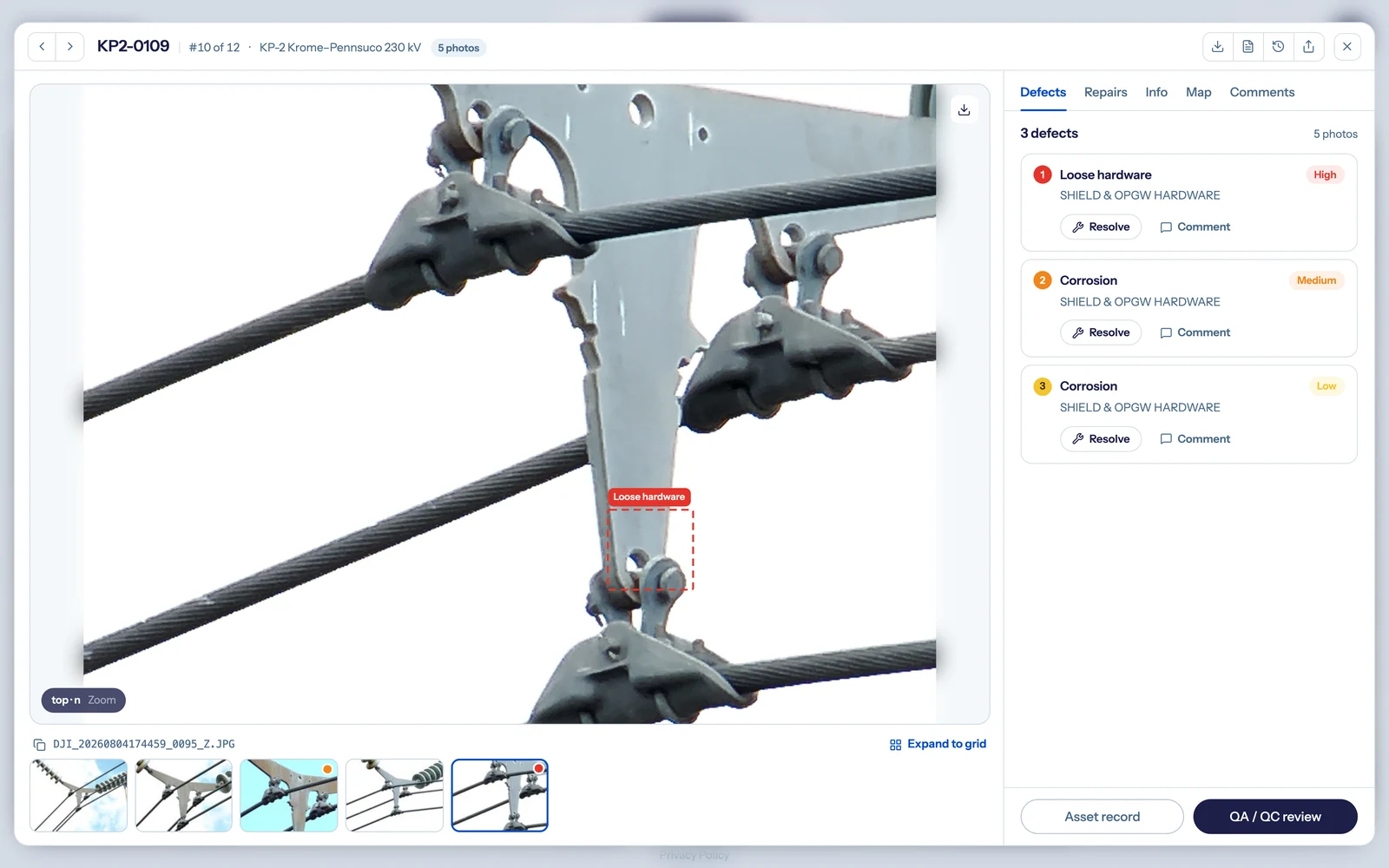
The product view: a structure's findings with imagery, defect class, severity, and review status in one record (DetectOS, shown in a demo environment).
Evidence is also what makes findings usable downstream. A confirmed defect with its image, structure ID, and severity attached can flow straight into a maintenance queue - how a verified finding becomes a work order is its own guide. A screenshot of a dashboard cannot.
5. Does the severity distribution make sense?
Real inspection programs surface few critical findings, and the criticals cluster where engineering says they should. On one new 345kV line, 67 findings out of 45,335 were critical - about 0.15% - and 51 of those 67 concentrated in a single construction segment (Detect CompassData 345kV case study, 2026). That pattern told the operator something true about how the line was built.
Compare that with a deliverable where a third of findings are "high severity", spread evenly across the line. That distribution is not a discovery. It is a threshold set to impress, and it guarantees your planners will start ignoring the color red - the most expensive habit an inspection program can teach.
6. Can a crew find the structure from the finding?
A finding that points to the wrong structure is worse than no finding: it dispatches a crew to healthy steel while the defect waits somewhere else. Association errors are common in ad-hoc pipelines - GPS-based misassociation alone accounts for 35% of drone service provider rework on utility contracts (Detect, State of Utility Drone Inspections 2026).
Spot-check ten findings against your GIS: does each one carry your structure ID, not just a coordinate pair? Findings keyed to your asset registry can be trusted into work orders. Findings keyed to raw GPS deserve a verification pass first.
7. Would the results survive an audit?
The final check is time. Findings you trust today must still be defensible in two years, when a regulator, an insurer, or your own reliability team asks why a structure was or was not repaired. That takes an exportable record per finding - image, confirmation, severity, reviewer, timestamp - and per cycle, so this season's condition can be compared with last season's on the same structure.
Binoculars do not leave evidence. Neither does a dashboard you can no longer log into. If the platform cannot export the evidence trail, the results are rented, not owned.
How do utilities adopt AI inspection without a trust gap?
Start bounded, verify in parallel, and let the numbers build the trust. Programs that stall usually skipped verification and asked engineers to believe a vendor deck; programs that stick give those same engineers the evidence to check the AI's work - and the AI keeps passing.
- Pick one corridor with a known condition history - assets your engineers already understand.
- Run the Evidence Audit on the first deliverable: all seven checks, on real findings.
- Have your own SMEs spot-review a sample of confirmed findings and a sample of cleared flags.
- Track two numbers per cycle: share of findings confirmed on review, and share of imagery passing the quality gate.
- Wire verified findings into your EAM before you scale - trust travels with the work order.
Selection belongs before this cycle, and it has its own discipline - a weighted platform evaluation scorecard keeps the comparison on utility-native criteria instead of feature counts. But no scorecard replaces the first verified deliverable. That is where the trust gap actually closes.
How do drone service providers prove their data can be trusted?
By delivering the verification evidence before the utility asks for it: capture-quality scores per frame, structure association against the client's asset IDs, and coverage confirmation per shot list. DSPs that make their data checkable win the renewal; DSPs that deliver raw card dumps join the roughly 30% of ad-hoc imagery that utilities reject (Detect, State of Utility Drone Inspections 2026).
The margin case is direct. Rework consumes 15-25% of delivered imagery on typical utility contracts, and standardized capture-and-QA workflows cut that to 3-7% within two campaigns (Detect, State of Utility Drone Inspections 2026). The same report traces where rework comes from - GPS misassociation 35%, missed component coverage 30% - and the capture failures that cost DSPs most are all checkable before delivery, not after rejection.
Read the seven checks in reverse and they become a DSP deliverable spec: gate your own capture, associate to the client's structure IDs, and hand over evidence a utility reviewer can open. Cutting rework on inspection contracts starts with making your data easy to trust.
The bottom line
Trust AI inspection results that survive the Evidence Audit: gated capture, per-class accuracy, expert review, openable evidence, a credible severity spread, real structure IDs, and an exportable record. Do not trust results that ask you to skip a check - the checks are where the outages hide.
This is the standard Detect builds to. DetectOS scores every frame for assessability before analysis, screens against a 258-type defect catalog, puts an expert on every flag, and delivers findings with the evidence attached - decision-grade grid intelligence from every image, across your network.
Run the Evidence Audit on your own imagery
Send one corridor's imagery through DetectOS: capture quality scored up front, defects screened against a 258-type catalog, and every flagged finding expert-verified with the evidence attached - across transmission and distribution.
Book a free audit →