
Drone Inspection of a New 345kV Transmission Line in a Fortune 200 Utility
A Fortune 200 utility, a drone service provider, and DetectOS. 45,335 findings across 927 structures. 67 critical defects caught inside warranty. Every defect fixed at the EPC's cost.
What a missing cotter key revealed about a new 345kV line
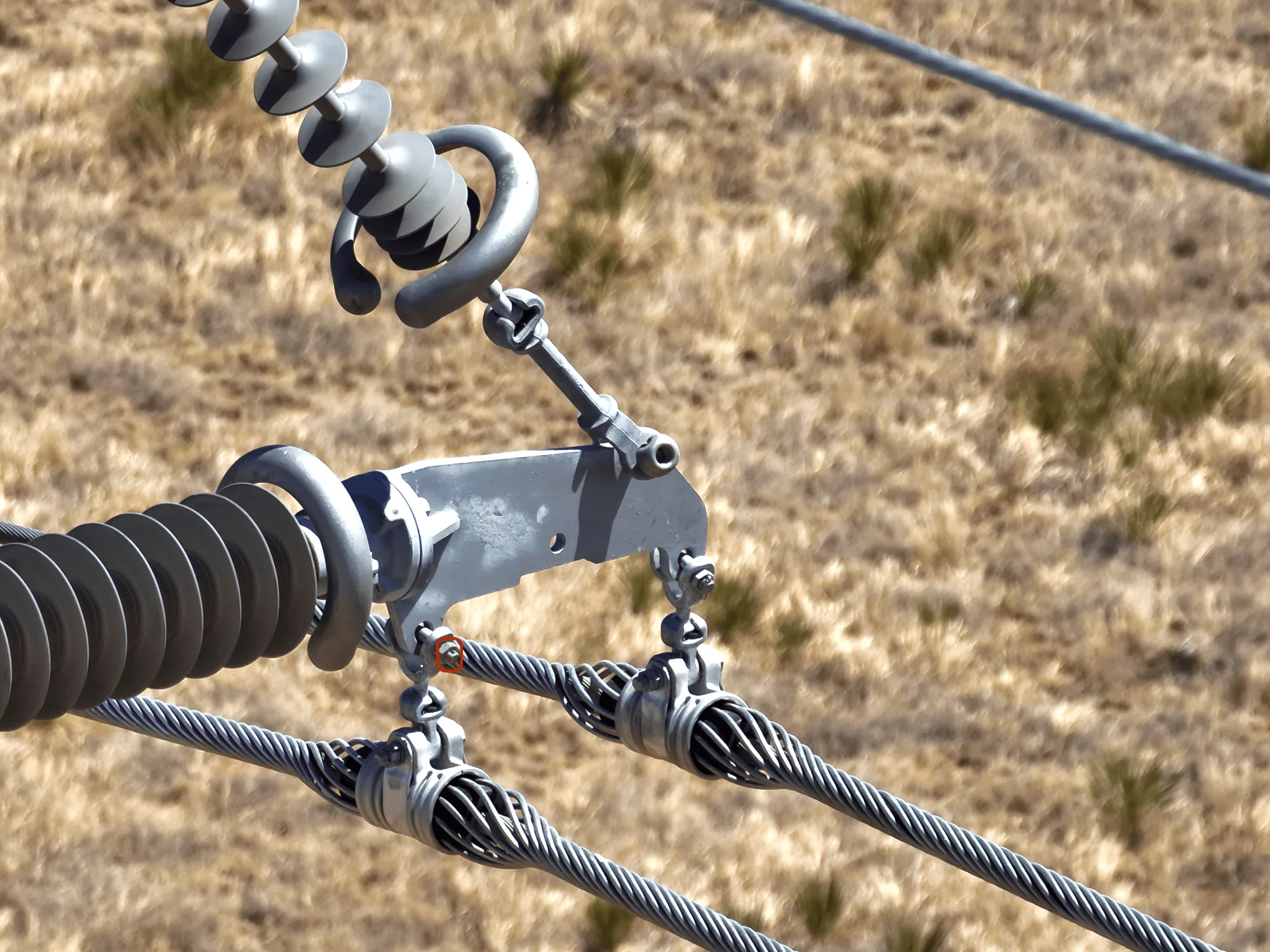
Week 22 of a 26-week new transmission construction project. An analyst at Detect stopped scrolling. The image was one of 65,701 captured on a new 345kV transmission line over the previous five months. It showed a suspension clamp on a double-circuit phase conductor. The primary load-bearing nut had backed off the threaded bolt by several turns. That was bad.
Worse was what was not in the frame. The cotter key, the small split pin engineered to keep the nut from vibrating off the threads entirely, was missing.
Wind on the conductor was already at work. Aeolian vibration on a 345kV bundle generates thousands of micro-cycles a day. With the cotter key in place, the nut would have loosened slowly and been caught at the next inspection cycle. Without it, the timeline collapses. The nut works off the threads. The clamp opens. The phase drops.
Dropping a 345kV phase is not a maintenance event. It is a regional transmission outage, a cascading-failure investigation, and a regulator's phone call.
The analyst flagged it as Critical, Priority 25, maximum score on the matrix. The note went to the utility the same day. A live-line crew reached the structure inside the week. Total cost of repair: about $15,000.
That was the easy math. The hard math was what the same defect would have cost three years later, when the warranty had closed and the conductor was on the ground.
What this case study covers: How one defect on one structure, found in week 22 of a 26-week program, justified an entire 927-structure inspection. The data behind the discovery. The warranty claim it compelled. And the playbook any utility can run on the next new build.
Key takeaways
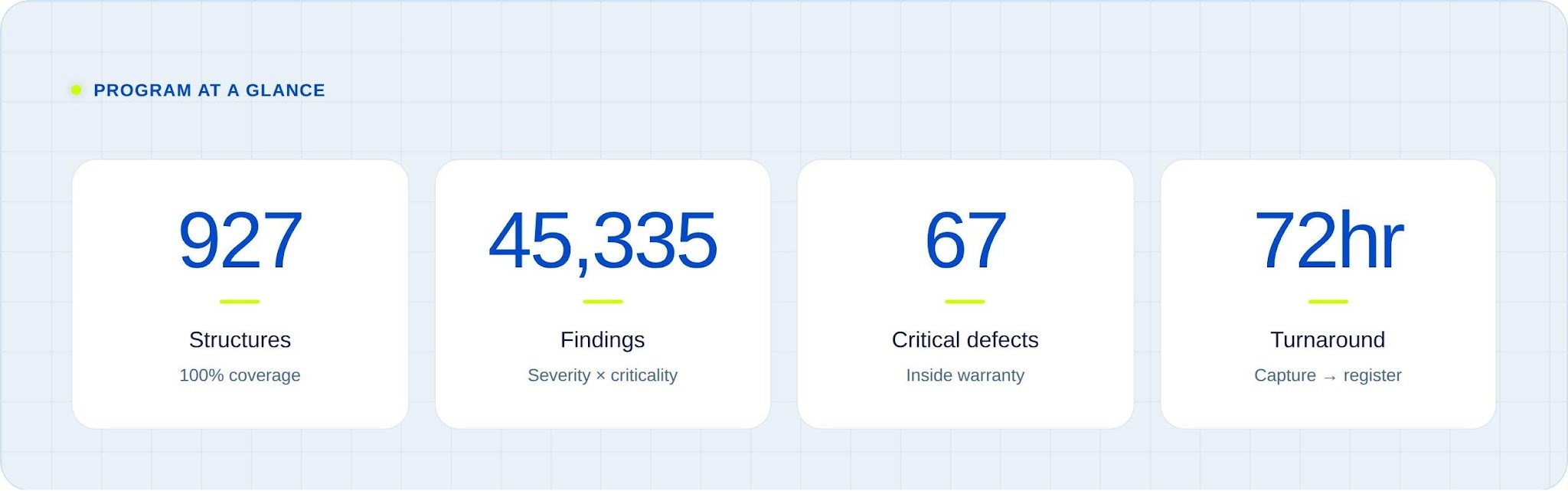
- Every structure inspected. 927 structures across two segments and three inspection phases. 100% coverage, not sampling.
- 67 critical defects caught inside warranty. Plus 12,937 high-priority findings. Every one fixed at the EPC's cost, not the utility's.
- One defect paid for the program. A missing cotter key on a 345kV suspension clamp. $15,000 of planned repair against $150,000 of six-month statistical risk and $750,000 over a decade.
- Pattern detection that sampling cannot match. A 63-structure cluster of missing corona rings on one stretch of Segment A. Same EPC, same crews. Fixed before the line went live.
- 72-hour turnaround from drone capture to warranty-ready register. 45,335 findings triaged into action tiers before engineering review began.
Why new transmission construction needs drone inspection QA
Six months earlier, the line was a finished project. 927 structures of new steel across two segments. The conductor was strung. The EPC had demobilized. By every traditional measure, this was clean infrastructure entering a clean warranty period.
Two things were also true. New construction defect rates are not zero: loose hardware loosens further, missing components stay missing, installation shortcuts compound under wind and aeolian vibration. And under the operator's existing program, no one would look at these structures systematically for three to five years. By then the warranty would be closed and whatever defects remained would be the utility's to fix at O&M rates.
This is the gap every utility sits inside. It is also the gap a regulator finds during a post-incident review. The 2003 Northeast blackout traced to a transmission line sagging into an unmanaged tree, compounded by an alarm system nobody had verified. The 2018 Camp Fire was sparked by a C-hook on a line PG&E had no record of climbing-inspecting in at least 17 years. The cost of not looking compounds with time, and it changes who pays.
The team running this 345kV asset knew the math. They wanted a different answer.
The approach: a utility, a drone service provider, and Detect
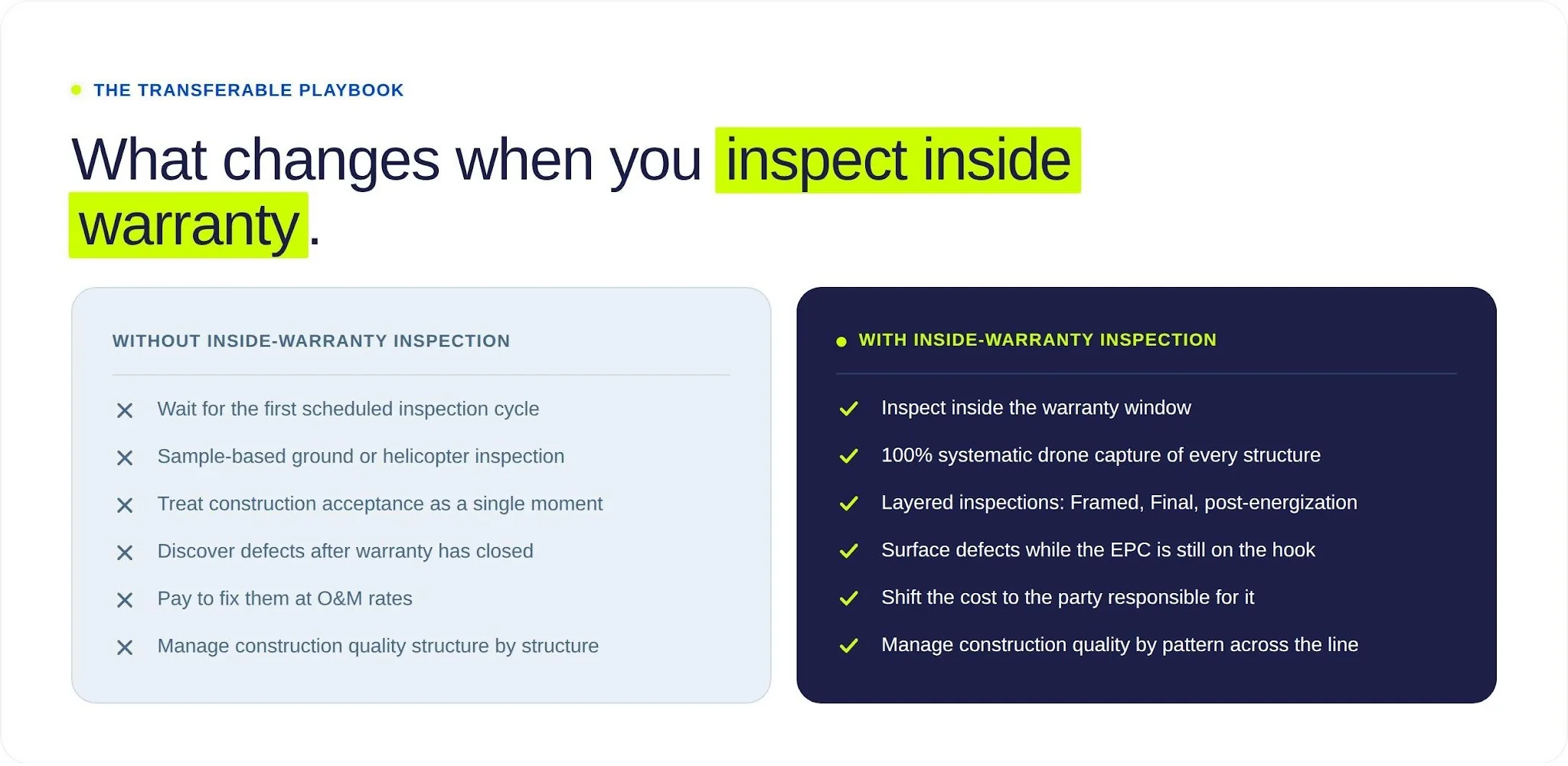
The operator made an unconventional call. Instead of waiting for the first scheduled inspection cycle, they commissioned a systematic drone inspection of every structure on the new line. Inside the warranty window. With documentation good enough to compel contractor action. Climbing crews were too slow and too expensive to cover 927 structures with anything approaching coverage. Helicopter patrols caught the obvious and missed the subtle. Sample-based inspection would find a fraction of the issues and miss every pattern.
Three disciplines came together to build the program:
- The utility: Line owner and project coordinator. Construction management and warranty enforcement.
- CompassData: Drone service provider. Field operations, pilot deployment, and aerial data capture against shot sheets developed by Detect.
- Detect: Inspection intelligence. Flight planning, shot sheet design, pilot training, DJI M30T hardware, on-site capture validation, and all analysis and defect classification through DetectOS.
What utility-grade drone service provider execution looks like
Utility inspection is one of the highest-stakes flight environments in drone services. Live conductors. Tight tolerances. Fixed-fee contracts where rework destroys margins. The pilot works against a shot sheet defining every required image; miss an angle and the analyst back at base cannot label the defect.
This program demanded 73% more imagery than the original scope: 65,701 images against a projected 38,007. The shot sheets evolved mid-pilot as early findings surfaced structure configurations the originals had not specified. Most DSP relationships break under mid-pilot scope expansion. This one did not. CompassData absorbed the change in the field and held the schedule.

Inspection findings: 45,335 defects across 927 transmission structures
Capture ran from November through April. CompassData's field teams worked both segments in parallel, deploying Detect-provisioned DJI M30T drones against structure-specific automated flight plans. Two on-site visits from Detect's engineering team mid-program verified that capture quality was holding to spec. Segment B received an intermediate Framed-phase inspection on 256 structures after erection but before conductor stringing. Detect's analysts labeled every image through DetectOS.
By month three, three patterns had emerged. None of them was what anyone expected.
Pattern 1: the dampers were not where they should be
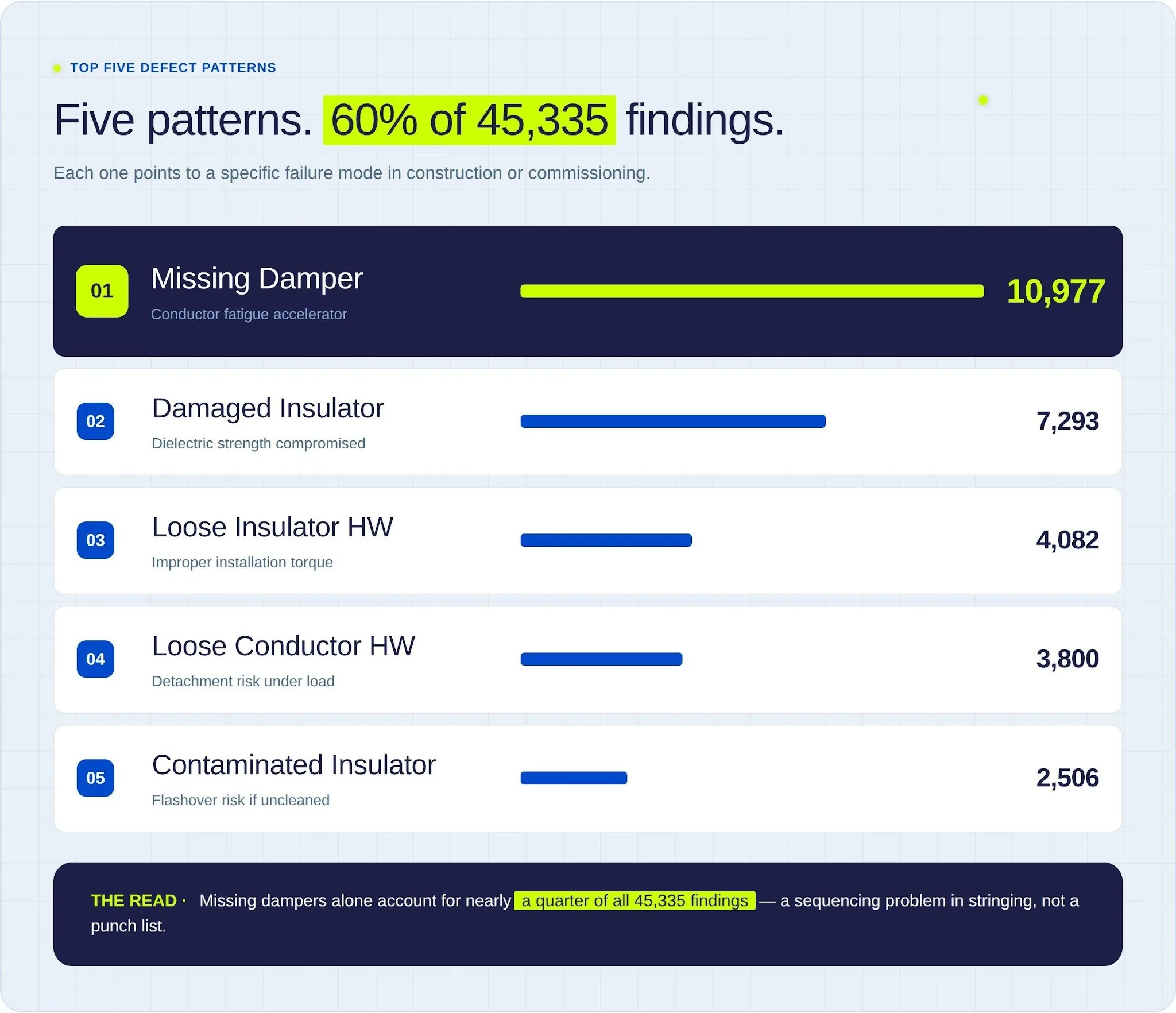
Missing dampers were the single largest defect category on the project. 10,977 findings. Nearly a quarter of everything the analysts logged. That number does not describe a punch list. It describes a sequencing problem in how crews install dampers during stringing. IEEE Std 664 makes damper placement a routine pre-energization check, and it was not being executed. The first damper-related entry in the next MSA negotiation was already writing itself.
Pattern 2: a 63-structure cluster nobody designed for
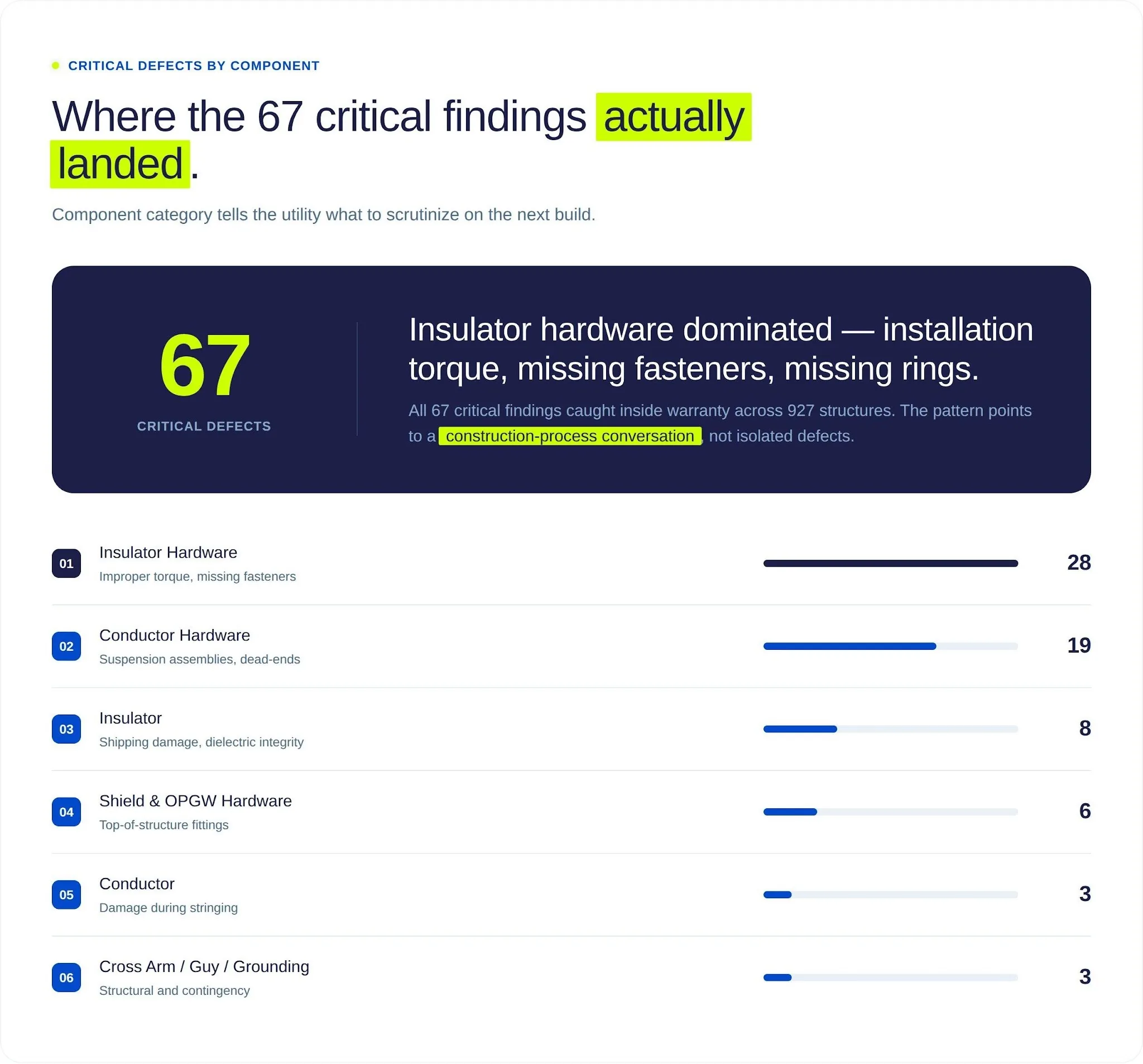
51 of the eventual 67 critical findings would come from Segment A. A 76% concentration on a segment that held 69% of the structures. The component breakdown sharpened it further: a 63-structure stretch on Segment A accounted for nearly every missing corona ring on the project. Same EPC. Same crews. Same drawings. One localized failure of installation discipline that no sampled inspection would have surfaced. The pattern took five hundred structures of context to see.

Pattern 3: a construction shortcut the analyst almost missed
On day one of labeling, an analyst flagged corrosion on the ends of through-bolts in insulator assemblies. The normal call would have been to log surface corrosion and move on. The analyst stopped. The oxidation pattern was wrong. It matched what happens when field crews cut bolts to length in the field and skip the protective painting on the cut ends. That is a construction shortcut, not a material defect, and the only way to see it is by recognizing the wrong-looking corrosion.
The observation went to the utility within hours. The EPC changed the practice the next day. The problem stopped before it became a 900-structure pattern.

Defect severity breakdown by line segment
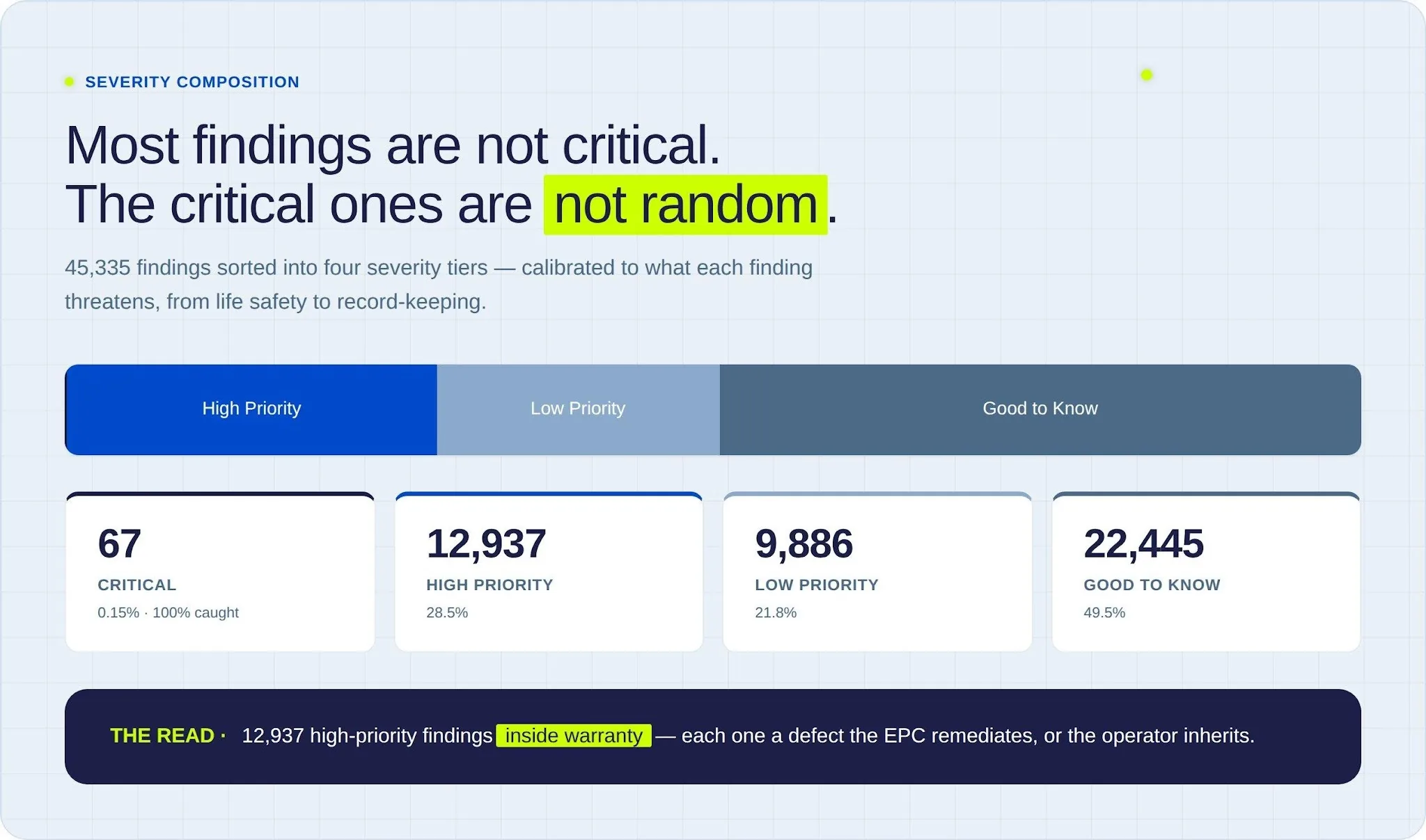
By the time capture closed, the analysts had logged 45,335 findings across all 927 structures. The headline number was the 67 Critical defects. The operating number was the 12,937 High Priority. Every one of those was a defect the EPC fixes inside warranty, or the operator inherits afterward. The segment split told its own story:
| Severity | CH segment | HR segment | Total |
|---|---|---|---|
| Critical | 51 | 16 | 67 |
| High Priority | 8,478 | 4,459 | 12,937 |
| Low Priority | 6,063 | 3,823 | 9,886 |
| Good to Know | 13,008 | 9,437 | 22,445 |
How risk-based priority triage works for utility inspections
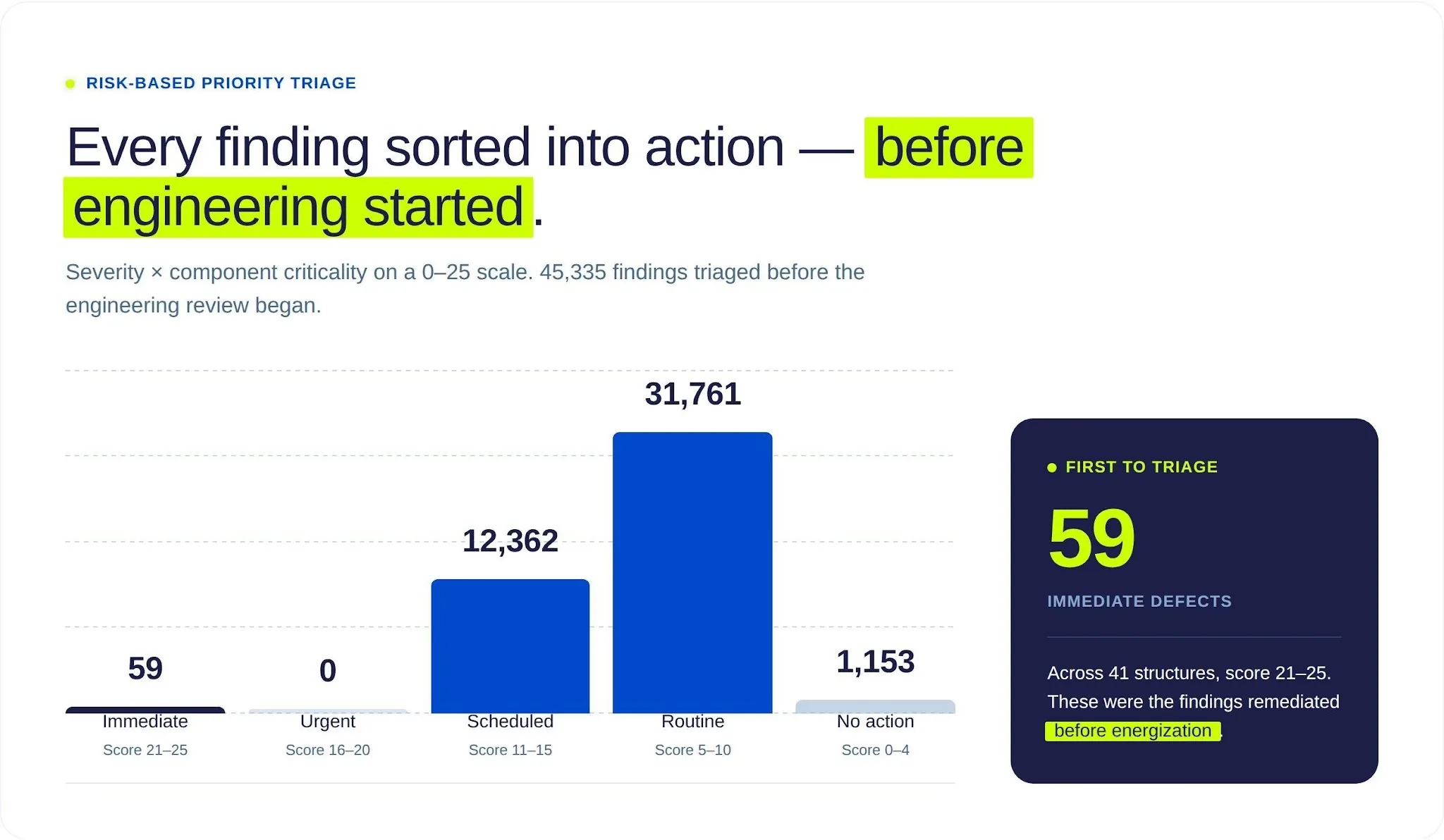
DetectOS multiplies defect severity by component criticality on a 0-25 scale. A loose nut on a non-essential bird diverter is not the same as a loose nut on a primary conductor clamp, and the priority score reflects that. 59 findings landed in the Immediate tier. 12,362 landed in Scheduled. 31,761 in Routine. The triage finished before engineering review started, which is the capital-ranking signal utility asset management teams build inspection programs around.
Framed vs Final inspection: catching defects before conductor stringing
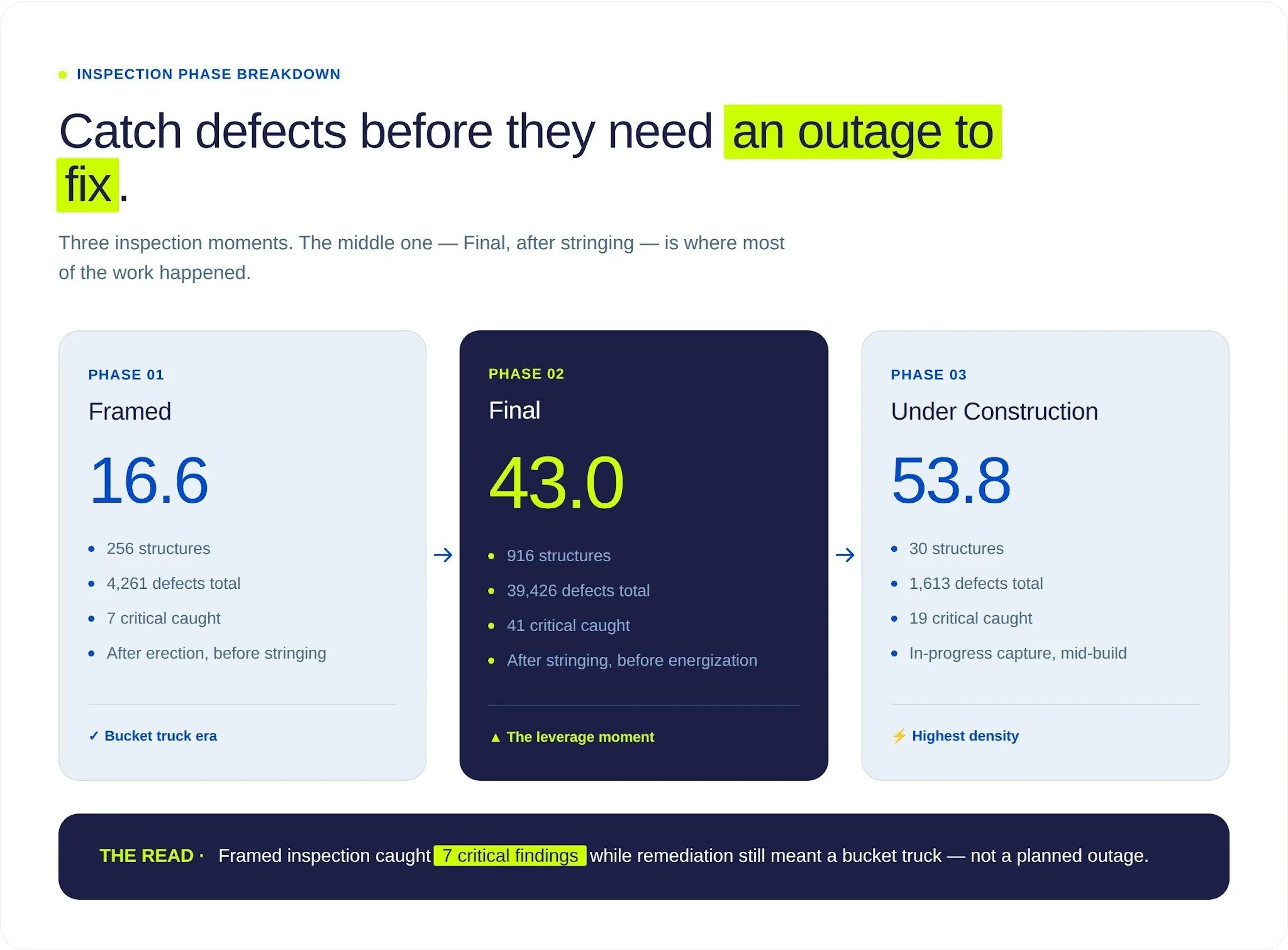
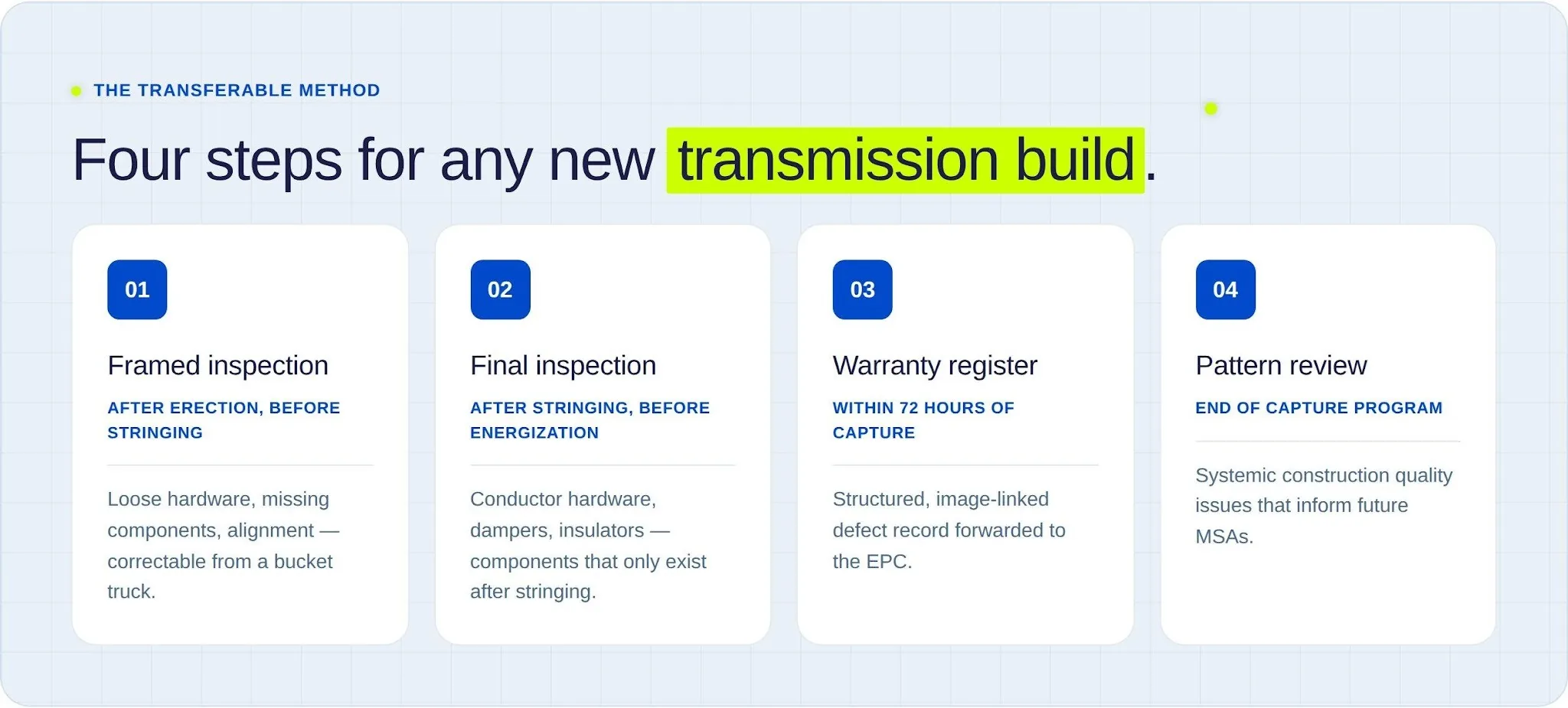
256 structures on Segment B received a Framed-phase inspection: after erection, before conductors were pulled. Average findings per structure at that stage was 16.6. After stringing it climbed to 47.1, because conductors and dampers and shield wire hardware only exist as inspectable components after stringing.
Seven Critical findings were caught during the Framed phase. All loose insulator hardware. Each one on a structure where remediation still meant a bucket truck and an hour, not a planned outage on a fully strung line. The Framed phase was the moment construction QA stopped being a single post-completion checkpoint and became a sequence of inspections aligned to the build. The same logic holds on any project: a close-out construction site inspection is the first entry in the asset's condition record, not a sign-off.

Beyond hardware: proximity, foundations, wildfire
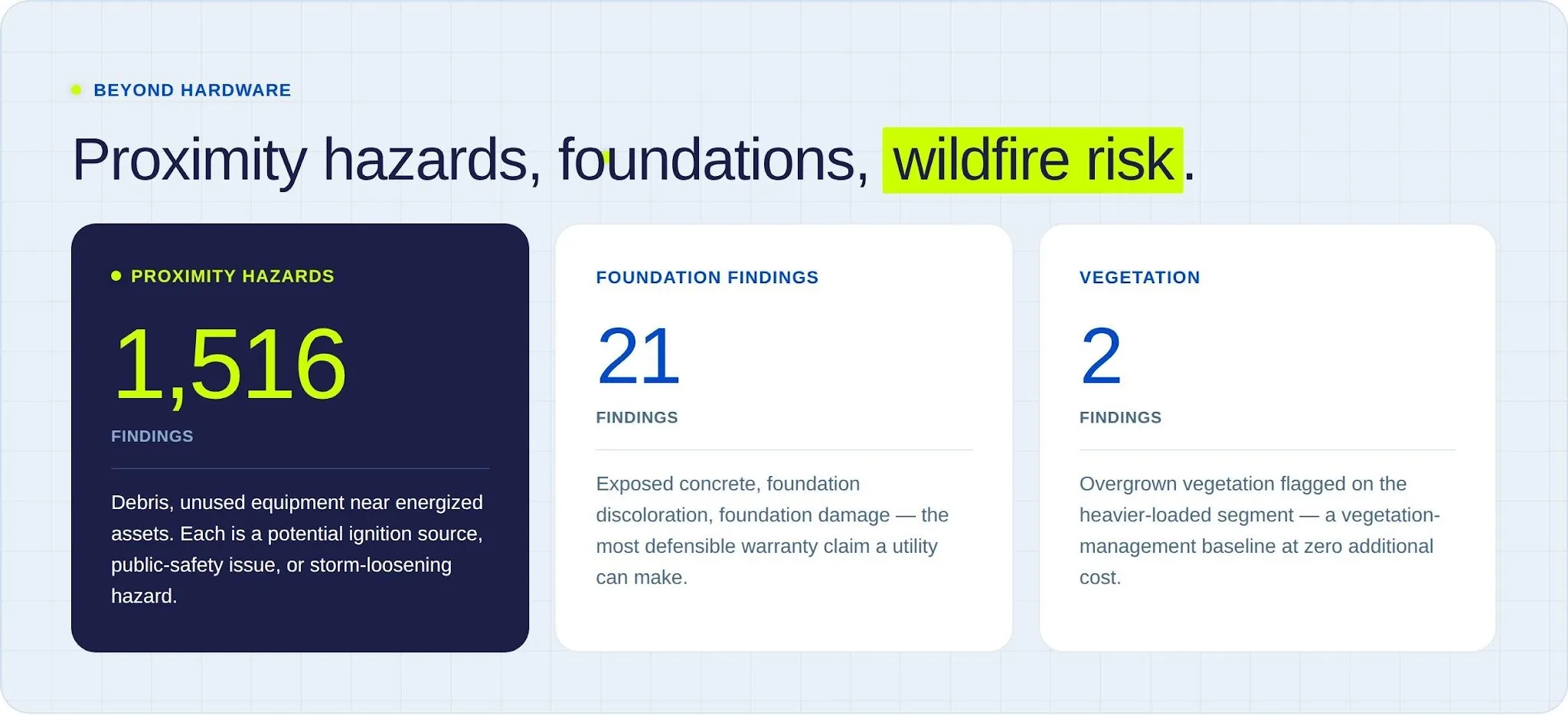
1,516 proximity hazards: debris, unused equipment, and storm-loosening risks near energized assets, each one a potential ignition source under wildfire scrutiny. 21 foundation findings:
- Exposed concrete
- Discoloration
- Settlement damage
- Two vegetation flags on the heavier-loaded segment.
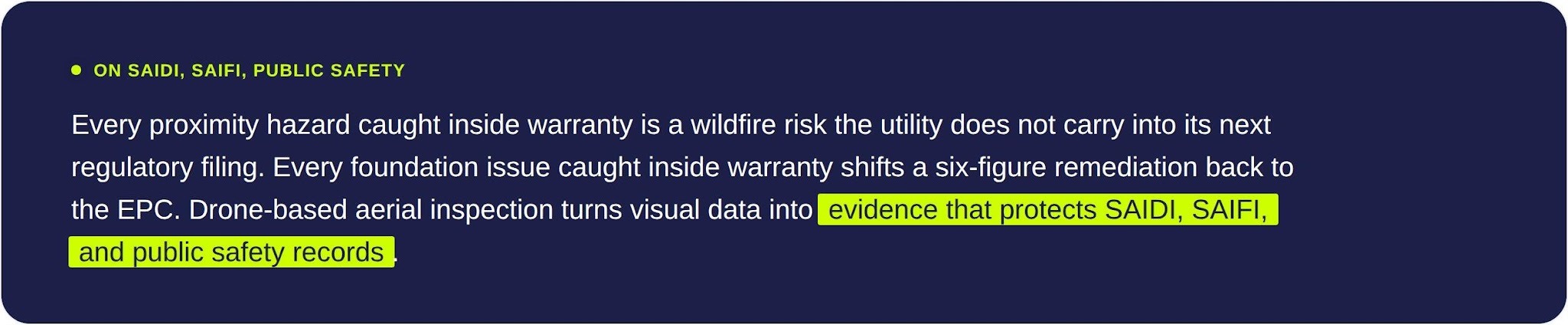
None of these would have shown up on a hardware-focused inspection. All of them feed the same documentation system: SAIDI, SAIFI, and state wildfire mitigation filings. The inspection that started as construction QA was already on its way to becoming something else.
Week 22: the math that broke the program loose
By April 2026, the discovery was complete. The patterns were named. The defect register held 45,335 findings, sorted into action tiers, every one image-linked and traceable to a specific structure and component.
Then the cotter key surfaced. The same Tuesday the analyst flagged it, Detect's reliability team began the calculation that would turn one defect on one structure into a warranty claim the EPC could not refuse.
They ran the defect through a calculation drawing on DOE-funded outage cost methodology. The inputs were the structure value, the total cost of failure with a 3x multiplier for emergency dispatch, helicopter crews, outage penalties, and cascading mechanical failure if a 345kV bundled phase dropped, and the planned repair cost of $15,000 for a live-line dispatch. The output was a Failure-to-Repair ratio at every horizon.
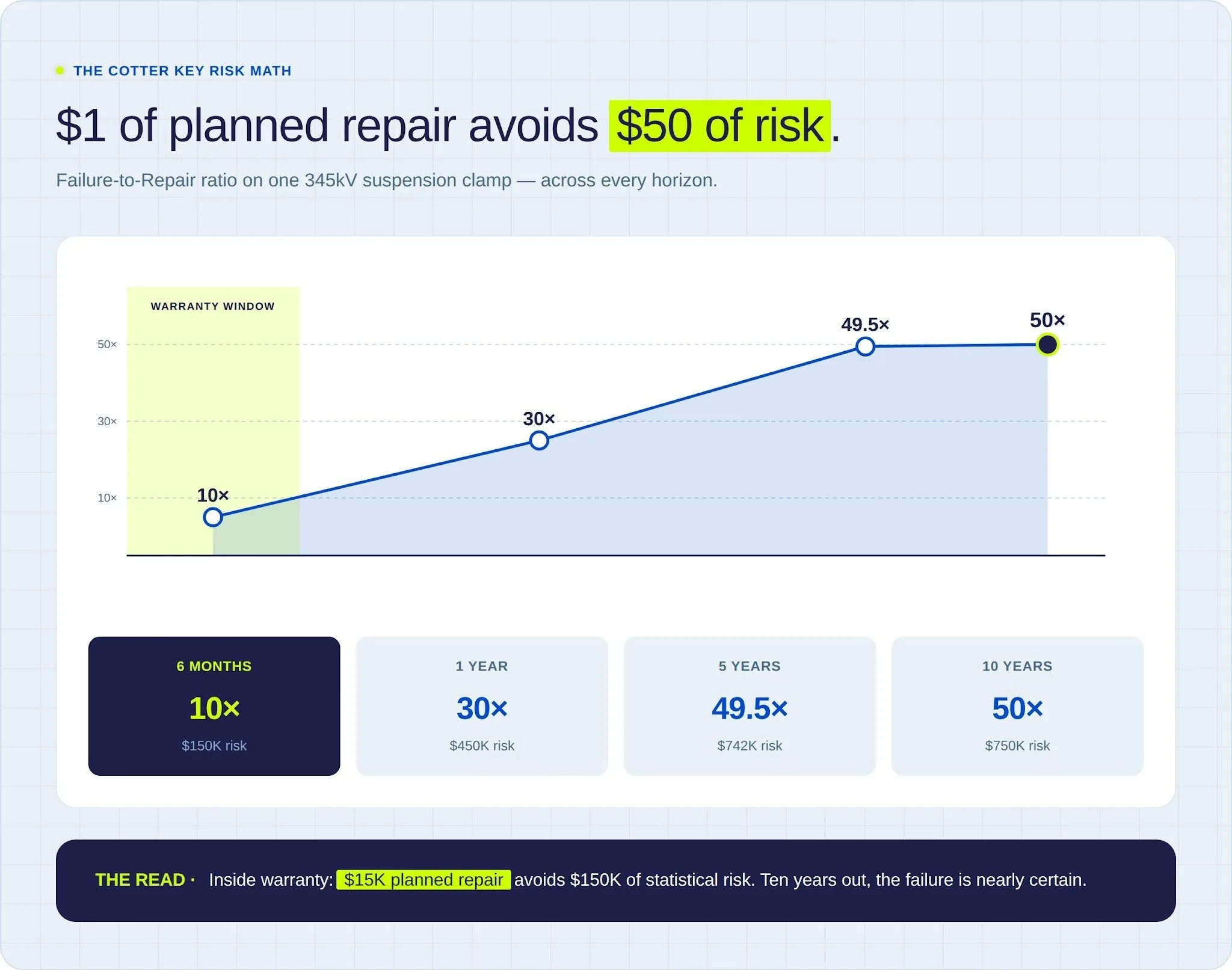
Inside the six-month warranty window, $15,000 of planned repair avoided $150,000 of statistical risk. At twelve months, the same defect carried a 30x return on the same repair. At five years the failure was nearly certain. At ten years, it was guaranteed.
Sixty-six other critical findings carried their own version of the math. Different components, different time horizons, same conclusion: this is the cheapest these defects will ever be to fix, and inside the warranty window, the EPC pays.
The cotter-key math is what the operator's transmission engineering group walked into the warranty conversation with.
From defect register to warranty claim: holding the EPC accountable
Findings are not outcomes. The real test of an inspection program is whether the operator can turn a 45,335-row register into action inside a contractual window against a contractor that has already demobilized.
Three things made this workflow different from a conventional inspection report:
- Image-linked defect register within 72 hours. Every finding traceable to a specific structure, component, and image. The exact documentation a warranty claim needs to compel action.
- Risk-based priority matrix sorted before engineering review. 45,335 findings fell into action tiers automatically. Engineering started where the risk was.
- Pattern view that surfaced systemic issues. Missing dampers, the corona ring cluster, loose hardware concentrations. No single-structure report would have made any of these visible.
The operator forwarded the priority register to the EPC with timestamps, geolocation, and annotated imagery for every finding. That is the exact evidence the warranty terms require to compel action. The cotter key was example one. The corona ring cluster was example two. The damper sequencing problem was example three.
The EPC's response was the response a contractor gives to documentation it cannot dispute. Live-line crews dispatched to the suspension clamp. Bucket trucks back on the line to fix the corona rings. A revised installation procedure for the damper sequencing. The 10,977 missing dampers became the basis for a construction-process conversation that will reshape how the EPC sequences installation on the next build.
Every defect remediated was a defect the contractor paid to fix, not the utility.
The result: four outcomes from a 6-month construction QA program
The inspection outlived the project. That is the line worth pinning.
On the day the program closed, the operator held four things they did not have six months earlier:
13,004 defects fixed at the EPC's cost
Every Critical and High Priority finding remediated inside warranty was a defect the contractor paid to fix. The same defects discovered at the first scheduled inspection cycle, three to five years out, would have been the utility's to fix at O&M rates.
An as-built baseline that compounds
22,445 Good to Know findings became the starting condition for every structure on the line. Every subsequent inspection cycle measures change against a known baseline rather than building one from scratch.
Construction QA evidence that outlives the project
The corona ring cluster and the missing damper sequencing problem became live entries on the EPC scorecard and evidence in the next MSA negotiation. The data shaped the next build before that build broke ground.
Regulatory documentation by default
Image-linked records for 1,516 proximity hazards, 21 foundation findings, and the full structure population feed SAIDI, SAIFI, and state wildfire filings without additional capture cost.
The drone inspection method for new transmission construction
The specifics of this pilot will not transfer. Voltage class, EPC, geographic profile, wildfire regime, all of these will shift on the next line. The method generalizes.
Where the method flexes: voltage, region, and EPC variables
Three variables will reshape the playbook on the next line. Voltage class changes shot geometry: 500kV bundle conductors need different angles than a single 345kV phase. Regulatory region reshapes defect priorities: wildfire and ice-loading zones push different categories to the top of the matrix. EPC stringing practice changes the defect mix: the corona ring cluster on this project was specific to this contractor's sequencing, not a universal pattern.
What transfers is the four-step sequence, the severity-by-criticality triage, the warranty-window timing, and the 72-hour register turnaround. Those are the load-bearing parts.
Your next warranty window is closing
Every utility commissioning a new transmission line has a clock running. Most of them are not watching it. The warranty closes faster than the first scheduled inspection cycle opens. The cost of finding out what is wrong with new construction does not go down with time. It goes up. And it changes hands.
The window is about to matter more. The Senate permitting bill introduced on September 30, 2026 would compress transmission siting and build timelines while leaving the inspection record untouched - the Permit-to-Baseline Gap that a construction QA program like this one closes before energization.
Somewhere on every newly energized line, there is a cotter key missing.
AFTER THE PILOT
Seven program extensions validated by this pilot
Every extension starts from the data that already exists. This is the difference between a one-off inspection and an ongoing inspection program: the second engagement does not start from scratch. It starts from the baseline this pilot produced.
Three extensions sharpen the existing method. Two add new evidence types the regulator wants. Two compound the data over time.

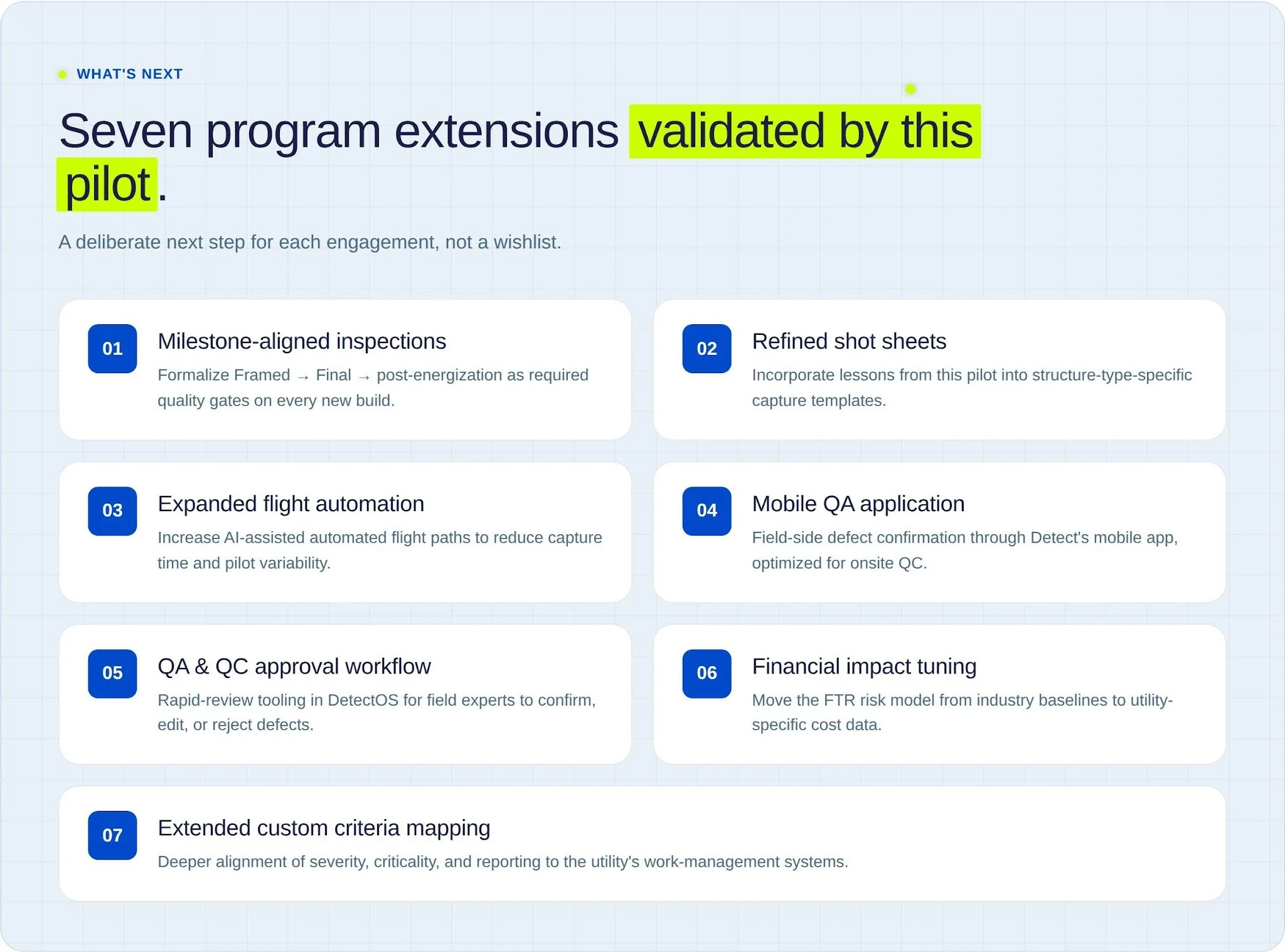
None of these are speculative. Each one was tested or scoped during the six-month pilot. The next engagement on the next line is where they ship.
Frequently asked questions
Can drone inspection reliably detect corrosion, broken hardware, and damaged insulators from images?
Yes. On this 345kV line, DetectOS labeled 67 critical defects across insulator hardware (28), conductor hardware (19), insulators (8), shield/OPGW hardware (6), conductors (3), and structural components (3). Defect types included loose fasteners, missing cotter keys, missing corona rings, damaged insulators, and contamination. Every label is image-linked and traceable to a specific structure and component.
How can aerial inspection prevent million-dollar failures on new high-voltage transmission lines?
By inspecting inside the construction warranty window. On this pilot, one defect (a missing cotter key on a 345kV suspension clamp) carried a Failure-to-Repair ratio of 10x at six months and 50x over ten years. $15,000 of planned repair avoided $150,000 of short-term risk and $750,000 of long-term risk. The same method prevented a $1M+ outage on a 2,600-structure HVDC line.
What is the fastest turnaround from drone capture to a defect register?
Detect delivered the structured defect register within 72 hours of capture. Each finding linked to a specific structure, component, and image. Triage finished before engineering review started: 59 Immediate, 12,362 Scheduled, 31,761 Routine. Urgent issues, like the day-one bolt-cutting catch, reached the utility within hours.
How does a utility standardize aerial inspection quality across multiple drone service providers?
Through standardized shot sheets, flight automation, and analyst-led capture validation. On this project, Detect designed structure-specific shot sheets, trained the pilots, provisioned DJI M30T hardware, and ran two on-site visits to validate procedures. CompassData executed against that standard and delivered 65,701 images, 73% above the original projection, all to the same quality bar.
Can drone inspection platforms support custom defect taxonomies aligned with a utility's internal standards?
Yes. Detect mapped DetectOS's severity and criticality framework to the utility's internal naming conventions during onboarding, then customized further as construction patterns emerged. Custom criteria mapping is part of the engagement, not a separate workstream.
How does AI inspection avoid false positives on critical grid reliability decisions?
Every image and finding flows through human-in-the-loop validation by trained analysts before reaching engineering. The day-one bolt-cutting catch on this project is the model: AI flagged the corrosion pattern, but human analysts recognized it as a construction shortcut, not material degradation. The result is a defect register with audit-ready documentation for warranty and regulator review.
How does drone inspection cut transmission inspection costs?
By replacing helicopter dispatch and climbing crews with systematic drone capture, shifting defect repair cost from the utility to the EPC inside warranty, and cutting re-inspection cycles through high-quality first-pass data. On this pilot, the workflow caught 67 critical defects at the contractor's cost rather than the utility's. The warranty claim alone covered the program.
About the partnership
Detect is an AI-powered inspection intelligence platform helping electric utilities, contractors, and drone service providers turn inspection data into decisions they can trust. Detect provided flight planning, shot sheet design, pilot training, DJI M30T hardware, on-site capture validation, and inspection analysis through DetectOS.
CompassData is a drone service provider with deep utility inspection experience. CompassData's field teams executed every capture mission across both segments and three inspection phases, delivering 65,701 images to spec across a six-month program.
The utility is a Fortune 200 transmission operator. Some details kept private per partnership agreement.
