
Substation Inspection: Checklist, Frequency, and Methods (2026 Guide)
A substation puts some of the grid's most expensive, longest-lead equipment behind one fence. Here is what a substation inspection should check, how often utilities run each layer, and where drones and AI change the work.
A substation inspection is a scheduled check of transformers, breakers, switches, bus, insulators, protection systems, and site security for defects and degradation. Utility programs commonly layer three cadences: visual walk-downs every one to two months, infrared scans at least annually, and diagnostic tests on fixed intervals. Drone imagery and AI review increasingly document each component.
- Three layers, three cadences. Published utility programs run visual walk-downs monthly to bimonthly and infrared scans at least annually, with diagnostics on fixed intervals (CPUC audit of SDG&E, 2023; SMUD, 2017).
- Regulators set some of the clocks. NERC PRC-005 caps protection-system maintenance intervals, down to four calendar months for some station-battery checks; EPA's SPCC rule and NERC CIP-014 add oil and physical-security duties where they apply.
- The Substation Inspection Stack has four layers: Look, Scan, Test, Record. The first three find conditions; Record is what makes change visible.
- Each method sees a different failure. Infrared finds heat, oil analysis finds internal faults, and close imagery finds cracks, leaks, and corrosion. No single method covers the yard.
- Image quality caps photo review. In Detect's grading data, sharp imagery leaves 100% of a 258-type defect catalog assessable; blurry imagery leaves 7%.
A substation rarely fails, and when it does, every circuit behind it goes with it. The equipment inside is power transformers, breakers, switches, bus, protection relays, and the batteries that keep the relays working. Much of it is still inspected on one of the oldest routines in the utility business: a technician, a clipboard, and a monthly walk around the yard.
This guide covers what that walk should check, how often each layer of inspection runs, and which method finds which defect. It ends with how drone imagery and AI review change the record the walk produces.
What is a substation inspection?
A substation inspection is a scheduled check of the equipment and site inside a substation fence for defects, degradation, and conditions that could cause a failure. It covers transformers, circuit breakers, disconnect switches, bus and connections, insulators, protection and control systems, batteries, grounding, and security. Inspection observes and records condition; maintenance tests, repairs, or replaces.
Most programs run inspection in layers. A frequent visual walk-down catches what changed since last time: a leak, a broken insulator, a cut fence. Periodic infrared scans find heat the eye cannot see. Diagnostic tests, from oil sampling to battery checks, look inside the equipment on fixed intervals. Where those layers meet is the record - what each component looked like last time, and what it looks like now.
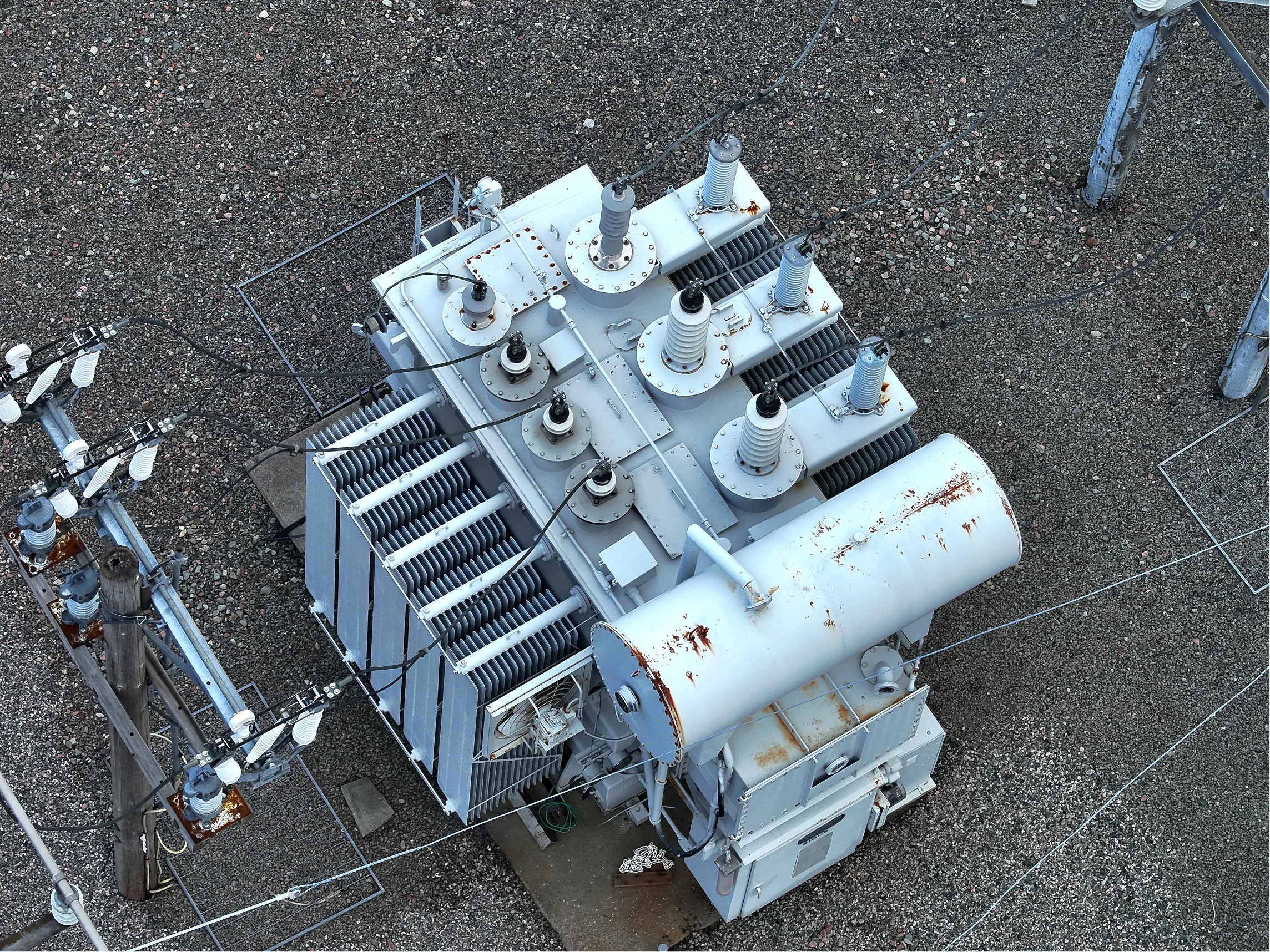
A substation power transformer from above: bushings, radiators, and the conservator tank. A ground-level walk-down sees most of these components from below.
What should a substation inspection checklist include?
Every major component, each with the specific conditions that signal trouble. The table below is a component-by-component starting point. Each utility adapts it to its own equipment, voltage classes, and manufacturer guidance.
| Component | Look for | Also check with |
|---|---|---|
| Power transformers | Oil leaks and stains; oil-level and temperature gauge readings; cracked or contaminated bushings; cooling fans and radiators; breather desiccant color; corrosion | Infrared on bushings and connections; dissolved gas analysis of oil samples |
| Circuit breakers | Gas-pressure or oil-level readings; leaks; operation counter; cabinet heaters and door seals | Timing and contact-resistance tests per the maintenance program |
| Disconnect switches | Blade alignment; contact condition; arcing marks; damaged insulators; operating mechanism | Infrared on contacts and jaws |
| Bus, connectors, and clamps | Loose or missing hardware; discoloration; corrosion; broken strands | Infrared on every connection |
| Insulators and bushings | Cracks, chips, tracking, contamination, flashover marks | Close imagery from above; power factor tests on bushings |
| Surge arresters | Cracked housings; operated disconnectors; damaged ground leads | Infrared |
| Instrument transformers | Leaks, cracks, swelling, oil level | Infrared; electrical tests per the program |
| Capacitor banks | Bulging cans; blown fuses; leaks | Infrared |
| Control house, relays, and batteries | Alarm and relay status; battery electrolyte levels, corrosion, and charger readings; HVAC; signs of water | NERC PRC-005 interval checks where they apply |
| Grounding and fence | Exposed or missing ground conductors; fence damage and gaps; gates, locks, and warning signs | Physical-security assessment where NERC CIP-014 applies |
| Yard, structures, and foundations | Vegetation; drainage and surfacing; animal intrusion and nesting; steel corrosion; foundation cracks | Close imagery from above |
| Oil containment | Pit or berm condition; standing water; oil sheen | The facility's SPCC plan where the rule applies |
Two rows deserve more attention than their length suggests. Grounding is one. An exposed or missing ground conductor can turn a fence into a hazard, and it is easy to miss on a walk that looks up at the equipment. Animals are the other. In a study of more than 200 animal-caused substation faults at six New York utilities, squirrels caused 55%, birds 16%, and raccoons 12% (Eastern Wildlife Damage Control Conference, 1989). Older, taller distribution-voltage stations saw the most. The study is old, but the pattern it describes is still the reason intrusion checks sit on the list.
How often should substations be inspected?
Most programs set a separate cadence for each layer. Published utility programs run visual walk-downs monthly to every other month and infrared scans at least annually. Diagnostic tests follow the maintenance program or the regulator's intervals. Criticality decides where each station sits within those ranges.
| Layer | Typical cadence | Where the number comes from |
|---|---|---|
| Visual walk-down | Monthly for the most critical stations, every two months for the rest | SDG&E's program under California General Order 174 (CPUC audit, 2023) |
| Visual walk-down | At least 10 times a year for distribution substations | SMUD Substation Inspection Annual Report, 2017 |
| Infrared scan | At least annually | Most utilities, per a MAAC substation O&M standard published by PJM; a Kentucky utility's filed plan scans energized conductors in all substations every year |
| Station batteries (vented lead-acid) | Some checks every 4 calendar months, others every 18 | NERC PRC-005 maximum intervals for unmonitored station dc supplies |
| Oil-filled equipment and containment | Per the facility's SPCC plan | EPA SPCC rule, 40 CFR 112, where the facility is covered |
| Physical-security risk assessment | Every 30 or 60 calendar months; 36 under CIP-014-4 once in effect | NERC CIP-014, for applicable transmission stations and substations |
The pattern behind those numbers is simple: inspect the equipment that can change fastest most often, and let consequence set priority. SDG&E's split is a clean model - the same walk-down, run monthly at its highest-priority stations and every two months at the rest (CPUC audit of SDG&E, 2023).
Which regulations govern substation inspections?
No single rule covers the whole yard. Federal reliability standards, environmental rules, and state commission orders each govern a slice, and most of the inspection program sits in the utility's own procedures.
What does NERC PRC-005 require?
PRC-005 sets maximum maintenance intervals for protection-system components on the bulk electric system: protective relays, communications, voltage and current sensing, station dc supplies, and control circuitry. For unmonitored vented lead-acid station batteries, some checks are due every four calendar months and others every 18 (NERC PRC-005, Table 1-4(a)). A missed interval is a compliance violation, which makes the battery room the most calendar-driven corner of the substation.
When does the EPA's SPCC rule apply to a substation?
When the facility stores more than 1,320 gallons of oil aboveground in aggregate and could reasonably discharge oil to navigable waters or adjoining shorelines (40 CFR 112). Only containers and oil-filled equipment of 55 gallons or more count toward the total. Oil-filled operational equipment such as transformers needs general secondary containment sized for the most likely spill. EPA treats routine visual inspection of that equipment as good engineering practice.
What does NERC CIP-014 add?
Physical security for the transmission stations and substations whose loss could cause instability, uncontrolled separation, or cascading. Applicable transmission owners reassess every 30 calendar months if they identified critical facilities and every 60 if they did not, with verification by an unaffiliated third party (NERC CIP-014-3). CIP-014-4 consolidates those into a single 36-month cycle once it takes effect.
Do states set substation inspection rules?
Some do. California's General Order 174 requires utilities to inspect substations as often as necessary under a written program. Utilities report the resulting intervals - which is where the monthly and bimonthly cadences above come from.
Which inspection methods find which substation defects?
Each method sees a different failure. Close imagery finds what is cracked, leaking, corroded, or missing; infrared finds heat; diagnostic tests find what is happening inside oil, insulation, and batteries. A program that runs only one of them has a blind spot by design.
- Ground walk-downs are fast and frequent, but they see tall equipment from below. Transformer tops, bushing heads, and bus connections sit above eye level.
- Aerial imagery adds top-down and close angles from a standoff distance, without taking anything out of service.
- Infrared is the one routine method that finds a hot connection while the equipment stays energized.
- Diagnostic tests - dissolved gas analysis, power factor, contact resistance, battery checks - are the only way to see inside the equipment.
What each finding means depends on the failure mode behind it. Inside a power transformer, five failure modes each give a different warning window, and the inspection layer that catches each one differs too.
What is the Substation Inspection Stack?
The Substation Inspection Stack is Detect's four-layer model of a complete substation inspection program: Look, Scan, Test, Record. The first three layers find conditions. The fourth turns them into a history, which is how a condition gets caught changing before it becomes a failure.
What belongs in the Look layer?
The frequent visual walk-down, from the ground and increasingly from the air. Its job is spotting change since the last visit: a new stain under a radiator, a chipped insulator, a gate that no longer latches. It runs monthly or every other month in the published programs above.
What does the Scan layer add?
Heat, and sometimes sound. Infrared finds the loose or corroded connection that is running hot before it fails, and some programs add ultrasonic or corona cameras for electrical discharge. Most utilities scan at least annually, and many add scans after load changes or repairs.
Which tests belong in the Test layer?
The diagnostics that see inside the equipment: dissolved gas analysis of transformer oil, power factor tests on bushings, breaker timing and contact resistance, and relay and battery checks. Where NERC PRC-005 applies, its intervals are the floor, not the target.
Why is Record the layer that decides?
Because a condition only means something against its last observation. A rust stain that grew, a leak that spread, a bushing that discolored - each is invisible on a pass/fail checklist and obvious in a side-by-side photo. Record means one image-backed history per component, filed by asset, so every inspection starts from the last one.
How do drones and AI change substation inspection?
They change the Look and Record layers most. Drones capture the top-down and close angles a ground walk-down cannot reach, without an outage. AI review sorts that imagery by component, grades it for usability, screens it for visible defects, and routes findings to expert reviewers by severity.
Utilities are already putting this into operation. Entergy has deployed docked drones at substations in central Mississippi, with FAA approval to fly them beyond visual line of sight. Pilots launch inspections remotely, and the aircraft return to weatherproof docks to recharge (Entergy, as reported by T&D World). Flying inside an energized yard still takes the utility's own procedures: approach distances, electromagnetic interference near high-voltage equipment, and coordination with operations.
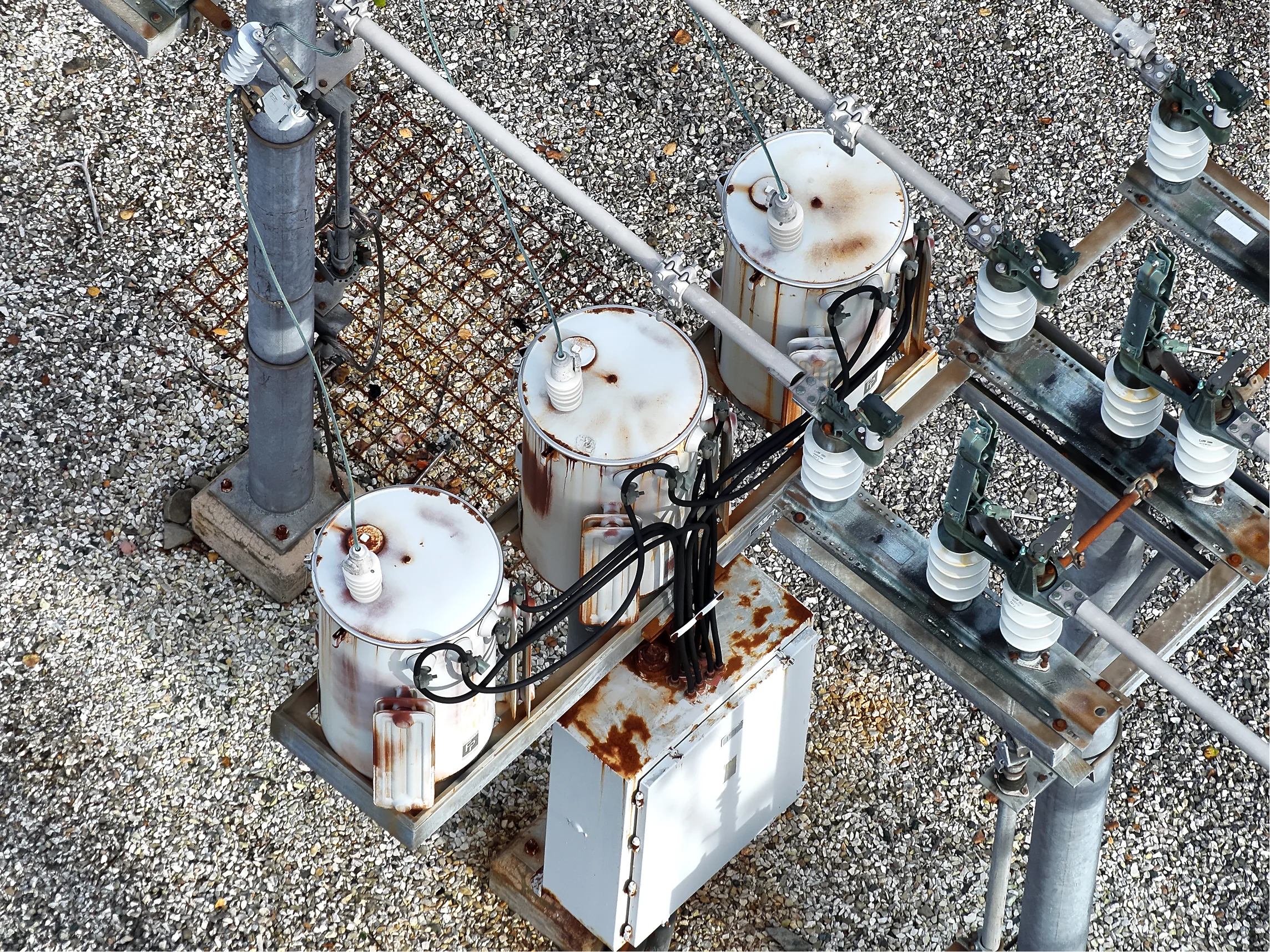
Corrosion on substation equipment, photographed from above. Conditions like this progress for years; the inspection that catches the change is the one that can compare this year's photo with last year's.
Image quality sets the ceiling on every review, human or machine. In Detect's grading data, sharp imagery leaves 100% of a 258-type defect catalog assessable, soft imagery 69%, and blurry imagery 7%. That is the assessability ceiling every inspection photo carries. A walk-down photo taken through a fence at dusk records that an inspection happened; it is not evidence of condition.
100% / 69% / 7% - the share of a 258-type defect catalog that stays assessable in sharp, soft, and blurry inspection imagery. Capture quality is decided before any reviewer, or any model, sees the frame.
Source: Detect grading data.
In a workflow like DetectOS, substation imagery is organized by asset, graded for usability, screened for visible defects, and confirmed by expert reviewers before it reaches a work plan. The substation asset monitoring view keeps one imagery-first record per component, so each walk-down is compared with the last.
How do you build a substation inspection program?
Start from consequence and end with a record. Six steps cover it.
- Rank stations by consequence. Tier substations by what their loss would cost - customers served, critical loads, and obligations such as NERC CIP-014 and PRC-005 - and set each tier's cadence.
- Write the component checklist. One checklist per equipment type, built from the table above and the manufacturer's guidance, with the photos each item requires.
- Give every layer a cadence. Look, Scan, Test, and Record each get a written, tracked interval, so a missed infrared scan is as visible as a missed walk-down.
- Standardize the capture. Specify the angles for each component, from the ground and the air, plus a settings floor, so this month's photo can be compared with last month's.
- Grade and review every image. Score usability before review, route findings by severity, and have qualified reviewers confirm anything that would dispatch a crew.
- Keep one record per component. File every finding and photo against the asset rather than the visit, so trends show up before failures do.
The last step is what connects inspection to maintenance. A finding filed against the asset can move from a confirmed image to a scheduled work order without being re-keyed. The next walk-down can then check whether the work closed the condition.
The bottom line: a substation inspection is only as good as its record
A walk-down that ends on a clipboard records that an inspection happened. A substation inspection that ends in an image-backed record per component shows what changed - and change is what precedes failure. Layer the program with Look, Scan, and Test, then make the fourth layer real.
The test for any program is one question: for the transformer that worries you most, can you pull up what its bushings looked like a year ago?
See what your substation imagery can show
Send Detect a recent substation inspection set - walk-down photos or drone imagery. The free audit grades every image for usability and screens it for visible defects, so you see what your current record can and cannot show.
Book a free audit →