
How to Inspect a Construction Site: Process, Checklist, and QA (2026 Guide)
The types, the cadence, the step-by-step process - and what changes when the site is energized utility infrastructure.
- Six inspection types run on every serious site - safety, quality, progress, code compliance, punch list, and fire - each with its own trigger and owner
- Cadence follows phase: pre-construction reviews, daily-to-monthly checks during the build, and a close-out that decides what you hand over
- Safety inspections start from OSHA’s Focus Four: falls, struck-by, caught-in/-between, and electrocution
- The evidence gap is real: on one 345kV build, 65,701 images surfaced 45,335 findings - 67 critical, three-quarters in a single construction segment
- On infrastructure, close-out is cycle zero: the commissioning record becomes the baseline every future inspection is measured against
- What is a construction site inspection?
- What are the types of construction site inspections?
- Who inspects a construction site?
- When should construction sites be inspected?
- How do you inspect a construction site, step by step?
- How do you inspect a construction site for safety?
- How do you monitor construction site progress?
- What’s different about utility infrastructure?
- Why close-out becomes the asset baseline
- Frequently asked questions
What is a construction site inspection?
A construction site inspection is a structured check of the work against the plans, the applicable codes, and the contract - performed at a defined point in the schedule and documented so someone can act on it. It’s not a walk-through with a clipboard for its own sake; each inspection exists to answer three questions: is it built right, is it safe, and is it on schedule.
The documentation is the deliverable. An inspection that lives in an inspector’s memory protects no one; a finding written down with a location, a photo, and a severity becomes a work item, a compliance record, and - years later - evidence of what the site looked like when it was handed over.
Get the discipline right and inspections stop being a tax on the schedule. Problems surface while they’re cheap: a misaligned anchor bolt found before the concrete pour is a shim; found after energization, it’s an outage risk with a mobilization bill attached.
What are the types of construction site inspections?
Six types cover almost everything, and each has its own trigger, owner, and consequence for failing.
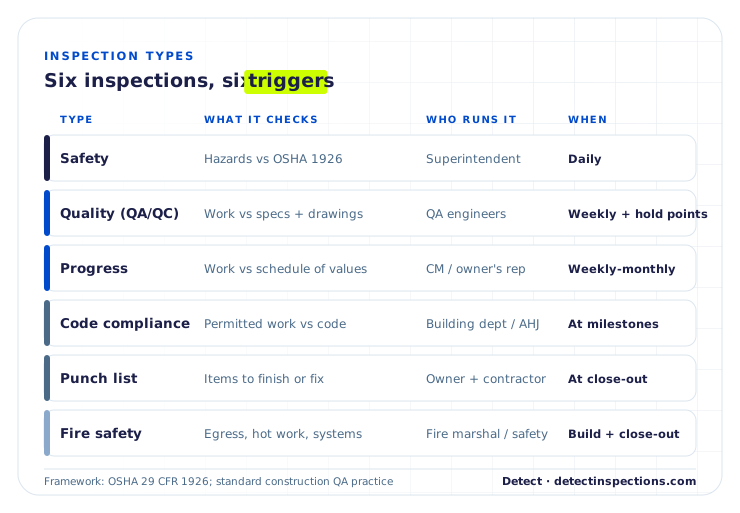
- Safety inspections - hazards, controls, and compliance with OSHA’s construction standards (29 CFR 1926). Run continuously; the superintendent owns the daily version.
- Quality (QA/QC) inspections - workmanship and materials against specs and drawings: welds, torque, coatings, concrete samples, installed hardware.
- Progress inspections - completed work against the schedule of values; these drive payment applications, so accuracy is contractual, not cosmetic.
- Code compliance inspections - the building department or authority having jurisdiction (AHJ) verifying permitted work at defined milestones; a failed one stops the schedule.
- Punch list (snag) inspections - the close-out sweep listing every item to complete or correct before handover.
- Fire safety inspections - egress, fire-stopping, temporary heating, and hot-work controls during the build, then life-safety systems at completion.
Who inspects a construction site?
The daily eyes belong to the superintendent; everything else layers on top. Site managers and foremen inspect as part of running the work. Project engineers and quality managers run the QA program. Architects and owner’s engineers verify design intent at milestones. The building department and other AHJs inspect permitted work. Specialists - electrical, structural, welding, geotech - come in where the code or the contract requires certified eyes.
Utility and energy projects add one more layer: the owner’s QA function, inspecting the contractor’s work at a scale where walking every structure isn’t realistic. On a transmission rebuild that can mean hundreds of structures across counties - which is why aerial capture has become part of the inspection toolkit rather than a novelty.
When should construction sites be inspected?
Cadence follows phase, and the close-out matters most because it’s the record you keep.
| Phase | What gets inspected | Typical cadence |
|---|---|---|
| Pre-construction | Site conditions, utilities located, permits, erosion controls | Once, before ground breaks |
| During construction | Safety walk; work-in-place vs specs; hold points (pre-pour, pre-backfill, pre-energization) | Daily (safety) · weekly-to-monthly (quality/progress) · at hold points |
| Close-out | Punch list, systems testing, documentation handover | Once, plus re-inspection of corrected items |
Work about to be buried, encased, or energized is work about to become invisible. The pre-pour and pre-backfill inspections are the last time anyone sees it cheaply - treat them as unmissable, not optional.
How do you inspect a construction site, step by step?
Walk it the same way every time. Improvised inspections find improvised results; a repeatable sequence is what makes findings comparable across weeks and inspectors.
- Review the plans, specs, permits, and the last inspection’s open items before you set foot on site.
- Start with life safety: access, egress, fall protection, trenching, energized areas.
- Walk the work systematically - by zone or by system, never by convenience.
- Check work-in-place against the drawings: dimensions, materials, hardware, tolerances.
- Photograph everything you flag - location, wide shot, close-up - and tie each photo to a structure or grid reference.
- Log findings with severity and owner; a finding without an owner is a note, not an action.
- Close the loop: verify corrected items on the next visit before they’re covered up.
What goes on a construction site inspection checklist?
The checklist is the sequence above made concrete for your site. A usable one covers: housekeeping and access · fall protection and scaffolding · excavations and shoring · electrical and energized-area controls · equipment and rigging · materials storage and sampling · work-in-place vs current drawings · environmental controls (dust, runoff, spill kits) · documentation (permits posted, drawings current, previous findings closed). Keep it to one page; a checklist nobody finishes protects nobody.
How do you inspect a construction site for safety?
Start from the hazards that kill, then work down. OSHA builds its construction outreach around the Focus Four: falls, struck-by, caught-in or -between, and electrocution - and a safety inspection that clears those four has covered the worst outcomes on almost any site. The applicable rulebook is OSHA’s construction standard, 29 CFR 1926.
In practice that means: fall protection at every leading edge and opening; exclusion zones under loads and alongside equipment; trench protection past five feet; lockout and minimum approach distances wherever the site touches energized equipment. On utility construction the fourth hazard is not an edge case - crews routinely work adjacent to live circuits, so clearances and permits get inspected like structural work, every time.
Document safety findings with the same rigor as quality findings. The inspection that prevents an incident is indistinguishable from paperwork right up until it isn’t.
What should a construction site safety inspection check?
Walk the site by hazard area and check each one against the OSHA construction rule that governs it. On most sites, these eight areas are the core of the safety walk:
| Area | What to check | OSHA rule |
|---|---|---|
| Fall protection | Guardrails, safety nets, or personal fall arrest at every edge 6 feet or more above a lower level; floor holes covered and marked | 29 CFR 1926.501-502 |
| Scaffolds | Inspected by a competent person before each shift; fully planked platforms, guardrails, and safe access | 29 CFR 1926.451 |
| Ladders | Side rails extend 3 feet above the landing; ladders with damaged rungs or rails tagged and taken out of service | 29 CFR 1926.1053 |
| Excavations and trenches | A protective system at 5 feet deep or more unless the cut is in stable rock; daily inspection by a competent person; spoil kept at least 2 feet back from the edge | 29 CFR 1926.651-652 |
| Struck-by hazards | Exclusion zones under suspended loads and inside equipment swing radius; backup alarms or spotters on vehicles | 29 CFR 1926 Subparts CC and O |
| Electrical | GFCI protection or an assured grounding program on temporary power; worn or damaged cords out of service; circuits locked and tagged before work | 29 CFR 1926 Subpart K |
| Overhead power lines | Cranes kept at least 20 feet from lines up to 350 kV unless the utility has de-energized and grounded them | 29 CFR 1926.1408 |
| PPE, housekeeping, fire | Hard hats and eye protection where required; walkways clear of debris; fire extinguishers accessible | 29 CFR 1926 Subparts C, E, and F |
OSHA expects several of these checks - scaffolds and trenches among them - to be made by a competent person: someone who can identify existing and predictable hazards and has the authority to correct them on the spot (29 CFR 1926.32). That authority is the point. An inspector who can write findings but cannot stop work turns a safety inspection into a report.
How do you monitor construction site progress?
Against the schedule, in evidence. Progress monitoring compares work-in-place to the schedule of values - and because payment rides on it, the standard is documentation, not impressions. Weekly photo documentation from fixed vantage points is the floor.
Increasingly the vantage point is aerial. A drone pass documents an entire site - or an entire transmission corridor - in a fraction of the time a walk takes, with every image geotagged to the structure it shows. The same capture that proves progress also feeds quality review: one flight, two deliverables. Our guide to drone utility inspection covers what the sensor choices mean; the short version is that progress needs coverage, while QA needs resolution.
What’s different about inspecting utility infrastructure construction?
Scale, consequence, and visibility. A commercial building concentrates the work in one place; a transmission or distribution build scatters it across hundreds of structures and miles of right-of-way. The defects that matter - a missing cotter key, an unseated insulator, a backwards-installed clamp - are small, high, and invisible from a truck.
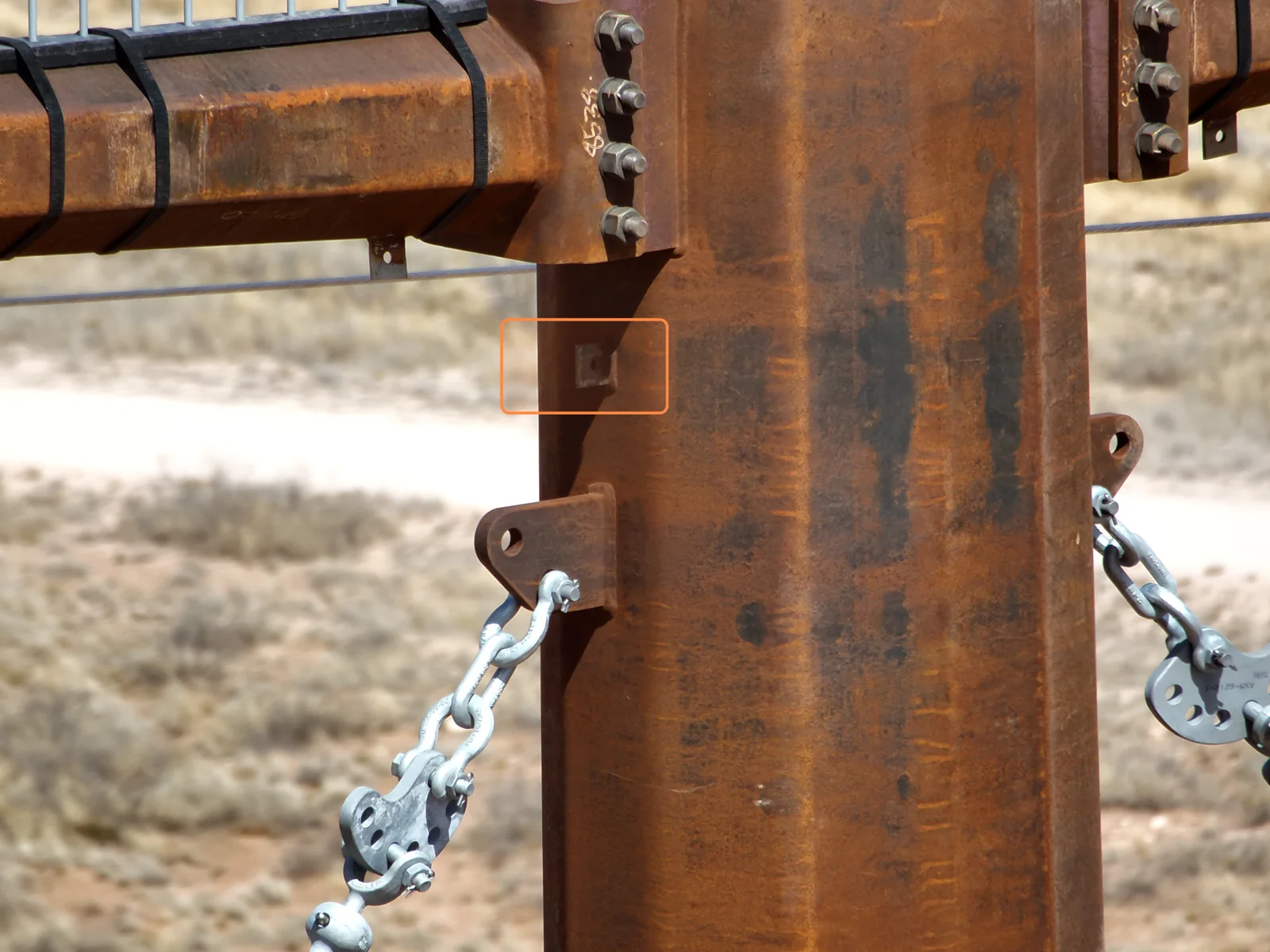
The numbers from a real build make the case better than argument. On a new 345kV line, component-level review of 65,701 images across 927 structures produced 45,335 documented findings. Sixty-seven were critical. And 76% of those critical findings clustered in a single construction segment - one crew, one stretch, one pattern.
On a newly built 345kV line, expert-verified AI review of 65,701 images found 45,335 conditions across 927 structures - 67 of them critical, 76% concentrated in one construction segment. The operator’s crews fixed 13,004 defects while the work was still under warranty.
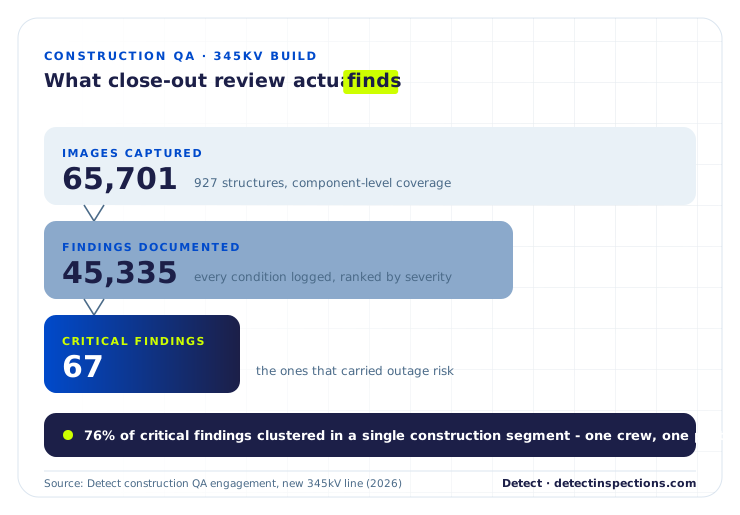
That last number is the economics. A defect corrected inside the warranty window is the builder’s cost; the same defect found three years later is yours, plus the outage risk it carried in the meantime. One cotter-key-class repair on that project ran roughly $15,000 caught in time - the post-warranty version of that math includes a mobilization and, in the worst case, a failure.
Why does close-out inspection become the asset baseline?
Because on infrastructure, handover isn’t the end of the record - it’s cycle zero. The close-out inspection is the first entry in a condition record that will outlive every crew on the project: every future inspection is measured against it, every warranty claim depends on it, and every “was it built this way or did it degrade?” question is answered by it.
That’s the Commissioning Baseline frame: treat post-construction inspection not as a sign-off but as the reference dataset for the asset’s operating life. It’s also why the documentation standard matters more than the walk - a baseline that lives in photos tied to structures feeds the same utility asset management record that will drive maintenance and replacement decisions for decades. One utility used exactly this approach to audit 618 towers in nine days before a warranty deadline; the claims went in with evidence attached.
DetectOS is built for that handoff: capture at close-out, expert-verified findings against the 258-type catalog, and a structure-by-structure baseline that drops into the owner’s asset register on day one - proven on transmission and distribution alike.
Frequently asked questions
What is checked during a construction site inspection?
How often should a construction site be inspected?
Who can inspect a construction site?
What is a punch list?
What happens if a site fails an inspection?
Can drones inspect construction sites?
What is a commissioning baseline?
What should a construction site inspection checklist include?
Building or accepting new infrastructure?
Get a free audit: we’ll analyze a representative section - during construction or at close-out - and show you what expert-verified AI review finds before the warranty clock runs out.
Book a free audit →