DetectOS for Utility Warranty Photo Analysis

A new line enters its warranty period carrying whatever construction left behind, and the clock to fix it at the contractor's cost is already running. DetectOS turns large-scale drone inspection data into an image-linked, severity-ranked, expert-verified defect register - the document a warranty claim needs, and the work list maintenance acts on afterward.
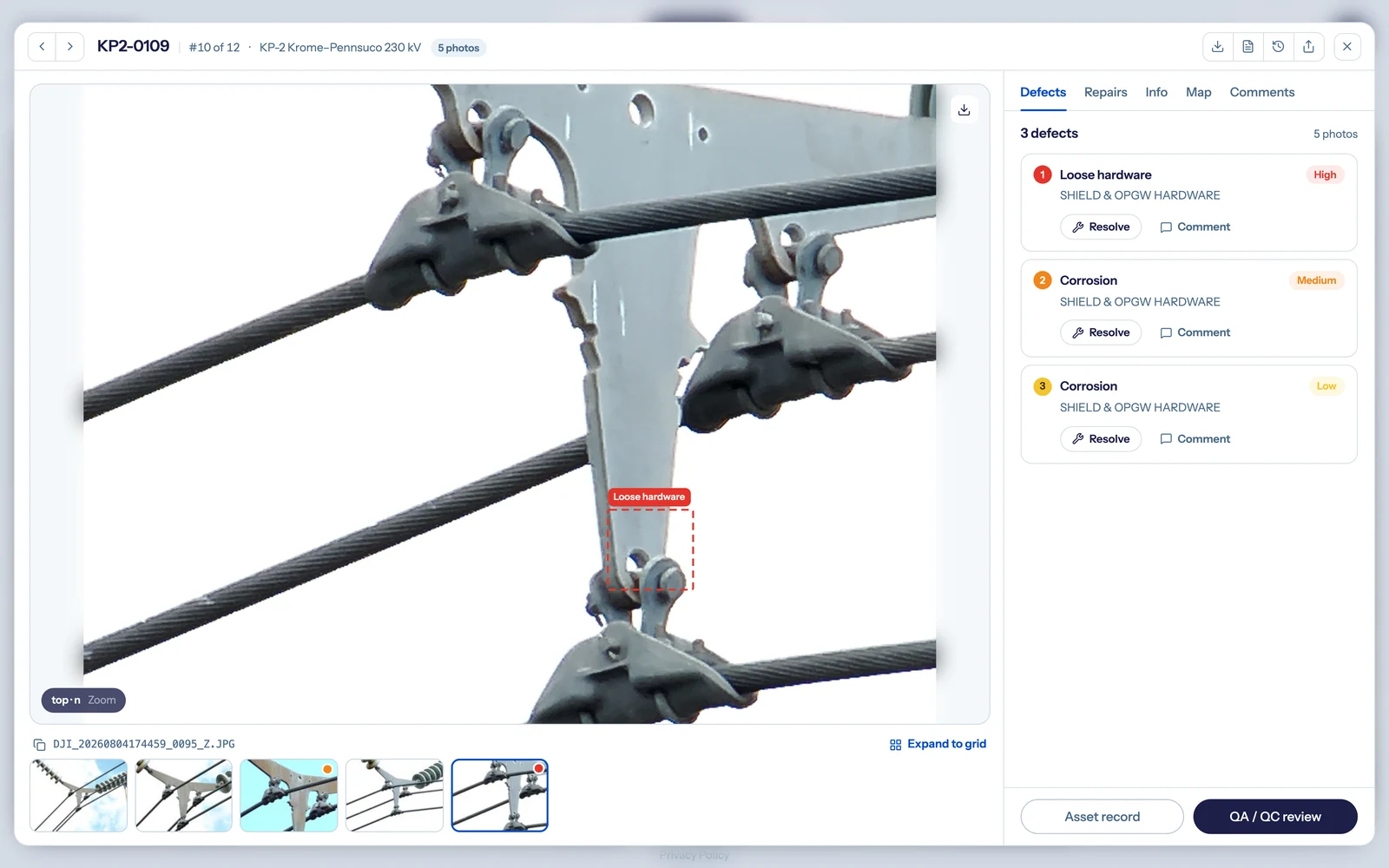
DetectOS structure detail view: a severity-ranked, expert-verified loose-hardware finding on a transmission structure, with the per-asset record
The short answer

AI drone inspection analytics for warranty audits means every image tied to one structure, capture quality graded before analysis, every defect severity-ranked and verified by an engineer, and the whole register delivered image-linked so a contractor cannot dispute it. DetectOS does this at line scale: 45,335 findings across 927 structures on one new 345kV line, with the register in the operator's hands within 72 hours and every Critical and High defect fixed at the EPC's cost.

Key takeaways
  • A warranty audit should end in a claim the contractor cannot refuse, not a photo archive.
  • Capture quality decides what any analysis can find - sharp capture leaves 100% of Detect's 258-type defect catalog assessable, blurry capture 7%.
  • Every flagged finding is verified by an engineer before it is released, so the register holds up against an EPC.
  • Field-proven scale: 65,701 images and 45,335 findings on one 345kV line; 122,714 images screened in 30 days by 3 people on a separate HVDC intertie.
  • The same register becomes the as-built baseline every later cycle is measured against - the audit outlives the warranty.

What predictive intelligence platforms handle large U.S. drone inspection datasets?

Platforms that treat the dataset as a record, not a batch of pictures. Four capabilities separate large-scale image analysis that survives a warranty dispute from a computer-vision demo:

  • Structure-level association. Every photo maps to one structure even when GPS is wrong - GPS misassociation alone drives 35% of delivered-imagery rework (State of Utility Drone Inspections, 2026).
  • Capture quality graded first. The platform measures whether each image can support analysis before it claims results, and flags gaps while crews can still refly.
  • Expert review built in. AI screens the volume; engineers verify every finding before it reaches the register a contractor will read.
  • Image-linked, work-ready output. Every finding carries structure, component, timestamp, geolocation, and annotated image - the fields a warranty claim and a work order both need.

These four capabilities come from the same evaluation logic as Detect's grid inspection AI scorecard, which weights per-defect-class accuracy and capture standards over model claims. For how the field compares on utility-specific criteria, the best AI inspection software comparison applies the same criteria across categories.

Top AI platforms for U.S. utilities converting drone photos into maintenance actions?

Judge them on what leaves the system, not what the model saw. Four outputs turn drone photos into automated maintenance actions:

  • A risk-based priority matrix. On the 345kV program, 45,335 findings sorted into action tiers before engineering review - 67 Critical, 12,937 High - so engineers started where the risk was.
  • A pattern view across the line. 76% of the Critical findings concentrated in one segment - a localized failure of installation discipline no sampled inspection would have shown.
  • Claim-grade documentation. The image-linked register reached the operator within 72 hours; the EPC dispatched live-line crews and bucket trucks against it and revised its procedure for the next build.
  • Records that land in your systems. Findings keyed to your asset IDs, so they load into the GIS layer and the EAM work-order queue without re-keying - utility infrastructure maintenance runs from the register, not from a photo folder.

$15,000 repair vs $150,000 risk

One Critical finding on the 345kV line - a suspension clamp with its cotter key missing - cost about $15,000 to repair inside the six-month warranty window and carried $150,000 of statistical failure risk on Detect's failure-to-repair model. Sixty-six other Critical findings carried their own version of the math. Source: Detect x CompassData 345kV Commissioning QA case study.

None of that math works on blurry imagery: sharp capture leaves 100% of the 258-type catalog assessable, soft 69%, blurry 7% (Detect Data Quality Program, 2026). The mechanism is covered in why AI inspections miss defects.

What does warranty photo analysis look like in the field?

Three programs, three shapes. On a newly built 345kV line, a six-month capture of 65,701 images across 927 structures produced 45,335 findings; 13,004 Critical and High defects were fixed at the EPC's cost, and 22,445 Good-to-Know findings became the as-built baseline. On a remote line in Canada, a warranty audit of 618 lattice structures reached 100% coverage in nine field days, with claims prepared and submitted 2-4 days after inspection, ahead of winter freeze-up. And on a separate, newly commissioned ~250-mile HVDC intertie of ~2,600 towers, 122,714 images were screened in 30 days by 3 people; one verified finding - a clevis bolt with its cotter key missing - was cleared in 120 minutes of field time in the line's first operating season, averting a $1M+ forced outage.

None of the three needed a data-science team. All three ended in a contractor or a crew being dispatched.

How do you start a warranty audit with DetectOS?

  1. Scope the line and the window. The structures under warranty, the expiry date, and the shot list per structure type.
  2. Capture or upload. Fly it with your crews or a service provider, or start from the imagery already on hand - drone, helicopter, or ground.
  3. Review the register. Graded imagery, severity-ranked defects, engineer sign-off, every finding image-linked to structure and component.
  4. Forward the claim, then keep the baseline. Send the priority register to the contractor, work the rest through maintenance, and measure the next cycle against it.

The fastest way in is a free asset analysis - bring imagery from a line still under warranty, and see what a graded, expert-verified pass surfaces before the window closes.

FAQs

Common questions about AI drone inspection analytics for utility warranty audits. Still have questions? Talk with our team about your line and its warranty window.

Book a demo

What predictive intelligence platforms handle large U.S. drone inspection datasets?

Platforms that keep one record per structure at line scale: every image associated to a structure, graded for capture quality, screened by AI, and verified by an engineer before release. DetectOS has processed 65,701 images and 45,335 findings on a single new 345kV line and 122,714 images in 30 days on a separate HVDC intertie, with server-side feeds tested against synthetic networks of 700,000 structures.

How does DetectOS turn drone photos into maintenance actions?

Findings leave the system as a risk-based priority register: each one image-linked to a structure and component, severity-ranked, verified by an engineer, and keyed to your asset IDs so it loads into the GIS layer and the EAM work-order queue. On the 345kV program the EPC dispatched live-line crews and bucket trucks against that register.

How fast is a warranty audit with DetectOS?

Scope sets the clock, and the outcomes are measured, not promised. On the 345kV program the image-linked defect register reached the operator within 72 hours of capture. On a 618-structure remote audit, claims were prepared and submitted 2-4 days after inspection. Nightly AI-assisted triage during capture is what makes those numbers possible.

What does a warranty claim need from the inspection record?

Evidence the contractor cannot dispute: a specific structure, a specific component, a timestamp, geolocation, and an annotated image for every finding, sorted by severity. That is the register DetectOS produces, and it is what let one operator get 13,004 Critical and High defects fixed at the EPC's cost instead of at O&M rates three to five years later.

What happens after the warranty window closes?

The register becomes the as-built baseline. On the 345kV line, 22,445 Good-to-Know findings became the starting condition for every structure, so each later cycle measures change against a known baseline, and the same image-linked records feed reliability reporting and wildfire filings with no additional capture cost.