DetectOS for Utility AI Inspection Pilots

Most AI inspection pilots stall because nobody trusts the output enough to act on it. DetectOS runs your pilot on real inspection imagery - every image graded for capture quality, every finding severity-ranked and verified by engineers - so the question at the end is not whether the AI works, but which structures you fix first.
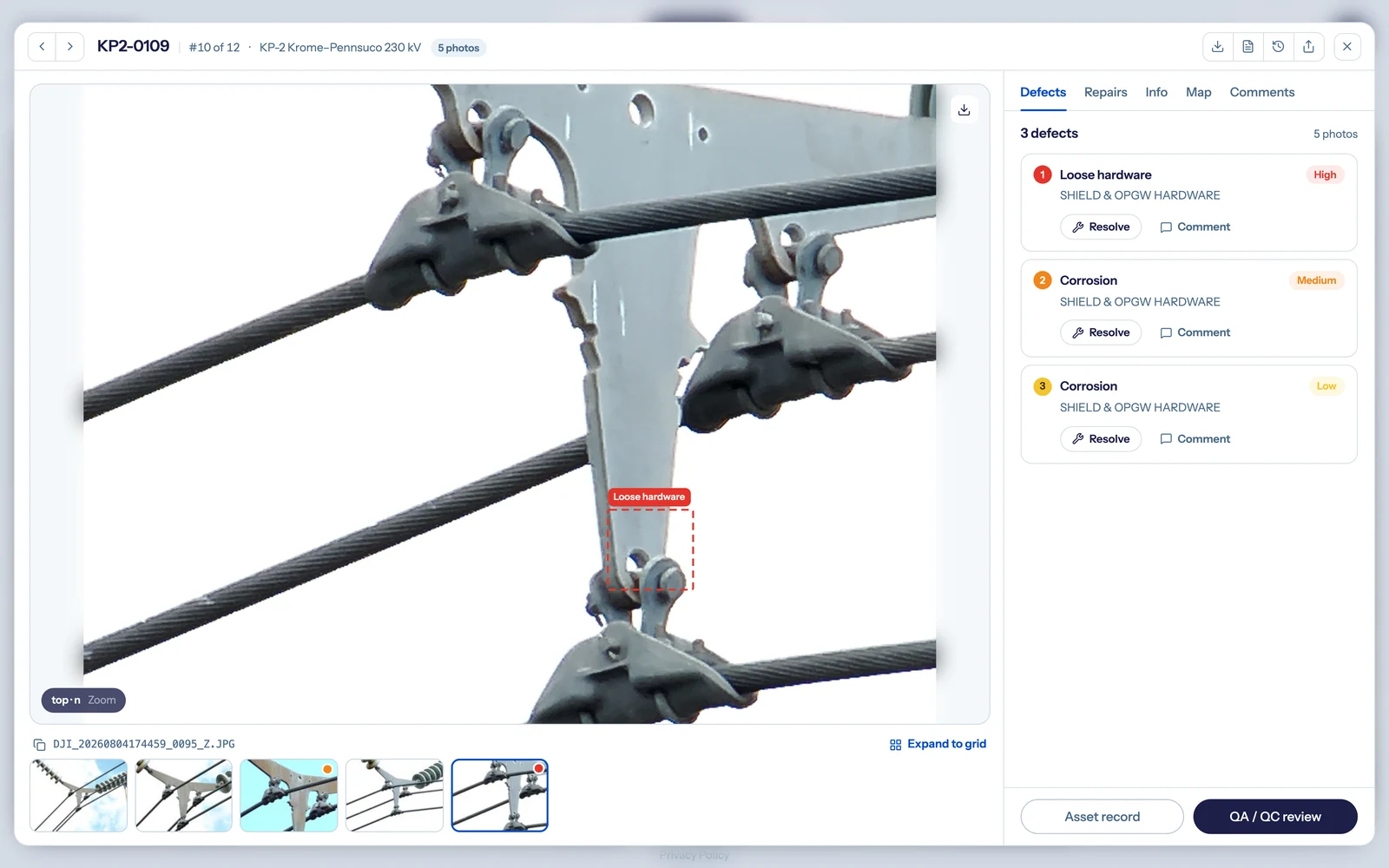
DetectOS structure detail view: a severity-ranked, expert-verified loose-hardware finding on a transmission structure, with the per-asset record
The short answer

U.S. utilities should pilot AI visual inspection on one line or segment, with four conditions in the contract: every image tied to a structure, capture quality graded before analysis, every finding severity-ranked and engineer-verified, and outputs delivered as work-ready records. DetectOS runs pilots exactly this way.

Key takeaways
  • A pilot should end in a ranked work list you act on, not a slide deck.
  • Capture quality decides results - sharp capture leaves 100% of Detect's 258-type defect catalog assessable, blurry capture 7%.
  • Every flagged finding is verified by an engineer before it is released.
  • Field-proven pace: 122,714 images screened in 30 days by 3 people on one HVDC intertie.
  • Start on imagery you already have - drone, helicopter, truck, and phone captures in one record.

What AI visual inspection tools should U.S. utilities pilot for grid assets?

Pilot platforms you can hold to evidence, not demo quality. Four tests separate a utility-grade platform from a computer-vision showcase:

  • Structure-level records. Every photo maps to one structure, so a finding is an address, not a filename.
  • Capture quality graded first. The platform measures whether each image can support analysis before it claims results.
  • Expert review built in. AI screens the volume; engineers verify every finding before it reaches your work list.
  • Work-ready output. Findings leave the system as severity-ranked records your EAM and GIS teams can use.

These four tests come from the same evaluation logic as Detect's grid inspection AI scorecard, which weights per-defect-class accuracy and capture standards over model claims. For how the field compares on utility-specific criteria, the best AI inspection software comparison applies the same criteria across categories.

What should a utility AI inspection pilot measure?

Measure the pipeline, not the model. Four numbers tell you whether the platform will hold up at program scale:

  • Assessable share. What percentage of pilot imagery was sharp enough to analyze - and what the platform did about the rest.
  • Verified-finding rate. How many AI detections survived engineer review. A platform that never disagrees with its own model is not reviewing.
  • Capture-to-decision time. Measured across the campaign, from last flight to ranked work list.
  • Record integration. Whether findings landed in your EAM and GIS as usable records, keyed to structures.

Sharp 100% - soft 69% - blurry 7%

Share of Detect's 258-type defect catalog that stays assessable at each capture-quality tier. Quality sets the ceiling on everything the AI can find - which is why a real pilot grades every image first. Source: Detect Data Quality Program, 2026.

That assessability gap is also why pilots on ungraded imagery quietly under-report defects - the mechanism is covered in why AI inspections miss defects.

What does a strong pilot look like in the field?

Two shapes, both real. The small one: a 96-structure wooden H-frame audit reached 100% coverage in a single field day with a 3-person crew, and the evidence-backed report unlocked funding for a full rebuild in a 10-minute meeting. The large one: on a newly commissioned ~250-mile HVDC intertie of ~2,600 lattice towers, 122,714 images were screened in 30 days by 3 people, 1,270 were flagged for expert review, and one verified finding - a clevis bolt with its cotter key missing - was cleared in 120 minutes of field time, averting a $1M+ forced outage the following winter.

Neither pilot needed a data-science team. Both ended in a decision.

How do you start a pilot with DetectOS?

  1. Scope one segment. A line, a district, or an archive of imagery you already hold.
  2. Capture or upload. Fly it with your crews or a service provider, or start from existing photos - any sensor.
  3. Review verified findings. Graded imagery, severity-ranked defects, engineer sign-off, structure-level records.
  4. Decide with evidence. Walk out with a ranked work list and the record to defend it.

The fastest way in is a free asset analysis - bring imagery from a line you worry about, and see what a graded, expert-verified pass surfaces.

FAQs

Common questions about piloting AI visual inspection for utility grid assets. Still have questions? Talk with our team about your pilot scope and see the platform live.

Book a demo

What AI visual inspection tools should U.S. utilities pilot for grid assets?

Pilot the tools you can hold to evidence tests: every image tied to one structure, capture quality graded before analysis, findings severity-ranked and verified by an engineer before they reach a work list, and results delivered in a record your EAM and GIS teams can use. DetectOS is built to those four tests, so the pilot produces defensible findings rather than a demo.

How long does a utility AI inspection pilot take?

Scope sets the clock. On a ~250-mile HVDC intertie, three people worked through 122,714 images in 30 days. A 96-structure wooden H-frame audit reached 100% coverage in one field day with a 3-person crew. Size the pilot to one line or segment and the imagery, not the software, is the long pole.

What imagery does a utility pilot need?

Any visual source works - drone, helicopter, vehicle-mounted camera, and phone imagery, including archives you already hold. Every image is graded for sharpness and effective resolution before analysis, because capture quality sets the ceiling: on Detect's 258-type defect catalog, sharp capture leaves the full catalog assessable, soft capture 69%, and blurry capture only 7%.

Are pilot findings verified by engineers?

Yes. AI screens the volume; engineers review each flagged finding on the image before it is released. On that HVDC campaign, 1,270 flagged images went through expert review, and the single defect that mattered - a clevis bolt with its cotter key missing - was cleared in 120 minutes of field time and averted a $1M+ forced outage.

What happens after the pilot?

The record carries forward - pilot findings become the baseline the next cycle is compared against. At program scale the same workflow has covered 927 structures and 65,701 images on a 345kV line, where 76% of critical findings concentrated in one segment - the kind of pattern that turns an inspection budget into a targeted work plan.