
One capture standard. Any pilot, any drone.

Ondas closed its acquisition of Cyberhawk in August 2026, putting the iHawk platform inside a company that sells drones. Detect sells none. Your crews, your service providers, your fleet, and findings that stay yours when any of that changes.

vs

WHAT CHANGED

One vendor now owns the drones, the software, and the capture standard.

Ondas bought the aircraft. Cyberhawk brought iHawk. Now one vendor flies the mission, reads the imagery, and sets the standard it's graded against.

Detect sells no aircraft, so it never competes with the crews you already pay.

A capture vendor grading its own capture

When the same company sells the drones and scores the imagery, quality standards and hardware sales sit on the same balance sheet.

A roadmap you do not control

Pricing, integrations, and account teams typically take 12 to 18 months to settle after a close. Your inspection program waits it out.

Where the two models differ

Both companies turn inspection imagery into asset condition findings. The split is who has to fly, whose standard the capture is measured against, and what happens to your data the day you change vendors.

Capability

Sells aircraft

No. Detect never competes with your crews or your DSPs.

Yes. Drone hardware and autonomy are the parent company.

Data capture

Source-agnostic. Drone, helicopter, truck cam, or smartphone, flown by anyone qualified.

Its own fleet, with a commercial reason to fly it.

Capture standard

Published and free. Shot sheets, camera settings, and upload checks any qualified pilot can meet.

Lives inside the integrated stack and arrives with their capture.

Validation

Expert review against the standard before delivery, with an audit-ready record.

AI analytics and in-house services run on their own stack.

Focus

North American transmission, distribution, and substations only. 17 models tuned across 30 hardware component classes.

Global and multi-vertical. Utilities alongside oil and gas, industrial, and defense.

If you switch capture vendors

Nothing changes. The standard and the data travel with you.

Your data layer sits inside a hardware vendor’s platform.

THE DATA QUALITY PROGRAM

One capture standard, every vendor you already use

Learn a best-practices backed capture standard, then prove its effectiveness on a real shot sheet our team reviews with them.

It is free at every step. Any pilot, any drone.
Join the partner network
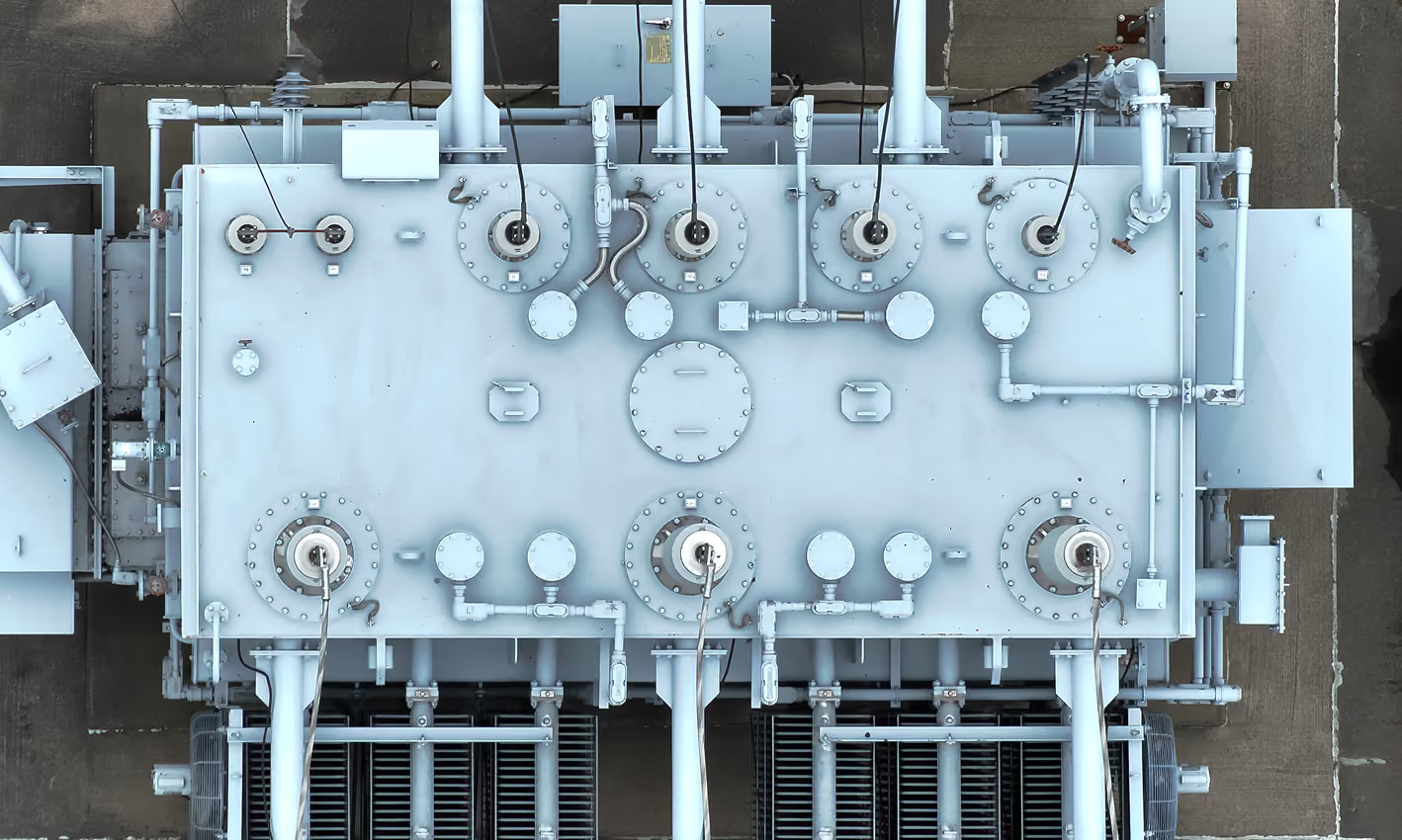
Aerial top-down view of a substation transformer with bushings and radiator banks

PLACEHOLDER

Published, not bundled

Shot sheets, camera settings, and upload checks are written down and handed to any qualified pilot. Your in-house crews and your DSPs fly to the same standard, so capture quality stops depending on who showed up.

Aerial top-down view of a substation transformer with bushings and radiator banks

PLACEHOLDER

Checked in the field, not in the deliverable

Capture gets verified at upload. A failed shot is re-flown while the crew is still on site, where it costs a morning instead of a full mobilization.

Aerial top-down view of a substation transformer with bushings and radiator banks

PLACEHOLDER

Reviewed by people who know T&D

Detect experts review findings against the standard before anything ships. What you receive is an audit-ready record you can act on and defend to regulators, insurers, and your own engineers.

Aerial top-down view of a substation transformer with bushings and radiator banks

PLACEHOLDER

Yours to take anywhere

Qualified capacity grows without a hardware commitment. Change drone providers next year and the standard, the imagery, and the findings still apply.

WHAT THE STANDARD IS WORTH

Capture quality decides what the analysis can find

Blurry, mislabeled, or incomplete imagery limits every model that runs after it. Standardizing capture before the flight changes the economics of the whole program. These are Detect’s own findings from customer campaigns.
3-7%
Rework falls to about one delivery in 20
Ad-hoc capture gets re-flown on 15 to 25 percent of deliveries. A standardized workflow cut that to 3 to 7 percent across two campaigns.
93%
Blurry imagery erases most of the defect catalog
Of 258 identifiable defect types, roughly 18 stay assessable in blurry capture. Sharp imagery keeps all of them.
52
Half the shots, and the coverage gaps closed
One pre-built shot sheet took a utility from 106 shots per structure down to 52, with better coverage than before.
$1M+
One missing cotter key, cleared in 120 minutes
On a 2,600-tower HVDC intertie, screening narrowed 122,714 images to 1,270 for expert review. The find was flagged and fixed the same day.
Read the HVDC story

Questions utilities
ask us

Short answers on capture neutrality, data portability, and what the Ondas acquisition changes.

Talk to our team

Is Detect a Cyberhawk alternative?


Yes. Both platforms turn utility inspection imagery into asset condition findings. Detect differs in that it sells no aircraft and no flight services, so it works with whatever capture you already have in place.

What happened with Ondas and Cyberhawk?


Ondas, a drone hardware and autonomy company, announced its acquisition of Cyberhawk in June 2026 for a reported $125 million and closed it in August 2026. The iHawk inspection platform now sits inside a company that also sells the aircraft.

Does Detect sell drones or fly inspections?


No. Detect does not sell aircraft or compete for flight work. Capture comes from your in-house crews, your existing drone service providers, helicopters, truck cameras, or a smartphone.

Can Detect work with the drone service providers we already use?


Yes. Any pilot can qualify through the Data Quality Program at no cost, and DetectOS accepts capture from any qualified source. Existing crew and vendor relationships stay intact.

What happens to our data if we change capture vendors?


Nothing. The capture standard applies to any qualified pilot, and findings stay portable, so a hardware decision never forces a platform decision.

Does Detect work outside transmission and distribution?


No. North American transmission, distribution, and substations are the entire business. The models are tuned for T&D hardware, and the partner network is built only for this work.